it is a common tactic of climate change deniers to line up some number of scientists to convey the sense that there is some question about climate change. but this isn't how science works; it's not the case that because one or 10 or 100 scientists have questions about gravity it means that gravity doesn't exist.
the existence of climate change caused by humans is settled science. no amount of wall street journal editorializing or smears by conservative politicians is going to change that.
It's a freaking joke. Compare the publication records, science activity, and career impact of the people on the other side. These tend to be people who have spent their lives seriously measuring and analyzing climate, not just dilettantes with a grudge. (E.g., http://science.jpl.nasa.gov/people/Miller/, who's the science PI of a satellite designed to measure CO2, and a contributor to the fourth IPCC report.)
It's not really a conservative or liberal issue. Yes, many liberals are pro anthropomorphic climate change, and many conservatives are anti, but it goes both ways.
Nothing is settled science until you can prove it beyond reason of doubt - i.e. see it in action.
If the earth does warm dramatically in X years, then we can measure the temperature difference against our CO2 output and past warm periods like the Medieval Warm period. That is REAL science. Anything else is speculation or...wait for it...a HYPOTHESIS.
Keep in mind, even minorities can be right, even when it seems completely foolish or counter-intuitive. Remember when everyone thought the earth was flat, and that we lived in a geo-centric or helio-centric universe?
Except that it is now a conservative issue. There used to be bipartisan consensus among politicians and the public that global warming was a real phenomenon. Then Kyoto asked people to do something about it, and denial became an article of faith among conservatives. You just have to look at the polling: ten years ago, conservatives and liberals had the same views on global warming, but since Kyoto support for denialism has skyrocketed among conservatives. It is almost impossible now to be a conservative politician in America without denying global warming.
I think it's a false equivalence to claim that it isn't a conservative vs. liberal issue when denial is almost entirely confined to one side, and that side is massively biased.
I'm curious what would it take to overturn "settled science," or are you saying that is impossible. I was not aware that science took that kind of a dogmatic stance.
Look at what's been going on with the "faster than light neutrinos".
That would really overturn settled science. But to do so is going to require more than 16 people writing an op/ed saying that the results were correct and the effect was real. It's going to require more than articles in newsmagazines.
The scientists behind the original results have examined their work for mistakes, and rerun the experiment controlling for possible confounding issues. The apparent effect remained.
Now other labs are going to try to produce a similar result.
If you want to overturn "settled science", you need data to clearly back up your claim. It's not enough to have a contrary interpretation of existing data. You need more data to support your interpretation as the correct one.
It's not "dogma" to say that gravity exists or that fire is hot. Just because science is a constant process of investigation and discovery, it doesn't mean that we can never arrive at any conclusions or take action based on what we know to be true.
> I'm curious what would it take to overturn "settled science,"
Evidence to the contrary. Or, failing that, a lack of the traditional continual build-up of supporting evidence is often enough to cast a theory into doubt.
I feel like I should note: I know next to nothing about climate science, and this comment is meant neither in support or in denial of any related theory. I'm merely defending science as a whole. (Remediating the sad state of my knowledge about climate science is high on my todo list.)
The very idea of "settled science" is antithetical to the scientific method. Science is not a popularity contest. Nor is it a matter of dogma vs. heresy. It is a matter of evidence and theories that are either backed up by evidence or refuted by it. Discussing science on any other level is counterproductive.
The very idea of "settled science" is antithetical to the scientific method.
Huh? Theories that are backed up by enough evidence are generally regarded as "settled". That of course doesn't mean they can't be "unsettled" if some truly remarkable data shows up, but it's still a useful heuristic to concentrate on things that are more uncertain.
Science is a debate. Use of the term "settled science" is an attempt to shut-down debate, which is unhelpful.
More so, the subject at hand is the evolution of a chaotic system with literally thousands of different influencing variables. This is not something as simple as gravity, electromagnetism, or even evolution. And the science of climatology is still very much an open debate. If the evidence of AGW actually was overwhelming then it'd be easy enough to present it and move on, as happened with the ozone hole. Instead the evidence is rather more subtle and has very significant error bars. If you believe that AGW requires bold action to avoid catastrophe then shutting down debate is an enormous mistake, because all it does is leave people who are unconvinced even less convinced while it forestalls the advancement of climate science and potentially the strengthening of evidence in support of that theory.
You're confusing the notion of "settled science" with "the end of knowledge".
The changes in our understanding of gravitation that have occurred in our generation do not make it advisable for you to walk off the edge of a building. That's what is meant by settled science.
This makes no sense. We've been assured now for years AGW is true because it's the scientific consensus. Isn't that how it became "settled science", after all? And now you say it doesn't matter how many scientists are skeptical. Is this some kind of one-way street, this settled science?
I mean, clearly the models are wrong, so it wasn't that. They've utterly failed to predict the lack of temperature rise in the last decade or so. Come to think of it, besides the models, what makes anyone think it's real? Oh yeah, settled science. So... it's like phrenology, then?
Do you realize that your chart doesn't actually show "the last ten years"? It stops in 2007. What's happened since 2007 is not irrelevant to the question at hand.
Here's an example of a temperature chart that does show "the last 10 years":
Hah! I also used to do crap fits to curves like that when my data didn't work. You can only fit a line to the graph like that if you assume temperatures are going to rise quickly in the future. This is a joke, right?
  >We did not wish to mislead the public into thinking that scientific issues
  >are decided by who has the longer list of scientists!
I was under the impression that currently accepted scientific discoveries required that the majority of the scientific community to be in agreement. If this is not the case could you point me to an explanation? I'm really curious, not trying to be a smart-ass or something.
I actually wish the APS had avoided the statement "incontrovertible", because I think that overstates it. They could have said something along the lines of "the evidence is strong enough that failing to take action is now indefensible". The guy that resigned does have a point in saying that we can discuss whether neutrinos are faster than c, and the uncertainties when it comes to climate change are certainly larger than that.
How is this different from the tactic of its supporters to line up inflectional politicians & hollywood to make movies waxing romantic over nature, anecdotal polar bears stories, or the ice caps on Kilimanjaro?
I mean, for or against, global warming, both sides are filled with blowhards.
It just makes it a frustrating endeavor to get at real data.
Agreed, climate change is built into cycles of earth's atmosphere, everyone agrees about that. The reasons for climate change, and the question if whether how much we can do about is up for debate. Lining up scientists for popular press articles are a "tactic" often used for all kinds of arguments, no need to call them out for that.
Sure it questions it. As a helpful thought experiment, try this: look at how many phrases are placed in quotation marks in this piece. Each time the writer encloses a phrase like "global warming" or "pollutant" in question marks, he's trying to cast doubt in your mind. It's a very transparent and sophistic technique.
The writer (Claude Allegre) is, in fact, a climate-change denier. He's not merely trying to foster more scientific investigation into climate change or slow the pace at which we adapt to it (although it looks like that's what he wants you to believe here). He doesn't believe that humanity is causing climate change at all (a view that flies in opposition to the long-settled science on this subject), and therefore he's trying to get you to believe that simply slowing down our response to climate change is perfectly OK. But this just isn't the case; it's a recipe for permanently hosing the environment.
At the end of the day, there's an Occam's razor test you can apply to this kind of thing. If this were real science, it'd be published in a peer-reviewed journal, not a conservative mouthpiece of big business like the Wall Street Journal.
Not so. In fact the opposite is true; as scientists reach consensus about facts, it enables science to progress. Just because facts exist does not mean the process of scientific discovery ceases.


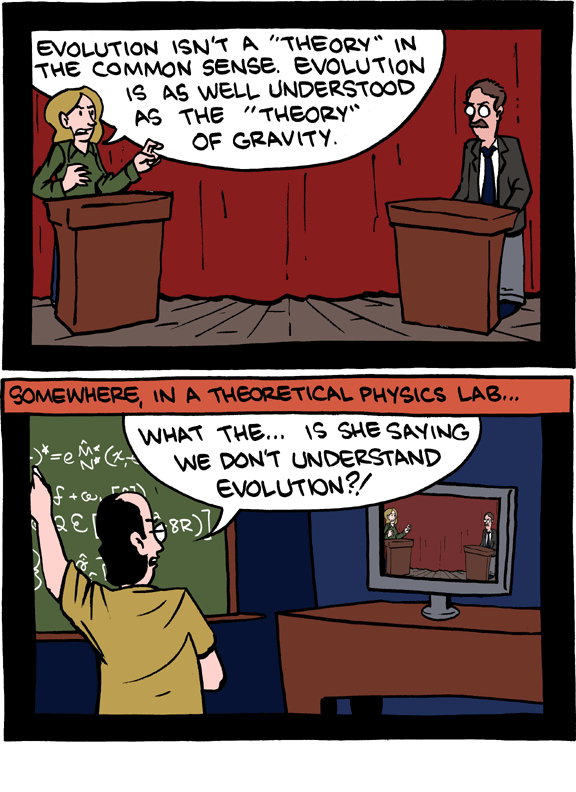
the existence of climate change caused by humans is settled science. no amount of wall street journal editorializing or smears by conservative politicians is going to change that.