The Wall Street Journal’s editorial board has long been understood to be not only antagonistic to the facts of climate science, but hostile. But in a remarkable example of their unabashed bias, on Friday they published an opinion piece that not only repeats many of the flawed and misleading arguments about climate science, but purports to be of special significance because it was signed by 16 “scientists.”
(Note: I wish he hadn't put the word "scientists" in quotes as it, sadly, undermines a good editorial piece.)
Hell, just start Googling people from the list of contributors. The first is "Claude Allegre, former director of the Institute for the Study of the Earth, University of Paris".
> In 1996, Allègre opposed the removal of carcinogenic asbestos from the Jussieu university campus in Paris, describing it as harmless and dismissing concerns about it as a form of "psychosis created by leftists". The campus' asbestos is deemed to have killed 22 people and caused serious health problems in 130 others.
I think I'd pass on his endorsement, personally...
Isn't it accepted fact right now that removing asbestos creates more cases of cancer then leaving it where it is? What happened at the time was a very un-rational and unproductive response - the removal of all asbestos everywhere, with no regard to costs and side-effects.
Given that he's also arguing with a Nobel Prize winner in physics that atmospheric drag doesn't affect falling objects, I doubt his opposition was that nuanced.
Leaving asbestos where it is can be better, but it'd depend on how well contained it is. If it's in a building that's showing its age, removal might be the only option.
He was also right about Kilimanjaro - changes in snow cover there likely did relate to longer-term trends and to local agricultural deforestation reducing the amount of moisture in the air and likely did not significantly relate to local or world temperature changes.
I'm willing to give him benefit of the doubt on "nuance" given the number of filters we're seeing things through here. (It's bad enough relying on wikipedia for climate-related info at all, but when it's on a relatively obscure topic based on source material in another language, that's a whole new level of indirection.)
I doubt it's ok to paint him with a wide brush. He seems like a very intelligent person, extremely respected in his field and who's not afraid of a good controversy. Exactly what was the context of the falling objects dispute I don't know, but it's a fair chance there's some context to it. From a cursory look it seems to be more about how to teach the phenomenon then about the physics involved.
Was it the asbestos that allegedly killed 22 people, or was it the asbestos removal effort - against Claude's advice - that did so? Given that he objected in 1996 and the article claiming some number of deaths and injury was written in 2007, the timing works with either interpretation...
Wikipedia has a picture (http://en.wikipedia.org/wiki/File:Jussieu_d%C3%A9samient%C3%...) of the facility during asbestos removal. Given that they've taken out everything but the metal frame of the building, I doubt many students were going to class in the building as they removed it.
Common sense? The dangers of asbestos were well known in 1997 (hence its removal!), it's a developed nation that enforces protective measures for workers, etc.
Losing 22 workers in France in the 1990s/2000s on a single asbestos removal project is extremely unlikely.
Since 1959 in an entire campus, not one building. There'd be many, many more students passing through over five decades than there would be construction workers in a 10 year cleanup effort.
The piece is not designed to be credible to you and me. Its simply so that Fox News can report "New evidence that global warming is a myth is being reported today by a respected newspaper."
I don't think that it's wrong to put the word "scientists" in quotes. Consider this: it seems that one of the 16 concerned individuals is Burt Rutan. He is a well-known aerospace engineer who has a high level of skill in a difficult technical field, and he has accomplished a great deal in his life. But is he a scientist? That might be the reason for the scare quotes.
My problem is that it justifies one of the points made in the letter, that: if you are a scientist who makes a case against global warming you are actively excluded from the scientific community.
This article is a bit high on polemics and low on science for my tastes (unsurprising since it's a WSJ editorial, but still). Is there a more sober whitepaper version that spends less time explaining that CO2 is colorless (true but irrelevant) and talking about the ominous drumbeats of their opponents, and more time on their thesis? Not just a rhetorical question; it seems like they might have a defensible thesis, especially about the cost/benefit profile, but it's hard to tell as presented.
You will find most arguments for and against global warming a bit high on polemics, and a bit low on science. Asking whether or not the earth will be warmer in 100 years is about as fruitless as asking whether or not it will rain in 100 days. The earth has warmed and cooled dramatically long before human existence, and will continue to in spite of us. Our CO2 output is only one of many factors in a very difficult to compute equation of thermodynamics. Keep in mind, its not just activity on earth, but the state of the sun that largely determines temperature, and both are very complex systems that are virtually impossible to model accurately.
You don't have to model the solar contribution to temperature, you can measure it.
We have in fact been measuring total solar irradiance (TSI) for a few decades now. See http://acrim.jpl.nasa.gov/ for the newest version of the instrument.
It's hard to paste the time series together from multiple instruments; not all of them work the same way, and there are discontinuities (TSI has to be measured from space, and you have to schedule launches to obtain overlap between the time series of successive instruments).
The current thinking is that there's no way that TSI increases can explain the warming we have measured of the Earth. The TSI changes are just not large enough.
***
In fact, here's a nice recent summary of the big picture regarding remote sensing of climate variables:
I am not sure that is a meaningful position -- it would require that there is an alternative to coal and fossil fuels (other than neuclear).
Certainly you can use wind or solar but they are not realistic because they are too limited and too costly for our current and future needs. There are bunch of other technologies that might one day make the cut, but what will you change to until they (may) become available?
This is where a market based system comes a bit short. Fossil fuel prices are going to continue rising. As they rise, they'll put pressure on everything. They are a pillar of our modern economy. Our ability to do large scale investment and infrastructure change is reliant on our ability to redirect the outputs of our economy, and abundant energy.
In other words, the best time to invest in new massive sources of wind and solar is when you still have cheap fossil fuels, not when your economy is staggering from oil shocks, and your cost of construction has risen by like 20% due to energy costs.
Please don't automatically assume the market is falling short here. Many governments including our own play a huge part in manipulating the price of fuels.
I actually agree with you...at present, we do not have any great alternatives (on the basis of cost-effectiveness) - although nuclear energy is an up-and-coming candidate. However, I do think we should at least reduce foreign dependence on energy - it complicates our relationships, twists our political motives, and enriches countries with questionable motives. By some estimates, we have enough natural gas under native soil to make up for foreign oil several times over, only environmental regulations prevent tapping many of these resources.
A curious question that immediately popped in my head was: would it be ethical to use the fear of the public for disruption by global warming (whether it's true or not)? This fear could be used for good purposes, such as trying to increase funding for fusion. (I mean, good graces, it'll be at least 2033 before DEMO becomes productive!)
Understandably, I'd prefer all people to be scientifically (and 'engineerically') literate on these issues and be able to make good decisions for the good reasons. However, I'm also realistic enough to see that this probably won't be happening anytime soon.
(Also, on a more personal note: no, I would not consider this ethical.)
The problem with that line of thinking is that there's no monopoly on such abuses. Once the "good guys" do it then what's to stop the "bad guys" from using the same power. And now that you no longer have the backing of truth on your side how do you prove to the public that you are in the right?
How is this any different from the police planting evidence on someone they KNOW, but cannot prove, is guilty?
No. A scientist most be known to say the truth and only the truth otherwise the public wont believe them when they tell them something that they cant possibly tell is true or not.
That's probably the role of politicians or activists, not scientists directly.
The problem is that while science is content to sit and collect data, people need to decide what to do, and can't afford wait to see how it turns out. We don't know if anything bad is going to happen, but we should be prepared for the possibility.
People like the WSJ op-ed writer might as well be telling people not to save for retirement or carry insurance. You might die young, so why waste money on a 401k. You might never get in a car accident, or get sick, or have your house be flooded. So why waste money on insurance?
Sure, but that's not terribly relevant to CO2 production in the 21st century. The big issue will be the maturation of developing economies (China, India, Malaysia, Indonesia, Brazil, etc.) Even if the existing developed world drops their carbon emissions to zero tomorrow that won't drastically effect worldwide carbon emissions over the next hundred years. We need technologies that are not only suitable for developed nations but also for nations still in the process of bootstrapping themselves into industrialization.
Googling the cosignatories names revelas that several work for Exxon. I don't see how the WSJ didn't consider this relevant information to disclose, instead presenting them only as 'distinguished scientists.'
If you're going to make allegations of that sort, you should at probably list the "several" who you conclude "work for" Exxon. Better yet, link your sources.
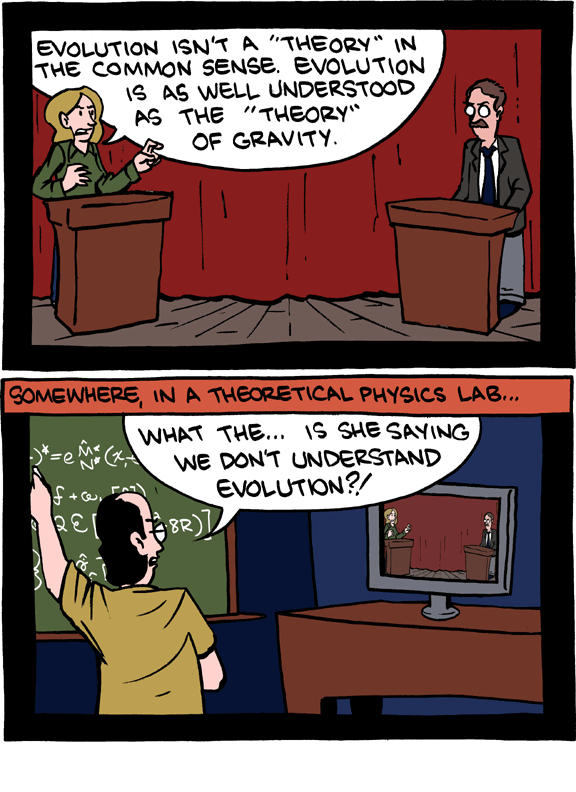
it is a common tactic of climate change deniers to line up some number of scientists to convey the sense that there is some question about climate change. but this isn't how science works; it's not the case that because one or 10 or 100 scientists have questions about gravity it means that gravity doesn't exist.
the existence of climate change caused by humans is settled science. no amount of wall street journal editorializing or smears by conservative politicians is going to change that.
It's a freaking joke. Compare the publication records, science activity, and career impact of the people on the other side. These tend to be people who have spent their lives seriously measuring and analyzing climate, not just dilettantes with a grudge. (E.g., http://science.jpl.nasa.gov/people/Miller/, who's the science PI of a satellite designed to measure CO2, and a contributor to the fourth IPCC report.)
It's not really a conservative or liberal issue. Yes, many liberals are pro anthropomorphic climate change, and many conservatives are anti, but it goes both ways.
Nothing is settled science until you can prove it beyond reason of doubt - i.e. see it in action.
If the earth does warm dramatically in X years, then we can measure the temperature difference against our CO2 output and past warm periods like the Medieval Warm period. That is REAL science. Anything else is speculation or...wait for it...a HYPOTHESIS.
Keep in mind, even minorities can be right, even when it seems completely foolish or counter-intuitive. Remember when everyone thought the earth was flat, and that we lived in a geo-centric or helio-centric universe?
Except that it is now a conservative issue. There used to be bipartisan consensus among politicians and the public that global warming was a real phenomenon. Then Kyoto asked people to do something about it, and denial became an article of faith among conservatives. You just have to look at the polling: ten years ago, conservatives and liberals had the same views on global warming, but since Kyoto support for denialism has skyrocketed among conservatives. It is almost impossible now to be a conservative politician in America without denying global warming.
I think it's a false equivalence to claim that it isn't a conservative vs. liberal issue when denial is almost entirely confined to one side, and that side is massively biased.
I'm curious what would it take to overturn "settled science," or are you saying that is impossible. I was not aware that science took that kind of a dogmatic stance.
Look at what's been going on with the "faster than light neutrinos".
That would really overturn settled science. But to do so is going to require more than 16 people writing an op/ed saying that the results were correct and the effect was real. It's going to require more than articles in newsmagazines.
The scientists behind the original results have examined their work for mistakes, and rerun the experiment controlling for possible confounding issues. The apparent effect remained.
Now other labs are going to try to produce a similar result.
If you want to overturn "settled science", you need data to clearly back up your claim. It's not enough to have a contrary interpretation of existing data. You need more data to support your interpretation as the correct one.
It's not "dogma" to say that gravity exists or that fire is hot. Just because science is a constant process of investigation and discovery, it doesn't mean that we can never arrive at any conclusions or take action based on what we know to be true.
> I'm curious what would it take to overturn "settled science,"
Evidence to the contrary. Or, failing that, a lack of the traditional continual build-up of supporting evidence is often enough to cast a theory into doubt.
I feel like I should note: I know next to nothing about climate science, and this comment is meant neither in support or in denial of any related theory. I'm merely defending science as a whole. (Remediating the sad state of my knowledge about climate science is high on my todo list.)
The very idea of "settled science" is antithetical to the scientific method. Science is not a popularity contest. Nor is it a matter of dogma vs. heresy. It is a matter of evidence and theories that are either backed up by evidence or refuted by it. Discussing science on any other level is counterproductive.
The very idea of "settled science" is antithetical to the scientific method.
Huh? Theories that are backed up by enough evidence are generally regarded as "settled". That of course doesn't mean they can't be "unsettled" if some truly remarkable data shows up, but it's still a useful heuristic to concentrate on things that are more uncertain.
Science is a debate. Use of the term "settled science" is an attempt to shut-down debate, which is unhelpful.
More so, the subject at hand is the evolution of a chaotic system with literally thousands of different influencing variables. This is not something as simple as gravity, electromagnetism, or even evolution. And the science of climatology is still very much an open debate. If the evidence of AGW actually was overwhelming then it'd be easy enough to present it and move on, as happened with the ozone hole. Instead the evidence is rather more subtle and has very significant error bars. If you believe that AGW requires bold action to avoid catastrophe then shutting down debate is an enormous mistake, because all it does is leave people who are unconvinced even less convinced while it forestalls the advancement of climate science and potentially the strengthening of evidence in support of that theory.
You're confusing the notion of "settled science" with "the end of knowledge".
The changes in our understanding of gravitation that have occurred in our generation do not make it advisable for you to walk off the edge of a building. That's what is meant by settled science.
This makes no sense. We've been assured now for years AGW is true because it's the scientific consensus. Isn't that how it became "settled science", after all? And now you say it doesn't matter how many scientists are skeptical. Is this some kind of one-way street, this settled science?
I mean, clearly the models are wrong, so it wasn't that. They've utterly failed to predict the lack of temperature rise in the last decade or so. Come to think of it, besides the models, what makes anyone think it's real? Oh yeah, settled science. So... it's like phrenology, then?
Do you realize that your chart doesn't actually show "the last ten years"? It stops in 2007. What's happened since 2007 is not irrelevant to the question at hand.
Here's an example of a temperature chart that does show "the last 10 years":
Hah! I also used to do crap fits to curves like that when my data didn't work. You can only fit a line to the graph like that if you assume temperatures are going to rise quickly in the future. This is a joke, right?
  >We did not wish to mislead the public into thinking that scientific issues
  >are decided by who has the longer list of scientists!
I was under the impression that currently accepted scientific discoveries required that the majority of the scientific community to be in agreement. If this is not the case could you point me to an explanation? I'm really curious, not trying to be a smart-ass or something.
I actually wish the APS had avoided the statement "incontrovertible", because I think that overstates it. They could have said something along the lines of "the evidence is strong enough that failing to take action is now indefensible". The guy that resigned does have a point in saying that we can discuss whether neutrinos are faster than c, and the uncertainties when it comes to climate change are certainly larger than that.
How is this different from the tactic of its supporters to line up inflectional politicians & hollywood to make movies waxing romantic over nature, anecdotal polar bears stories, or the ice caps on Kilimanjaro?
I mean, for or against, global warming, both sides are filled with blowhards.
It just makes it a frustrating endeavor to get at real data.
Agreed, climate change is built into cycles of earth's atmosphere, everyone agrees about that. The reasons for climate change, and the question if whether how much we can do about is up for debate. Lining up scientists for popular press articles are a "tactic" often used for all kinds of arguments, no need to call them out for that.
Sure it questions it. As a helpful thought experiment, try this: look at how many phrases are placed in quotation marks in this piece. Each time the writer encloses a phrase like "global warming" or "pollutant" in question marks, he's trying to cast doubt in your mind. It's a very transparent and sophistic technique.
The writer (Claude Allegre) is, in fact, a climate-change denier. He's not merely trying to foster more scientific investigation into climate change or slow the pace at which we adapt to it (although it looks like that's what he wants you to believe here). He doesn't believe that humanity is causing climate change at all (a view that flies in opposition to the long-settled science on this subject), and therefore he's trying to get you to believe that simply slowing down our response to climate change is perfectly OK. But this just isn't the case; it's a recipe for permanently hosing the environment.
At the end of the day, there's an Occam's razor test you can apply to this kind of thing. If this were real science, it'd be published in a peer-reviewed journal, not a conservative mouthpiece of big business like the Wall Street Journal.
Not so. In fact the opposite is true; as scientists reach consensus about facts, it enables science to progress. Just because facts exist does not mean the process of scientific discovery ceases.
"Easter Island 2: Earth" is going to be so much more entertaining for the people 1000 years from now. We didn't get to read through all their "why cutting down the last tree won't be so bad - plus we need more Moai statues" hack WSJ op-eds from concerned islander scientists
What I learned from this letter: CO2 emissions are good for plants and poor people; controlling CO2 emissions is Stalin
However, we're fully capable of annihilating ourselves or at least obliterating a significant chunk of our population. I believe that's what shingen may have been alluding to.
I'm saying that our own evolution is now directly in our hands. At the current rate of change, much less a further acceleration, what we'll be able to do to ourselves engineering wise in just the next 50 years will be dramatic.
Normal evolution is over for humans. We will self-evolve by action and choice.
In 1,000 year - whatever we are at that point, we will not be human as we recognize the term today. Whether it's a super mutant form, still organic and engineered to the moon; or cyborg in shell, with a soft organic inside; or stored digitally in organic matter; or any variation there of. There are a lot of possibilities, the one with zero chance of being around in 1,000 is the form we currently take on.
It is news that the WSJ is continuing to print articles of this nature. Regardless of the truth or quality of the op-ed, the fact remains that the WSJ has a large audience and this article will be influential. Such an event warrants discussion.
Politics doesn't happen in a vaccuum: it can and does involve issues that intertwine with real life, of which SOPA was just one. Ecology underlies both economics and tech; Earth's ecosystem is the ultimate platform.
First, this is a serious problem. People don't seem to realize that "sixteen scientists" don't matter. Sixteen thousand would have; just sixteen is a drop in the bucket. The problem is that headlines like that sell ad impressions. Our media has a conflict of interest, and the news is losing.
Second, this post has been bouncing back and forth between 6 and 14 karma for the last two hours, which I find amusing.
It only takes one scientist to be right about something. We don't measure scientific truth by weighing or tallying up the numbers of religious adherents on each side, we do so by evaluating the arguments and the evidence given.
If we are going to be using crops for food by the time global warming effects become significant we deserve to die out. They are already using bacteria to produce amino acids industryially, few decades in that are is inevitably going to bring us to a point where you can have a shallow pool of water with bacteria in it under UV lights, stacked on top of each other producing amino acids, carbs and fats. Maybe even directly synthesize some of those using a large scale chemical reaction.
That's sort of the answer to "global warming problems". All of those problems are going to exist anyway and a far simpler solution is to modify our environment (eg. large protective domes around cities that can withstand the stress of a tornado, filter cosmic rays, etc.) and technology instead of trying to regress to "organic farming" and cutting energy consumption. That might sound like SF but considering the technological progress, I don't think it's unreasonable to expect advances in nanotechnology/materials/construction/food production etc. in that time-frame. The biggest hurdle seems to be energy, with Thorium and micro nuclear reactors looking very realistic in that timeframe. Who knows, maybe we get efficient nuclear batteries by then.
As a society, we know how to take action under uncertainty and imperfect information. It makes no sense to me when people argue we should take no action. The only rational viewpoint I understand is taking action (and realizing cost) proportionate to our confidence. Risk-based cost-benefit analysis.
The "It's took expensive to address the problem" argument doesn't hold water; it presumes the outcome is binary.
The "It's took [sic] expensive to address the problem" argument
It’s amazing how common this is. It was smart of Gore to use the phrase “an inconvenient truth”, because so many arguments boil down to “it isn’t happening, because if it were we would have to do a lot of work”.
But the longer we wait the more certain we are of the exact changes, if any, and we will have better tech to deal with it.
And dealing with it does not mean cutting down on CO2 -- just because the environmental groups contains a vocal minority that feels guilty by not being a hunter/gatherer -- it means building dikes, transport water, etc, etc.
I agree, but that statement will always be true. The longer you wait, the better you'll be informed. Forever. That statement is a perpetual excuse for inaction.
The other factor that changes over time is the cost (if any) to address the problem (if any).
As an example, if burning oil does lead to global warming, then why do we as a society subsidize the price of oil to encourage its consumption?
My #1 doubt always comes from what constitutes a statistically significant temperature change on a 100-150 yr scale (or however long we have had consistent measurements). What is the variance in 100 yr temperature differences over the last 100K to 1M years? Even if the current historical models are accurate do we really have accuracy at this resolution? 2 or 3 degrees C change over 100 yrs may be a common occurrence.
To me it like trying to judge whether a stock price movement over the course of 10 minutes is significant based on historical daily stock prices.
As far as I'm aware, there is (indirect) data on that.
In fact I believe part of the concern is that the data suggests that when the planet was in fact 2 or 3 degress off, it was a rather less hospitable planet.
Regarding your stock analogy: People make real money decisions based on ten minutes of stock price movement and historical daily stock prices.
I find climate projections to be very similar to financial projections of startups. A typical chart will show hockey stick like growth (temp vs revenue) over a long period of time. Since both groups need to prove that they will have an impact in order to get funding they are motivated to show the most drastic/promising future. As a statistician I tend to discount any long term projections for complex systems because I know that there are too many factors that will influence the results.
"Same group of people again proves willing to go on public record to agree on position they've already agreed with on public record in the past"
"Astronaut, CEO, ex-US Senator, Chemist, Cardiologist, former Exxon Manager of Strategic Planning, Electrical Engineer and Rocket Scientist remain unconvinced by Climatologist Research on Climate" [1]
in other news,
- - - - - - - -
http://online.wsj.com/article/plumber-discovers-higgs-boson.... -- HONORARY PLUMBER DISCOVERS HIGGS BOSON "When the LHC folks called me in to fix their toilets, I knew it wasn't something ordinary clogging their pipes. So I got to work, and there it was, hiding in the drains", tells the plumber, honorary member of the New York-based Royal American-Italian Society for Interdimensional Drainage and Fungal Kingdoms. Recently, the Society has come under fire by animal-rights group PETA for allegedly wearing raccoon fur-suits[2]. "These guys never give up, do they? You accidentally step on a turtle once, and they'll hound you forever."
- - - - - - - -
[1] As wel as 2 or 3 people who's credentials I've been completely unable to verify except for being a "honorary" or "life" member or fellow of some (always US industry funded) scientific foundation or other and having worked closely with ExxonMobile in the past.
BTW weird how it's always ExxonMobile, not other oil corporations such as Royal Dutch Shell or BP, anyone know why it's specifically Exxon being involved with all the climate research?
The fact is that CO2 is not a pollutant. CO2 is a colorless and odorless gas, exhaled at high concentrations by each of us, and a key component of the biosphere's life cycle.
Ok lets play this game. The fact is that H20 is not a pollutant. It's a molecule that sustains life and a key component of the biosphere's life cycle.
The point they made is that more CO2 is not necessarily a bad thing. It's not my place as a non-specialist to judge how likely global warming really is (so I'm not judging) but I do wonder if it's really a bad thing. I mean, everything I know tells me making the earth a bit warmer and richer in CO2 is a good thing. And there is a distinct lack of credible apocalyptic scenarios... most I've seen say basically "there will be losers", i.e. there will be countries where the climate change will make things hotter and more arid. But for me, in central/eastern europe, warmer winters would be great...
Ok, here's the issue. We don't know if it's a good thing or a bad thing.
The problem: If it's a good thing... whatever. If it's a bad thing... Mass Death. Seriously, that's not an exaggeration. Any slight imbalance and we're talking catastrophe. Unless you don't think natural disasters matter much.
We're not saving the environment we're saving our goddamn selves. The environment isn't even a thing. But humans are, and we need a stable environment to get on with our lives.
I strongly subscribe to the idea that extraordinary claim require extraordinary evidence. Your reasoning also suggests that LCH should be shut down and dismantled immediately, because of the prospect of destroying the Earth or ending the Universe. Also that I should be a believer, because even if the chance is slight, spending an eternity in hell is not an option.
In order to take the "Mass Death" scenario seriously I want to see some credible indication that our environment actually is that fragile. What I do know (and again, I'm not a specialist) is that most catastrophes that actually happened in the distant past would be expensive for our civilization, but not "catastrophic". Worst case scenario would be something like making a 20 degree belt around the equator a desert, while at the same time making Norther Europe/Asia/America greener (or the other way around). Bad? Depends who you ask. Definitely catastrophic for the equator countries, but not for the humanity as a whole.
Yeah, that's the most retarded passage in the whole article. And that says something.
Maybe people are not aware that most things are toxic in concentrations higher than natural, including, for example, oxygen. And even if elevated CO2 caused humans to walk around in a blissful high, it would have nothing to do with its impact on climate...
Poop is not a pollutant. It's a substance that sustains life and is a key component of the biosphere's life cycle.
Thus, there's no point in controlling it, or making sure it doesn't accumulate.
(The next time a person in Congress tries the "CO2 is natural etc" gambit, I'd love someone to stand up and ask if that person has stopped wiping their ass.)
Plus, CO2 apparently has an odor (metallic) at high concentration, and our exhalations aren't particularly high - just 4-5% more CO2 than the air we inhaled. Three basic fact fails in one sentence.
> The fact is that CO2 is not a pollutant. CO2 is a colorless and odorless gas, exhaled at high concentrations by each of us, and a key component of the biosphere's life cycle. Plants do so much better with more CO2 that greenhouse operators often increase the CO2 concentrations by factors of three or four to get better growth.
Yes, and ozone is a poison, but in the high atmosphere it still protects you from skin cancer. This arguments seems calculated to appeal to the most scientifically ignorant of audiences.
> This is no surprise since plants and animals evolved when CO2 concentrations were about 10 times larger than they are today.
Yes, because evolution happened at a single point in the past, and no evolution at all happened in the many millions of years since CO2 concentrations dropped below that level.
First of all, I still remember reading articles from the 1970's from scientists who were convinced we were headed for another ice age. That's right, another ice age. The exact opposite of the what climate experts are telling us now - less than 40 years ago.
My other point is this - let's just assume all these scientists are right. Wouldn't it be better if we just did what they suggest and reduce our impact on the planet? If they're wrong, we help the planet. If they're right, we're still ok. I would prefer this outcome to not doing anything then finding out they're right and then we're really screwed.
For reference, here's the Time Magazine 1974 article about the coming Ice Age - http://bit.ly/zNZfI8
""For reference, here's the Time Magazine 1974 article about the coming Ice Age - http://bit.ly/zNZfI8
1. Time Magazine isn't a science journal, and that they did a story doesn't mean there was anything resembling consensus at the time among scientists. Magazines like Time regularly do stories based on 'intriguing' claims by a few scientists, that never actually pan out.
2. We have 40 years more data now, and better data, than they had in 1974. You might consider how the 'ice age' thing was an early 70s blip, but the data supporting warming has only been increasing for DECADES.
If Time magazine had run a story in 1974 about "Life in 2012", with flying cars and jetpacks, and it was wildly wrong, would you use that to dismiss or question the work of today's scientists and technologists?
And I remember reading book from 1906 (not when the books were first published, obviously) from scientists who were convinced that the unavoidable warming due to enhanced industrial carbon dioxide emissions would actually be beneficial, http://en.wikipedia.org/wiki/Svante_Arrhenius#Greenhouse_eff...
So in 1974 there were reasons to suspect that some powerful effect might have reversed the expected human driven rise in global temperatures typical for the first half of the century in spite of continuing strong carbon dioxide emissions. Today we see that these decades were just a temporary deviation from the expected trend, caused mostly by vulcanic ashes and soot in the atmosphere.
Unfortunately - reducing our impact in the way many advocate has serious consequences on the poor and impoverished. In fact the best way to lower humanity's impact on the environment is to reduce third world poverty and thus reduce population growth. Many scientists advocate a mixed approach - where we work on improving crops so that they'll grow in warmer climates, improve water processing, and in general improve humanity's ability to handle climate change all the while allowing developing countries to use fossil fuels to improve their standard of living. As technology advances they'll move to other means of energy.
"In fact the best way to lower humanity's impact on the environment is to reduce third world poverty and thus reduce population growth."
False. When you reduce poverty in a third world population, they simply breed more. This has repeatedly been observed. If you want to loosely throw around words such as "fact" and "best", then I submit that the following, although potentially unpleasant to you, is closer to the correct usage: "In fact the best way to lower humanity's impact on the environment is to eliminate third world population."
Gapminder has some good data on this, and it doesn't support your claim. It shows that population growth decreases slightly as income per person increases.
Animated, colored bubbles aside, history supports my claim. Gapminder's data is flawed because it mixes Whites with unwhites. For example, when Whites arrived in South Africa, there were so few blacks that the place was pretty much empty. Whites proceeded to create a first world country, resulting in the best economy in sub-Saharan Africa. This drew a large number of blacks, from other countries, despite apartheid. Segregation was just fine with them because their lives were otherwise much better in SA. This led to a rampant increase in breeding, which continued in post-apartheid SA due to the momentum imparted by foreign aid (which wasn't necessary when Whites were in control). Now, the total population of SA is more than 50M, with Whites accounting for less than 5M.
Increase income per person in the third world as much as you want, but there will be no permanent, negative effect on population growth for as long as the population is mostly unwhite because income has nothing to do with character, culture, IQ, and all of the other factors at play.
Actually, a few prominent scientists still argue that we are still headed towards another "Little Ice Age." I'm not saying they are right, do your own research, but if you look at the graph of past temperatures (the Medieval Warm period and the last Little Ice Age, it does not seem completely unreasonable).
The editorial is confusing. On one had, it seems to be suggesting that while human-caused global warming is happening, it is not necessary to panic and in fact it would be better to divert resources away from global warming mitigation and back to regular ole projects.
But then it also makes a number of suggestions that global warming is not happening or that if it is, it is not human-driven.
I do think scientists questioning aspects of the global warming debate should be able to have their say but they need to make sure their arguments are sound and fact-based.
The problem is, by doing everything they can to delay any response or preparation, the WSJ is in fact making panic more likely.
The WSJ approach would insist that it would be a mistake to insure your home against fire and buy fire extinguishers and smoke detectors. That would be "panic".
Perhaps the most inconvenient fact is the lack of global warming for well over 10 years now. This is known to the warming establishment, as one can see from the 2009 "Climategate" email of climate scientist Kevin Trenberth: "The fact is that we can't account for the lack of warming at the moment and it is a travesty that we can't." But the warming is only missing if one believes computer models where so-called feedbacks involving water vapor and clouds greatly amplify the small effect of CO2.
This is demonstrably false, and it is at this point impossible for those who published the article to be unaware that it is false if they made any effort whatsoever to verify it. The quote given has nothing to do with the overall rate of global warming, and it has been made abundantly clear since the quote was made public that it did not refer to global warming.
I think the heading is wrong. Should be "Sixteen Concerned Physicists, Administrators, Politicians and a Couple of Ex-Climatologists: No Need to Blame Us For Obama Getting Re-Elected"
Not all scientific fields are created equally. Some simply have access to better experimentation methods than others. Climate scientists have ridiculously poor measurement methods, historic records, and computational models to possibly be coming up with any conclusions.
An article on this topic: Err on the Side of Bologna – According to Scientists, http://bit.ly/wYbEIB
It's quite possible that the dangers of climate change are alarmist and overstated. But to think that aren't serious side effects to over a century of industrialization is to be short-sighted and willfully ignorant. There's a reason that geologists now refer to the current era as the "Anthropocene".
This editorial seems weak and poorly constructed. What does that say about the degree to which anthropogenic global warming exists and will be a significant hazard in the 21st century and the courses of action that are sensible to do anything about that, if any?
More Global Warming denialism from a Murdoch news source? I'd pretend to be shocked, but really the only thing surprising is that the WSJ is still even vaguely respectable considering it's ownership and bizarre bias.
What does that mean? A group of people preach one thing, and everyone takes their word for it. Your college professor told you anthropomorphic climate change is the real deal, and you took their word for it. Your conservative talk show host told you the opposite, and you took their word for it.
I do not care what f_cking side you are on. Yes, that's right, I called your "science" a religion. It is religion when you use more faith than reason or logic. Its a religion when you get emotionally involved in your belief.
Think for yourself. What does a REAL scientist try to do? Disprove their hypothesis. Look for holes in your argument, fallacies, unknown variables, false positives, etc.
That they don't spend as much time and effort trying to disprove their owns theories, is the prime indicator that something is wrong with the conclusions being drawn.
If you wait until oceans were going up 10m in a week, you're going to have a lot of people panicking and fighting over boats.
In order to avoid panic, you have to prepare well ahead of time. Airlines tell you what to do in an emergency when the flight starts, they don't wait until the plane hits the water.



http://www.forbes.com/sites/petergleick/2012/01/27/remarkabl...
The Wall Street Journal’s editorial board has long been understood to be not only antagonistic to the facts of climate science, but hostile. But in a remarkable example of their unabashed bias, on Friday they published an opinion piece that not only repeats many of the flawed and misleading arguments about climate science, but purports to be of special significance because it was signed by 16 “scientists.”
(Note: I wish he hadn't put the word "scientists" in quotes as it, sadly, undermines a good editorial piece.)