These game prices are no more absurd than a Mickey Mantle card being worth $20-$30 million (1952 Topps Mantle #311 PSA 9 sold for $5 million not long ago; there are three superior PSA 10 copies which in theory should be worth a lot more, two of which are owned by a billionaire).
Consider the global scale and love of video games, Mario, Zelda, etc. Versus the localized scale of Major League Baseball (even if it's in the largest economy) and particularly Mickey Mantle.
So why not Mario if Mantle? It makes just as much sense (however much sense that is, granted).
Check out what new prospects go for in the baseball card world. A Wander Franco card went for $200,000. This is a 20 year old that has barely played any professional baseball, recently got called up with the Tampa Rays, and hasn't hit well so far (and may just end up as a flop, as these guys sometimes do).
So Wander Franco cards make sense, and Mario doesn't? Obviously all of it seems crazy. And yet there it is.
You know what else is really crazy? Tesla's valuation. Shopify's valuation. Snowflake's valuation. DocuSign's valuation. And so on.
Yeah, I know, those are real companies that have products and services. Ok. I posit that many of those valuations are less sustainable than a 1952 Mickey Mantle card at $5m. And we're not talking a million dollars, we're talking trillions of dollars of laughably over-inflated valuations in the stock market. Mario at $1.5m is not crazier than Tesla at $600-$800 billion.
It's all part of the same asset speculation mania.
Millions of people out there are paying obscene prices for stocks and it won't end well. And with stocks it's not just some rich person with a toy hobby (because who really cares what that person burns their money on), it's retirement funds, pensions. All loaded up on Coca Cola at 33 times earnings, for a company that hasn't seen any growth in five years, has mediocre prospects for growth, and deserves half their present valuation at best (now repeat that scenario for most of the garbage-valuation blue chips, like McDonald's or Starbucks; check out the valuation on WD-40 (WDFC), an old slow-growth degreaser/lubricant spray company sporting a 40-45 PE; the entire market is like that now, out of its collective mind).
These are the consequences of perpetually low interest rates, it has bred a rabid culture of speculation and desperation for any yield or return.
I think the reason for the speculation it’s wash trading is that unlike the 1952 Mickey Mantle card, there are presumably a lot more Mario 64 cartridges in circulation and thus the auction price seems out of line for the supply available.
Doing a cursory google search, I can see most used cartridges going for ~$25-40. Is an unopened cartridge worth many more orders of magnitude? Possibly, but it at least raises a lot of eyebrows that there’s something else at play.
EDIT: An analogous collectible is probably more something like a black lotus card, which as far as I can tell has “only” procured 500K at auction for a flawless one, and as far as I can tell inferior versions cost an order of magnitude less (10K or so) but nothing near to the spread here.
> I can see most used cartridges going for ~$25-40. Is an unopened cartridge worth many more orders of magnitude? Possibly, but it at least raises a lot of eyebrows that there’s something else at play.
Yes, that's exactly how it works. The unopened package in near perfect condition is considered extraordinarily scarce.
It's the scarcity factor via grading that is being applied. That's obviously a graded Mario 64 package, not just a stray cartridge (of which there are zillions of copies as you note).
The supply, in the collectible world, is thus considered to be exceptionally low. You're talking about a sealed box, top notch grade. There are only a small number of those still in existence.
It's a 9.8, which is a very high grade for a vintage video game box. As far as the collectors are concerned, that's a very scarce item. The value is in the condition of the box and that it's sealed. Without that, you could just buy the item on eBay for ~$30-$50.
You see the exact same outcome in the comics world, for graded comics. And it's identical to the quality + grading = scarcity aspect in baseball / basketball / pokemon cards.
1969 is Mickey Mantle's last year for Topps baseball cards. There are a lot of copies of that card in existence, relatively speaking. You can buy it ungraded for $100-$1,000 depending on the condition you want. If you want a PSA 10 of that card (there are only two)? Be ready to pay $500,000+. That's the same exact scarcity by grading mechanism in action as with the 9.8 graded Mario cartridge, it's because there are not very many of them in that condition.
> These are the consequences of perpetually low interest rates, it has bred a rabid culture of speculation and desperation for any yield or return.
If and when the Fed starts raising rates, valuation on growth stocks (and others too) will come back down to earth. 0% FFR and virtually unlimited Fed support almost do justify some of the current valuations, at this specific moment in time. The Fed could change that though.


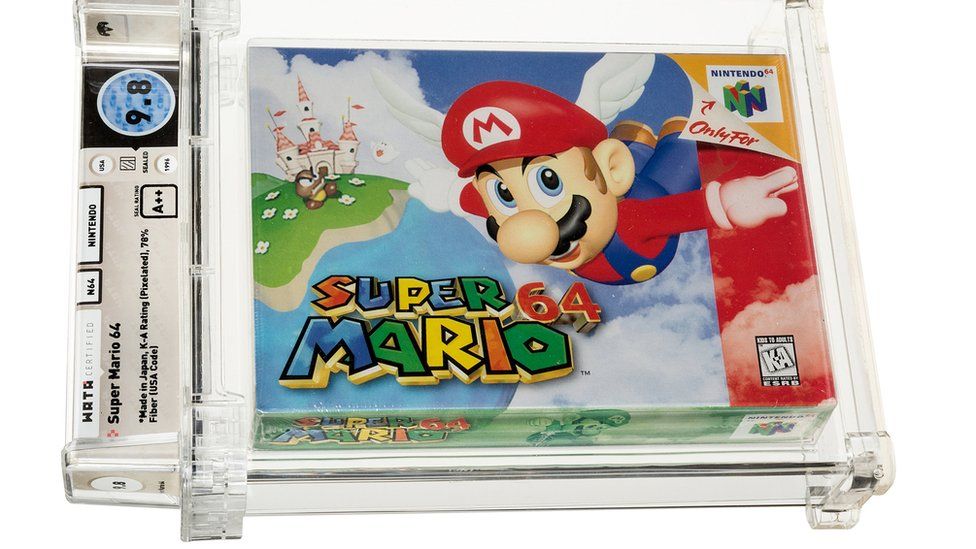
Consider the global scale and love of video games, Mario, Zelda, etc. Versus the localized scale of Major League Baseball (even if it's in the largest economy) and particularly Mickey Mantle.
So why not Mario if Mantle? It makes just as much sense (however much sense that is, granted).
Check out what new prospects go for in the baseball card world. A Wander Franco card went for $200,000. This is a 20 year old that has barely played any professional baseball, recently got called up with the Tampa Rays, and hasn't hit well so far (and may just end up as a flop, as these guys sometimes do).
So Wander Franco cards make sense, and Mario doesn't? Obviously all of it seems crazy. And yet there it is.
You know what else is really crazy? Tesla's valuation. Shopify's valuation. Snowflake's valuation. DocuSign's valuation. And so on.
Yeah, I know, those are real companies that have products and services. Ok. I posit that many of those valuations are less sustainable than a 1952 Mickey Mantle card at $5m. And we're not talking a million dollars, we're talking trillions of dollars of laughably over-inflated valuations in the stock market. Mario at $1.5m is not crazier than Tesla at $600-$800 billion.
It's all part of the same asset speculation mania.
Millions of people out there are paying obscene prices for stocks and it won't end well. And with stocks it's not just some rich person with a toy hobby (because who really cares what that person burns their money on), it's retirement funds, pensions. All loaded up on Coca Cola at 33 times earnings, for a company that hasn't seen any growth in five years, has mediocre prospects for growth, and deserves half their present valuation at best (now repeat that scenario for most of the garbage-valuation blue chips, like McDonald's or Starbucks; check out the valuation on WD-40 (WDFC), an old slow-growth degreaser/lubricant spray company sporting a 40-45 PE; the entire market is like that now, out of its collective mind).
These are the consequences of perpetually low interest rates, it has bred a rabid culture of speculation and desperation for any yield or return.