As an 80s and 90s gaming enthusiast --and, to a small extent, collector-- I really want to know what the hell is going on here. It doesn't seem that long ago that Nintendo World Championship was going for $15k and I could at least understand that from the confluence of historical significance and rarity, but $1.5M for one of the most sold games in history just because of its condition!?
Is this just a symptom of the ludicrous increases in wealth disparity, that someone has $1.5M to throw away on something like this? Or is it some kind of money laundering? Seriously, someone please explain this to me.
The general thought is that like Higher end Art, it's a form of Laundering / Tax evasion that's now running rampant in the Console Gaming side of the house.
It's rather sad, now a lot of classics are being ridiculously priced at used game stores and while i'm all for making money, some of the recents i've seen have been insane price gouges. I saw Panzer Dragoon for Saturn going for 3800 at a used game shop, it was not complete either. I bought a fully complete in box copy for like $380 a couple years back and That was pricey to me.
$380 for complete and good condition does sound a bit pricey, but it's within the realm of "I have this and I'm willing to wait for a buyer who wants it badly enough". $3800 is insane. I myself own a couple rare-ish games (none sealed, I bought them to play them), and if they got up that high I'd sell them in a heartbeat. I have a satiator, I don't need a CIB Saturn Bomberman.
Exactly, I like owning a few of my favorites. I do have a complete US Dreamcast collection and the vast majority are Sealed. I started snagging them up as soon as the console "failed".
I hadn't even noticed the Satiator was out finally! Thanks for dropping the reminder. There goes $250 lol.
My naive understanding is it’s a way of transferring money in return for something supposedly valuable. That might really be payment for something else.
That doesn't work. That's the great myth of donation tax dodging that isn't actually true, yet is endlessly repeated. You ultimately - at best - only save a fraction of your donated value, you'd be better off just selling the asset instead of donating it for a fractional tax saving.
If that actually worked the top 10% wouldn't be carrying such an outsized share of the nation's tax burden on its shoulders via our very progressive tax system, they'd all be busy dodging all of their taxes via donations.
If you really wanted to avoid taxes, you wouldn't donate anything, you wouldn't sell anything.
The single best way to avoid taxes in your lifetime, is to borrow against your assets and only repay the borrowing in death. Your cost will be interest (interest rates are ridiculously low today). You could go much of your lifetime without paying taxes, while enjoying the good life borrowing against eg your stock holdings. Warren Buffett has made this point numerous times, that if he wanted to avoid paying taxes during his lifetime while enjoying his immense wealth, he'd just use that approach. Buffett could have taken out a $1 billion loan 30 years ago, had fun with that cash, and paid zero taxes on it for decades (while also not selling his primary asset - Berkshire Hathaway stock - which has appreciated dramatically).
A fraction of the donated value is still much bigger than the actual value you paid for the art. The important part is to get an appraisal far above the actual value.
> you'd be better off just selling the asset instead of donating it for a fractional tax saving.
The idea of this scheme (which may be exaggerated on the internet) is that you cannot sell the asset.
This is a painting by the cousin of someone who went to the same barbershop as de Kooning. There is zero market. There are approximately zero buyers. There is some story to be constructed that plausibly justifies some "historical value." There is presumably some decorative value.
I keep seeing this discussed, but I have honestly had difficulty getting relatively large loans against assets. All they seemed to care about was income. Yes, Buffet definitely has a better relationship with the bank than I, but I wonder if this is really possible to copy by the average person.
Your assumption is it's only US tax evasion. It's also about getting money out of other countries and evading their taxes, creating values of wealth store. Much like the real estate industry in key markets of the US, foreign investors don't care about paying more if it means they can safely get their cash out of host countries.
1031 Exchanges are one method, buying overpriced items to bring illicit cash into legitimate ownership is another. There are a myriad of ways to make it beneficial. I think we all can agree though that the price is nuts.
Then again The H.Biden paintings are listed for 75 - 500,000 so maybe I just have 0 clue about what super wealthy people want.
You’d think so, and yet it’s come to light Crown Casino in Melbourne was doing just that, knowingly maintaining relationships with known crime organisations, and was actively enabling money laundering.[1]
I argue politics and big business is a front for bad behaviour, as evidenced by the endless stream of corruption news pouring out of the Australian federal government.
I find it difficult to believe the the other G20 nations[2] are markedly better.
Small businesses regularly make $20-30k deposits in cash. That represents the weekly cash revenue of a successful McDonald's franchise. You can slip an extra $1-5k in there, weekly - If you do your accounting "right", it looks like you're moving a little more product than you actually are, and is virtually indistinguishable from real business. See Walter White buying a Car Wash in Breaking Bad. You need a bit of scale: 5 or 10 locations to make it really work, but it does work.
I believe it's more like: here's 1.5 million dollars that you can use to explain to the IRS how you're paying for a new house. If you give me 2 million in illicit cash, I can use that elsewhere and the IRS doesn't care because I already have 100 million dollars in assets.
What if the buyer is from outside US - say a foreign oligarch or dictator? I find it hard they refuse to sell to such people altogether, esp. seeing how much real estate in London is being bought by Russian kleptocrats.
They're really great. You can play games on original hardware without having to worry about wearing out moving components or the availability (and therefore affordability) of any given title.
Some people balk at the satiator's ~$250 price tag, but I own individual Saturn games you can't even buy with that.
I read an interesting explanation on reddit somewhere that posited this is the result of a small group of devoted enthusiasts basically wash trading: They sell the games to each other back and forth for extremely high prices to make it seem like there's an insane amount of demand for them, in order to make that a self-fulling prophecy.
Whether that's true or not I have no idea, but it's certainly plausible.
They don’t even necessarily have to be coordinated.
If you’re operating a business that profits from selling collector items, you benefit from headlines about high sale prices. Spending $1.5 million to juice the market and generate excitement could manufacture enough demand and trade volume through follow-on buying frenzies that you come out ahead in volume sales of cheaper items.
Then you’re still sitting on an asset “worth” $1.5m that you can use to play games with taxes (depreciation?) and also use as collateral to secure cheap loans.
These game prices are no more absurd than a Mickey Mantle card being worth $20-$30 million (1952 Topps Mantle #311 PSA 9 sold for $5 million not long ago; there are three superior PSA 10 copies which in theory should be worth a lot more, two of which are owned by a billionaire).
Consider the global scale and love of video games, Mario, Zelda, etc. Versus the localized scale of Major League Baseball (even if it's in the largest economy) and particularly Mickey Mantle.
So why not Mario if Mantle? It makes just as much sense (however much sense that is, granted).
Check out what new prospects go for in the baseball card world. A Wander Franco card went for $200,000. This is a 20 year old that has barely played any professional baseball, recently got called up with the Tampa Rays, and hasn't hit well so far (and may just end up as a flop, as these guys sometimes do).
So Wander Franco cards make sense, and Mario doesn't? Obviously all of it seems crazy. And yet there it is.
You know what else is really crazy? Tesla's valuation. Shopify's valuation. Snowflake's valuation. DocuSign's valuation. And so on.
Yeah, I know, those are real companies that have products and services. Ok. I posit that many of those valuations are less sustainable than a 1952 Mickey Mantle card at $5m. And we're not talking a million dollars, we're talking trillions of dollars of laughably over-inflated valuations in the stock market. Mario at $1.5m is not crazier than Tesla at $600-$800 billion.
It's all part of the same asset speculation mania.
Millions of people out there are paying obscene prices for stocks and it won't end well. And with stocks it's not just some rich person with a toy hobby (because who really cares what that person burns their money on), it's retirement funds, pensions. All loaded up on Coca Cola at 33 times earnings, for a company that hasn't seen any growth in five years, has mediocre prospects for growth, and deserves half their present valuation at best (now repeat that scenario for most of the garbage-valuation blue chips, like McDonald's or Starbucks; check out the valuation on WD-40 (WDFC), an old slow-growth degreaser/lubricant spray company sporting a 40-45 PE; the entire market is like that now, out of its collective mind).
These are the consequences of perpetually low interest rates, it has bred a rabid culture of speculation and desperation for any yield or return.
I think the reason for the speculation it’s wash trading is that unlike the 1952 Mickey Mantle card, there are presumably a lot more Mario 64 cartridges in circulation and thus the auction price seems out of line for the supply available.
Doing a cursory google search, I can see most used cartridges going for ~$25-40. Is an unopened cartridge worth many more orders of magnitude? Possibly, but it at least raises a lot of eyebrows that there’s something else at play.
EDIT: An analogous collectible is probably more something like a black lotus card, which as far as I can tell has “only” procured 500K at auction for a flawless one, and as far as I can tell inferior versions cost an order of magnitude less (10K or so) but nothing near to the spread here.
> I can see most used cartridges going for ~$25-40. Is an unopened cartridge worth many more orders of magnitude? Possibly, but it at least raises a lot of eyebrows that there’s something else at play.
Yes, that's exactly how it works. The unopened package in near perfect condition is considered extraordinarily scarce.
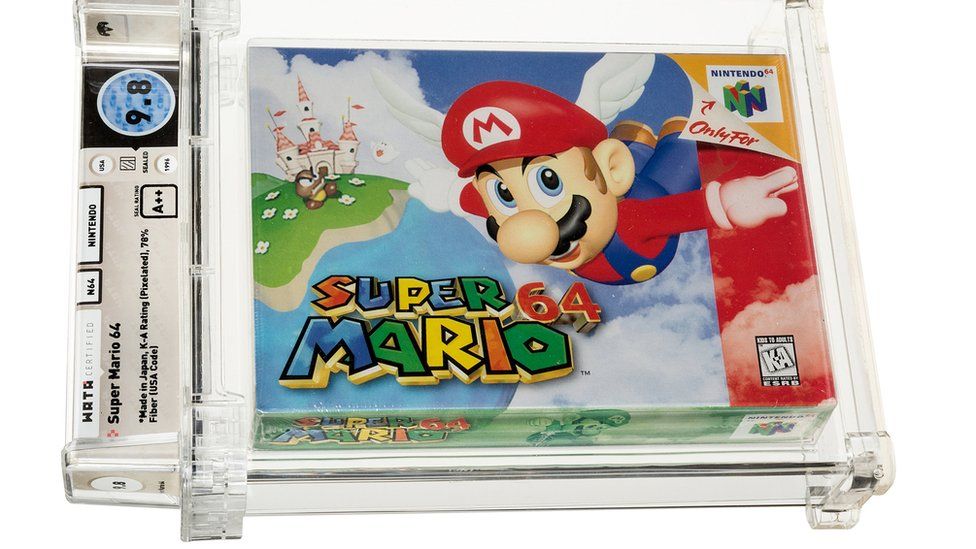
It's the scarcity factor via grading that is being applied. That's obviously a graded Mario 64 package, not just a stray cartridge (of which there are zillions of copies as you note).
The supply, in the collectible world, is thus considered to be exceptionally low. You're talking about a sealed box, top notch grade. There are only a small number of those still in existence.
It's a 9.8, which is a very high grade for a vintage video game box. As far as the collectors are concerned, that's a very scarce item. The value is in the condition of the box and that it's sealed. Without that, you could just buy the item on eBay for ~$30-$50.
You see the exact same outcome in the comics world, for graded comics. And it's identical to the quality + grading = scarcity aspect in baseball / basketball / pokemon cards.
1969 is Mickey Mantle's last year for Topps baseball cards. There are a lot of copies of that card in existence, relatively speaking. You can buy it ungraded for $100-$1,000 depending on the condition you want. If you want a PSA 10 of that card (there are only two)? Be ready to pay $500,000+. That's the same exact scarcity by grading mechanism in action as with the 9.8 graded Mario cartridge, it's because there are not very many of them in that condition.
> These are the consequences of perpetually low interest rates, it has bred a rabid culture of speculation and desperation for any yield or return.
If and when the Fed starts raising rates, valuation on growth stocks (and others too) will come back down to earth. 0% FFR and virtually unlimited Fed support almost do justify some of the current valuations, at this specific moment in time. The Fed could change that though.
Most collectors of old games do not understand why it was sold that much. Super Mario 64 in mint condition and wrapped is rare, but clearly not often to justify this price.
One thing I've noticed though if that people buying a auctions do not always seem aware of the actual prices on the market. I attended an auction recently and bought nothing, as all people in the community I know. Everything was sold for far too mych. We were laughing about it, wondering why people were buying those games at those prices, as we know we could easily get them for far less.
I'd be really interested to know more about the dynamics making people spending far too much money like that (misinformation? excitation during the auction?).
> A high rating is not enough to guarantee a high auction price - although it helps. Another copy of Super Mario 64 in the same auction with a 9.6 A++ rating sold for a comparatively affordable $13,200
This seems to reinforce some kind of laundering/tax evasion scenario. There is little logical reason for one cartridge to go for $13K and another to go for $1.5mm when both are certified excellent condition. It appears that the one going for far more is a product of timing. Someone needed to move a large chunk of money quickly and decided on the Mario cartridge.
If the normal buyers are only willing to pay $13k I don't see how it makes sense to pay $1.5 million to launder money. That's a big loss you'll have to take.
But if you use dirty money to buy a good, it doesn't magically turn into clean money. A possible scenario could be where the buyer has clean money and wants to pay the seller for services by bidding way too much for a rare game. It doesn't make too much sense though because now your transaction is under scrutiny by the entire world?
Not when you have bazillions of ways to do that without being in plain sight. NFTs seem to better fit this need, and even then I don't get why people always assume it has to do with black money
This is the answer I fundamentally agree with on this subject. Super Mario 64 for N64 is a part of humanity's cultural and history, and the supply of similar items will only decrease over time. The expected value is possible for several lifetimes from now though, and most rich families struggle to hold onto it forever.
I agree the software is part of humanity's cultural history but the physical artifact of the cartridge is nearly worthless. We could literally mass produce Mario 64 cartridges to exact specifications if we wanted to. You can buy reproduction carts on the internet, cheap. We can't recreate ancient works of art or antique machinery, those are truly unique, easily but Nintendo cartridges are just chips and plastic.
It is very convenient, for many reasons, if you can call a $1.5m transfer “a sale”. If you can support said price with an auction so the price is supported by a fair market, even better.
Legally transferring that much money to another person (and minimizing taxes) is difficult. Art and collectible sales are a convenient escape hatch.
Money laundering is definitely involved in the fine art market but the explanation here is more banal. It's the same thing driving absurd NFT prices: Quantitative Easing policies by the fed have dumped a shitton of money into the equities markets and some people have cash to burn and nowhere to put it. The nasdaq is up almost 200% in 5 years. What do you do with all this extra cash? There's only so much you can spend on luxuries for yourself. For the rest, why not put some into speculative assets which give the small chance of very high returns (crypto, startups, and, apparently, N64 carts).
>someone has $1.5M to throw away on something like this
Your reaction seems pretty normal and all, but your ethical viewpoint seems backwards to me.
If they spent $1.5M on something that involved the amount of labor and resources that normally buys, then they threw it away, if it wasn't for the general good. A yacht for instance.
But if they spent $1.5M on a collectible with no real use, then they have just exchanged a coupon, basically, for another coupon. They made a decision not to take useful resources away from society that they had a coupon for.
"Wow, those Charizard cards from your childhood are now worth lots of $" has been a common, popular headline across media in the last year, and now it looks like old video games are next. And as Pat says, I think there's reason to suspect that, in this instance, this is artificial pricing.
What I find really disheartening is that these games are attracting such huge valuations simply because of the condition of their boxes! They aren't rare editions, or exclusive, pre-release code. The money has nothing to do with the game itself.
These bidders aren't game collectors, they are cardboard box collectors, nothing more.
It's a fair point, the whole concept of buying something in a sealed container, and never opening it because that would ruin the value, is a bit bonkers. Mind you, the same could be said of wine collectors - just how much 'fine wine' gets bought at auctions for it never to be opened? At least with the wine collectors, they don't think a bottle is worth 10x the going price simply because the label on it is slightly cleaner than another.
Not to Scotsman the whole thing, but I would say that yes, in my experience game collectors play their games. Maybe not all of them if their desire is to own a complete set or something, but generally speaking.
Boxes play into it, but a rare, desirable edition with a bad box will probably be worth more than a common edition with a good box. The box is just one more dimension to grade the games on because collectors are always looking for something more pristine, and cartridges will generally be in good shape.
I still think it's silly--I just get the "box" motivation.
It's not odd, we're coming off of a global pandemic where people were commuting less, saving more (no daycare, not eating out), and collecting stimulus checks. Meanwhile, the businesses that should have failed because of the drop in consumer spending were kept alive with PPP loans.
At the same time, companies like Tesla and Micro-strategy are pouring billions into a new finite asset class.
There's simply more cash flowing into the system, it's just run of the mill inflation.
Isn't there, like hundreds of these floating around on eBay? I haven't searched eBay for them, but I would like to think that common and well circulated games are not that special or rare. It reminds me of the Comic Book Guy in the Simpsons saying: 'You opened it...it's no longer a collectible'
This is somewhat depressing because of how unusable it is. With baseball cards, you all you could ever do was look at them, so you lose nothing when they're encapsulated. With videogames, it's sealed (at least this one), and unplayable. You're not even sure if the cartridge works.
It's not like it's a rare game. You could buy a loose cart for $10 and play that. I can guarantee you that whoever bought this has one already to play.
I don't think this is what's happening, but I think this is the model.
I have a super Mario cartridge. I also have a lot of drugs (or whatever) that I'd like to sell, but I don't have a distribution network, so I have to sell at a wholesale price. I put up the proxy object for auction. You bid far more than we think anyone would pay for the proxy object, and you win. We've made separate arrangements for the drugs (or whatever) so you already have them, or will get them soon.
Now I have a pocket full of legitimate cash. I think there's some biases stuck in American minds about Al Capone. He was a bad guy that did lots of illegal things. But his downfall was tax evasion. This approach gives me a reasonable explanation for all that money, and I can pay taxes on it, so I _appear_ to be an upstanding member of society.
This assumes moving money is hard, when it really is not. If you go for such an effort and risk visibility why not just go with some shell companies, crypto or investments that arent bound to end up in every second newspaper?
The one problem with this theory is why not launder $1.5 million through a boring painting by a C-list painter, rather than a headline grabbing newsworthy object? It seems like unnecessary risk that'll attract IRS attention.
If I need to transfer $1M to you because a some type of "favor", you can buy a collectible like this for a reasonable price, then get it appraised for a ridiculous amount like this, and then I can buy it off you for that crazy amount.
Criminals can be very creative, but I struggle to understand this too. Fine, you sell a ridiculously overpriced thing, that amounts to disguising a money transfer as a sale, but how can you launder dirty money unless you pay in cash? Can auctions take a bag of cash as payment without repercussions?
OTOH, there might be something I'm not seeing here. In my country, private doctors at high-end hospitals accept cash as payment (even for major surgeries), which for common mortals would be a fiscal hell to convert into bank money, but they seem to be fine with it. I've noticed that most high-end hospitals also have a non-profit charity attached, and that many doctors have several big and ugly paintings in their offices.
Yes, and in fact these transactions are often in cash.
It's true there's always going to have to be an initial transaction that's dirty. But if you have some (other) way to wash that, you can do all your following transactions as "art" sales, keeping the art in a freeport so it's never taxed as an asset and is just moved from one vault to another when these sales are made.
Yeah, I'm not sold it being money laundering. Getting a story by the BBC is the absolute last thing you would want. You also want to avoid expensive items with paper trails. High-volume cash businesses is where it's at.
When more of these kinds of news hit the public forums like HN, maybe it's time to sell...but just my humble opinion and I don't know how to quantify these things.
Just a heads-up Pawn Stars is super fake. The 'customers', the 'store', the 'experts',the prices paid and items sold/bought are fakes sometimes (known and unknown).
Tons of articles all over about them over the years.
Disclaimer- I still watch it from time to time, it's a guilty pleasure.


Is this just a symptom of the ludicrous increases in wealth disparity, that someone has $1.5M to throw away on something like this? Or is it some kind of money laundering? Seriously, someone please explain this to me.