I'm very curious about this. My father put together a Heathkit (analog, of course) oscilloscope kit when I was a kid. It took me years to realize the amount of dedication involved in not just assembling the thing (which I helped do) but also importing it to Portugal from the US.
My dad built one of these: https://www.youtube.com/watch?v=iad37q9kNPk and we spent a lot of time looking at our house power and trying to figure out where recurring patterns came from. Back in the early 70s, refrigerators and air conditioners (things with high-load motors running intermittently) were often the culprit.
He built a bunch of Heathkit products. We had an intercom system that worked over the power wiring. It quit working before I was clever enough to use it to play jokes on my little sister.
I was always so jealous of the kids on Mr. Wizard's World that would get to play with the Heathkit HERO-1 robot: https://www.youtube.com/watch?v=FT7nZwxb-DI Sad that the current owners are letting the name & IP languish.
My dad actually bought and put a Hero One together; I used to type in programs on the numeric keypad when I was in 3rd grade (?). It was really cool, and really influenced my course in life.
I praise them for doing customer development before wasting money iterating crazily.
Therefore, I took their long, painful survey, b/c I'd like to see them win.
Although it seems very much like they're very out-of-touch with modern everything. It seems like they just want to keep making radio kits and other familiar, safe territory for them. I hope they can acquire and control that niche.
I had an H11 in high school (late 80's), but it was already an antique by then. My wish-I-still-had-it computer is a little known machine called the "Interact", my first computer from my elementary school days:
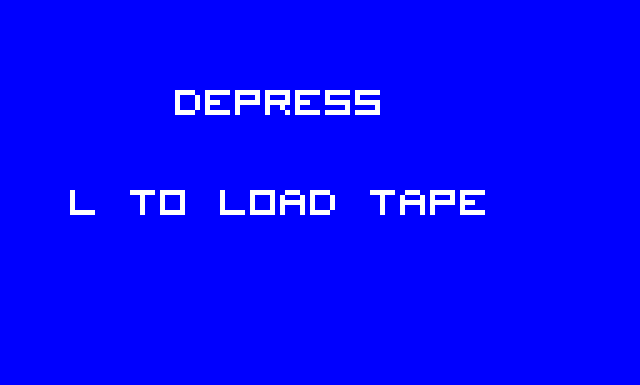
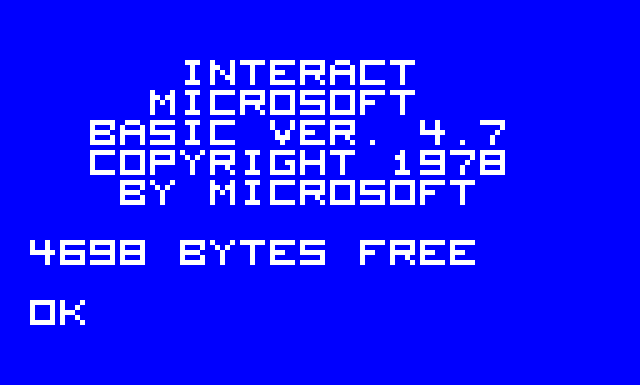
This caused me to spend a couple days writing a simple emulator under OS/X (mostly as an experiment since I'd never tried to write a graphical app on that platform) and got it to the "DEPRESS L TO LOAD TAPE" stage. (I luckily had kept the ROM chips when my mom pitched the computer, I was unable to save it all) Unfortunately things more complicated like Microsoft Basic crashed pretty quickly so there's probably still something a little buggy about my 8080A or other hardware emulation.
I've also got a reasonable sized collection of cassette tapes, both of interact branded software and of programs my dad wrote in BASIC and Forth. It shouldn't be too hard to extract the data from these but a converter will have to be written (the Interact's cassette interface was unique) It's clearly just pulse-width modulated though. I just need to find the right stack of tools that will convert a .wav to a cleaned-up set of pulse width timings, or write one myself. Audio/DSP is another category of programming I've never done.
Unfortunately I haven't touched this stuff in about a year since I've been too busy with other stuff. I probably need a good chunk of uninterrupted time to make much more progress -- the last time I tried I spent a few hours staring at instruction traces from BASIC trying to find out why it was failing and got nowhere. Maybe over the summer I'll have a chance to look at it again.
I lost my ROM, but there are copies on the internet. (I pulled all of the chips when I was in middle/high school, intending to build a computer of my own design, but never completed the project, dunno where they ended up.)
I also had a book with very thorough documentation on the hardware, but I don't know where it is. Dunno if my parents still have the tapes. It had the tape format documented.
It looks like "MESS" supports the interact, dunno how well though. After writing that post I looked it up, got it to run "Add-Em-Up", and let my toddler play with it. It appears to have a french keyboard mapping, however, so I'm guessing it's a modified Hector emulator.
Sorry, when I said "I was unable to save it all" I meant the entire computer. I do have a complete ROM and was able to successfully extract it.
I've got some documents including schematics and some of Interaction and Micro Video magazines. I was able to determine the bytewise format of the tape data (such as the dumps on archive.org) from reading the disassembled ROM, It's pretty simple as you can imagine. There is very little circuitry driving the tape drive so I'm confident that it's just toggling between + and - tape bias and the timing determines if it's a 0 or 1 bit. I looked at the wave form of a cassette rip in an audio editor and it looked pretty clear. I'm sure with a little work I could extract the data although there are probably tools that would help clean up the audio.
I had no idea MESS had any Interact support (they certainly seem to do a good job making their web documentation has hard to use as possible) I'll have to give it a shot at some point.
I remember at 3-years-old that I took endless mischievous joy in figuring out how to change the channel of a Healthkit TV* with an ultrasonic remote control system by furiously jangling keys. *My father and grandfather built it together.



(I'm 95% certain it was this one: https://www.youtube.com/watch?v=hoAmzsz_bJY - the knobs on ours were slightly different, though.)
I don't think they'll be doing oscilloscopes again, but I remember they had a kit catalogue I loved to pore over.