I downvoted you because you made zero effort in researching what the OP said before acting so dismissive. Depending on where you live, it's possible you never eaten nor seen meat substitutes made of soy, but before refuting a claim you should check some facts, not make a claim based on your own lack of knowledge about the subject. "I've never seen something therefore it must not exist".
Soy meat products are absolutely awful. They fail to compete with everything but the most processed cheap meats. Soy hamburgers aren't even as good as the cheapest crappiest frozen bulk-store beef patties. They are a far far cry from being able to compete with a fresh patty made with fresh chuck.
One of the biggest follies of the soy meat industry is trying to make their products healthy by default. Until they may a soy-based animal fat alternative, they don't have a fighting chance of competing. People who truly enjoy meat realize the importance of fatty tissue and how it contributes to flavor.
Go eat a slice of nicely prepared picanha, fat rind and all, and then show me a soy-based product that is even in the same ballpark.
Actually, soy "meat" doesn't even get that far - if you look at the nutrition information on a soy burger patty you'll find that it's full of fat. Like, ludicrous portions of fat that would compete with the fattiest ground beef you can buy.
And it still tastes awful.
In fact, if you look at a lot of soy meat substitutes out there, a lot of them are not at all good for you. The whole "soy meat healthier than real meat" thing is pure perception.
I disagree, I much prefer the flavored soy patties eg BocaBurger brand to real hamburgers. They're also easier to prepare (just microwave) and with good mustard, delicious. The problem is that they cost substantially more than ground hamburger, not less (must be the vegan/"organic" lifestyle premium).
Human populations, as with any other animal, grow exponentially until a point where the environment can no longer sustain such growth. You can of course use technology to push that further away (case in point: http://en.wikipedia.org/wiki/Haber_process). Eventually, though, you'll always get there: that's why plainly stating "humans will have fewer childs" is... I guess naive at best, deceptive at worst (humans will have fewer childs because no one will have the opportunity to).
What happened here is that one particular luxury (meat) was cherry-picked, out of ideology, and then coated in the veil of population growth and sustenance.
Thats distorting the point, because as the population continues to grow exponentially, any luxury will eventually subside. That can be a car, electricity, a toilet, more than a few square feet for yourself or your basic human rights.
> "Human populations, as with any other animal, grow exponentially"
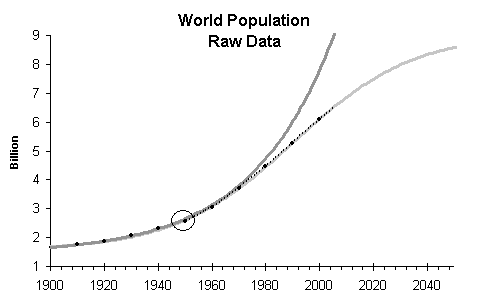
The "populations grow exponentially" argument was state of the art in 1798 [-1], but modern science has taught us that populations grow roughly logistically [0], not exponentially. It's easy to mistake for an exponential in the lower part of the curve (which is all the data we had in 1798), but once you know what to look for, you can see the difference clearly [1].
Of particular note, "exponential growth" means you'll see the same percentage growth rate every year, and larger and larger absolute growth. But what we actually see in humanity is that the percentage growth rate maxed out in the mid 1960s (about 2.2%; it's presently below 1.1%) and the absolute growth rate was at its peak in the late 1980s (88 million in 1989, down to about 75 million now) [2].
Every credible estimate of peak human population puts the number in the 9-12 billion range [3]. That's a lot of people, and will perhaps require some cutbacks, but it's nowhere near the dire levels you predict.
It's not even very interesting if the growth is logistically or exponentially. The point is: there is significant growth. And it doesn't stop until you reach the limit of what the environment can carry. You say that number is projected to be 9-12 billion.
And then we run out of oil. What happens as the mortality skyrockets and humanity downsizes to the new carrying capacity?
> "It's not even very interesting if the growth is logistically or exponentially."
It very much matters which it is. It's the difference between stabilizing at 20% more population than we currently have and dealing with a little more overcrowding, and getting so crowded that we don't have toilets any more.
Running out of oil is going to change American lifestyles significantly. I'm not convinced it's going to change global carrying capacity by very much, though. Do you have a credible model that says otherwise? I would like to see such a thing (in its fullest form.)
I'm more concerned with rising mean global temperatures rendering areas surrounding the equator uninhabitable, when the average temperature gets up near 40c. You won't be able to grow crops anymore, and it will drive people away. If you move the human habitable zone away from the equator, you have less and less land, and even less flatland for ariable farming. So besides the slash and burn land quality loss, you are potentially losing degrees of latitude of ariable space.
Logistic is effectively the same model as "exponential until pressure from a ceiling is applied". Look at formula for its derivative, it is the exponential multiplied by a factor that goes to zero as the ceiling is approached.
The models are effectively identical, until they're not. In particular, they're not identical for the purposes of this discussion.
"Until pressure from a ceiling is applied" is the difference between stabilizing at 9 billion people (a bit more crowded than right now), and growing to so many billions or trillions that the grandparent poster's "no more toilets" prediction would be realistic.
It's too bad michaelochurch didn't just say "plant protein" vs "animal protein", we could have avoided this inevitable nitpicking over technical details and semantics.
Neither you or alexchamberlain actually address his underlying point, so I downvoted you too.
Op's whole post was about meat substitutes. It was about replacing real meat with something else, a substitute. Op happens to call that substitute "plant based meat". In the context of his post, there is no confusion about what he could have meant.