Buying in NYC is just wild. A condo can have a 400$/mo tax, while the next door one is 1300/mo, and the other one down the street can be only 35$/mo for the first 20 years.
There is also a mortgage tax of 2.05% for a loan, which is batshit crazy as it favors rich 'cash only' people, instead of middle class / poor folks.
Also, everything over 1m has a 'mansion' tax, where a 1m gets you one bedroom, without even a washer and dryer, and also there is a 'new building tax' which is another 1% or 2%.
For a 'not new' smallish 2bdr, 800sfq, in Greenpoint, the cost of purchase was 1.3m-1.35m and just the closing costs (taxes and all) was 55K! Just to buy a place (not talking about downpayment and all).
With a current rates, you'd end up paying 9k-10k for a basic (10 years old) 2 bedroom, which is insane at any levels.
Anways, end of my rant. The city needs to both build more, and lower taxes for residents, and raise them for anyone that is not a NY resident. Period. But the builders have resisted this, and Cuomo the coorporate stooge gorvenor we had vetoed/ended a initiative to have good taxation that favors residents.
Building more and giving tax breaks to anyone (even foreginers/non state residents), is just a hand out to developers, and 1/3rd to those apartment will be used a 'storage' for outside money. Locals loose on this.
Even more tenement type layouts would be spectacular for increasing stock, but this is just half of the problem. It's all entirely dependent on reducing the level of greed landlords can get away with today.
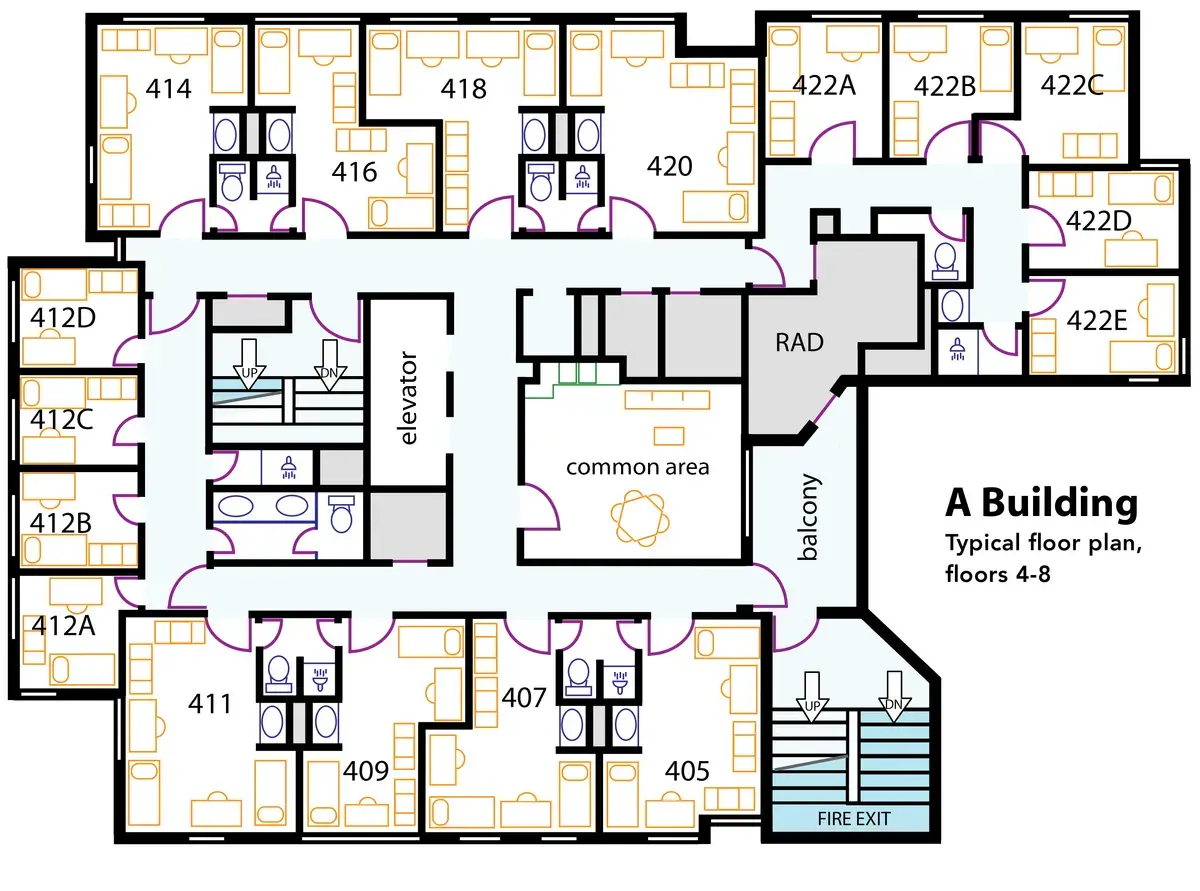
NYC restricts building height to restrict population by land area. There isn't really a need for small apartments since population density is the limiting factor not space. You could build a not much more expensive apartment building instead of a dorm for the same population.
In that floor plan some units don't even have their own dedicated bathroom, let alone kitchens. By allowing this kind of housing to be built, you are actually increasing the level of greed landlords can get away with.
Is it inhumane or just inconvenient? I think we should have all sorts of housing including this sort, and people should be able to select their experience and cost (above a humane standard).
When I traveled through Japan a few years ago, my group stayed at everything from super expensive Onsens, to basic airport hotels, to capsule hotels in Tokyo. The flexibility to choose the kind of stay I wanted was fantastic and allowed us to stay within a budget while getting the full experience both inside and outside of metropolitan areas.
Your perspective disregards how little a post-grad college student should have to care about managing spaces they only sometimes use and would otherwise need to fully maintain themselves.
I can see the benefit to allowing more people to live in NYC, at cheaper prices, because it gives more people more options.
Can you explain what benefit could come from making NYC more expensive? Who benefits from that, and how? I could see landowners wanting that, but that's such a tiny fraction of the NYC populace that I doubt that's your motivation...
NYC doesn’t have any physical gates, but living in manhattan in particular, has a high financial gate, keeping out people who can’t afford it.
Generally people paying 5k+ rents aren’t committing violent crime, homeless sweeps actually happen here and it’s not really possible to sleep on the street.
If you live in an exclusive neighborhood, it’s pretty clean and safe.
there’s angst cheaper rent would change that
EDIT: In a lot of ways NYC’s wealthy and the upper middle class that mostly lives in manhattan have mutual interests the biggest being public safety
interesting interview if you’re interested in more
Can you explain what the benefit is of giving “people” more options (putting people in quotes because they could be current residents, it could be visitors, it could be hypothetical would-residents, it could be people in Alaska - I don’t know what you’re referring to).
Also while it may “give people more options” it inevitably would increase density in one of the most dense cities in the western world. Can you explain why that’s a good thing too?
People move to New York City because they want to live in a dense environment. Currently, options to live in NYC are severely undersupplied compared to the demand to live there. If there was more housing in NYC, a lot more people would choose to live there.
Giving people an option to choose a better life for themself is good in and of itself in my opinion.
Further, density is far better for the environment, greatly decreasing our impact on the environment, and making it easier for us to prevent climate change. It's also far better for the economy, for arts, for science... nearly all human endeavors benefit from the density of cities.
>Can you explain what benefit could come from making NYC more expensive?
People in cities have fewer children, and since children are the future tax base you might want that to occur so that you're not ground up into dogfood in your old age to pay down the national debt.
I do wonder how people think office buildings will comply with fire code which demands multiple avenues of escape from bedrooms during such a catastrophe.
I think that's confusing correlation and causation on childbirth there.
Other places in the world that do not require multiple exits for fires tend to have lower rates of fire death than we do in the US. The multiple exits thing is not actually for fire safety, it's to make multifamily housing harder to build and have less pleasant floor plans. Better fire suppression technology, having closer access to the stairs, are things that actually improve fire safety in practice.
Residential interiors use far heavier products, don't have a central AC system (so each unit will have additional AC systems on the roof), and can have "upgraded over time" finishes (marble floors and countertops).
How will they avoid a similar thing as the surfside condo collapse.
Another thing to consider is that the plumbing is very different- way more bathrooms, and those bathrooms may not be near the core of the building - this can cause instability in weight distribution especially when everyone is doing their mornin routine.
I agree with your other points, but does actually each unit need a dedicated AC?
I live in a building with district heating, we all get the same hot water. If I don't want to live in an oven during the winter, I'll turn down the heaters' thermostats, which lets less hot water in.
Couldn't we have a similar thing for cold air in the summer? Send the same temperature to everybody, and allow people to choose how much of that air they allow in their units. Shouldn't this also be more efficient than a dedicated AC unit per home?
I lived in NYC. Problem with non-individual pipes is that you get Marijuana smoke and cigarette smoke from neighboring apartments to yours. Also if there are multiple units, there is always plausible deniability on who the culprit is.
Wouldn’t the air pressure keep whatever smoke is in an apartment outside the pipe ? So that would prevent it from traveling from one to the other.
I used to live in a high rise which had a common pipe for extraction, I never had any odor coming in, and I know my neighbors were smoking since I would get smoke if the windows were open.
Yes, depends on how much air pressure there is. The downside to too much air pressure out is that you also suck out valuable cold air (in summer) or hot air (winter.)
If the air pressure isnt sufficient, you get some smoke coming thru, esp if the pipes are horizontal. Also depends on how much people spoke and depends on how many units the exhaust travels past before being sucked up into the building-top exhaust.
This is called an FCU (fan coil unit) and is common in Asia. It consists of a high efficiency central chiller run by building management, and pipes to bring coolant to each unit. Then in each unit there is a heat exchange coil with a fan to blow the room air through the coil. Hence fan coil unit.
The advantages of this system are that the only sound in the unit is the fan, and air is not circulated between units. The disadvantage is that building management can turn off A/C centrally if they want to save money.
For some reason Americans are slow to pick up HVAC innovations that are common elsewhere: heat pumps, split-system air conditioners, FCU, etc. I guess it is because energy is cheap to them and they don't mind noise.
> For some reason Americans are slow to pick up HVAC innovations that are common elsewhere
Few want to spend the money to convert older buildings. That includes homeowners, building owners, and condo/co-op boards.
Someone a few weeks ago posted a long essay about how much heat pumps make sense from an investment and environmental standpoint. It glossed over the fact that most American middle income households, when presented with the choice of dropping $25,000 on a heat pump/mini split or sticking with window mounted ACs and that cost a fraction in terms of up front costs, will go for the cheaper option ... or spend the money on some other home improvement or accessory like a car.
One of the big questions that I haven't seen a compelling answer for re: heat pumps in the US is why heat pumps are so expensive compared to AC exchanges. The amount of equipment differences between an AC and a heat pump are largely a valve to reverse refrigerant flow and the small bit of electronics to control said valve. Yet heat pump units in the US are significantly more expensive for effectively the same COP and operating efficiency ranges as their cooling-only brethren.
It's more expensive in America - larger houses requiring larger units and more ductwork/labor, and probably the manufacturers pricing for the world's richest market.
How does ventilation (the V in HVAC) work for FCUs? If the pipes only bring coolant to each unit where does fresh air come from? Conventional HVAC systems have Heat Recovery Ventilation so what's the equivalent here?
Lots of cities have building codes for multifamily residential that requires independent ventilation for each unit to reduce cross contamination, or requires zones and duct work that prevents such mixture of air.
This generally isn't true in commercial office buildings, which are more along the lines of what you're talking about. But often tenants themselves don't even directly control their temperature at will; it is managed by property management.
You can consolidate the outdoor units e.g. one outdoor unit can supply several apartments worth of air handlers (heads). There is an edge case wherein during the transition between heating and cooling season, all the heads associated with one power unit can either heat or cool collectively, not some combination of both.
Mini splits also allow a lot more flexibility of layout as you're only running linesets from the outdoor units/branch box to the the heads, i.e. you have to plumb a couple of small copper lines to each head instead of running a huge ducting tree.
That "edge case" is simply unacceptable to many people. Agree with your neighbors in terms of cooling/heating? These days most apartment dwellers don't even talk to their neighbors in the first place.
The only kind of consolidation I can imagine is consolidating the outdoor units of different rooms in the same apartment.
They only need to agree on whether it's a heating period or a cooling period. I know many buildings are different, but there's a sizeable number of them in my city providing some form of central heating. I do live in a very dense city, where I bet most people don't know their neighbors.
The building management and HOA usually set up a fixed scheme, such as "heating is on from start_date to end_date. These dates tend to make sense according to the usual local climate. If I'm not mistaken, in my building it's something like late October to early May.
Of course, when the actual temperature is outside expected ranges around those dates, it's not optimal. Luckily, it's never more than a few days.
The same approach could be applied for providing cooling.
>Couldn't we have a similar thing for cold air in the summer? Send the same temperature to everybody, and allow people to choose how much of that air they allow in their units.
No. AC does not work like this. In fact, you're not supposed to change vents in individual rooms to control temperature or you risk causing problems for the AC unit.
Why is the surfside condo collapse specifically relevant for office-to-residential conversions? That building was built for residential from the start. And that building also had basically ignored a major maintenance issue for multiple years.
You could certainly force the bathroom placement with the wet walls. Code is code, and space folding does not exist. So if you only allow for 18” of drop on the pluming then all the drains have to be within fifteen foot radius of the sewer line. And the floor beams will limit that further.
That said, the responsible thing is not to convert the whole building but make a sandwich of retail ground floor, residential above, then commercial, then maybe real estate top floors. Weight carried low is fewer failure points for the building.
Each unit doesn't need AC systems on the roof. Window ACs and wall units suffice. They are also more efficient than central AC due to the lack of ducts. And if the office was old (prewar) it likely didn't have AC in the first place so it had ventilation shafts and courtyards, and you could get away with not having AC in certain spaces that are far from windows.
I’m sure that structural engineers will be heavily involved. While there are some things to consider or worry about, I don’t know that any of your concerns are actually valid things to be overly worried about.
They’re certainly all solvable and I have no doubt that the PE(s) putting their stamps on it will have valid proven solutions that check out mathematically.
Just to put this in perspective, the Mamdani housing plan is 200k homes over ten years which would be far below the historic pace of new construction in nyc. Conversions are great but a drop in the bucket.
It seems like it'd be pretty expensive to convert office buildings to apartments. I'd imagine there are a ton of building regulations that office buildings don't have to adhere to compared to an apartment.
I have toured a few converted buildings in NYC. You end up with weird apartment layouts for reasons you mentioned. For example, a lot of the layouts were really long and narrow to satisfy the window requirement since office buildings are generally just giant square floors where you can have desks without direct window access. I think the other issues are running plumbing and electrical to each unit where an office building just needs a central room with plumbing for a common bathroom area.
Overall the economics seem to work in NYC since rents are so expensive, but I would imagine converting an office tower in a MCOL or LCOL city would be harder to make profitable.
Not just regulations. Basic issues like - office floor plates are wide, but all bedrooms need windows so you end up with weird sliver rectangular floor plans bc you can’t have an all interior apartment. Or - the plumbing in office runs up the core so you are constrained where your bathrooms and kitchens sit.
Also most office buildings aren’t totally vacant and leases can be 10+ years. If you have 48 floors empty but an office tenant on the second floor and one on the 44th floor, and they both have 8 years left on the lease, you can’t just evict them for no cause. It compounds since most of these candidates are eg 30% occupied with a ton of small tenants. Most successful conversions are single tenant buildings where you just do a deal with that one tenant (JPM was tenant in one NYC building).
It's very expensive. But $5 billion in tax incentives helps:
"the report warns that the city’s new 467-m tax break may be overly generous, potentially costing $5.1 billion in lost property tax revenue over 37 years".
That's just too speculative. My viewpoint has always been no tax breaks on stadiums, headquarters, etc, but you just can't know what'll happen. At least if you give the break you have somewhat of idea that they'll be more incentivized
In the early 2000's when the dot com bubble burst, a well known commercial real estate developer here had the same idea because many of the large corporate buildings went empty or went into foreclosure or had various other financial issues.
He bought one and I was told by several contractors who worked for him that he would brag about the sweetheart deal the city gave him and how little he would have to pay to convert the buildings into town homes. Because of the dot com bust, he also got a bottom floor deal on the price of the building.
It took several years to convert, but that's kind of when the wheels started to fall off. 9 people (at last count) were charged with mortgage fraud in a kick back scheme. They tried to buy up a bunch of the condos and then planned to resell them at higher prices. They were using ghost buyers to get financing.
Ironically the developer was never charged, but several real estate agents and their brokers plead guilty to fraud. The developer had also bought several other buildings with the intention of doing the same. None of them ever came to fruition and by the time the 2008 housing crash rolled around, he had lost two of the other three buildings to foreclosure and I'm not sure what happened to the other one.
The developer just got lucky. Right time to buy low and sell high, but then once he was straddled with market cost of the building and no sweetheart deals on labor and tax breaks from the city? It quickly became apparent unless you have very, very deep pockets, a conversion like this is very expensive and takes a long time for you to see any return on your investment.
On the bright side if you google the name "Cloud 9 Sky Flats Hopkins MN" you'll see the building they used. There are several local real estate companies who still sell the flats and they are amazing with incredible views of the city.
Here's some articles about the Cloud 9 Flats fraud:
I think this is more a function of “development is hard and there are a lot of fraudsters” vs conversions specifically. Conversions are harder than an average development but there are hundreds of similar stories for normal ground up.


There is also a mortgage tax of 2.05% for a loan, which is batshit crazy as it favors rich 'cash only' people, instead of middle class / poor folks. Also, everything over 1m has a 'mansion' tax, where a 1m gets you one bedroom, without even a washer and dryer, and also there is a 'new building tax' which is another 1% or 2%.
For a 'not new' smallish 2bdr, 800sfq, in Greenpoint, the cost of purchase was 1.3m-1.35m and just the closing costs (taxes and all) was 55K! Just to buy a place (not talking about downpayment and all).
With a current rates, you'd end up paying 9k-10k for a basic (10 years old) 2 bedroom, which is insane at any levels.
Anways, end of my rant. The city needs to both build more, and lower taxes for residents, and raise them for anyone that is not a NY resident. Period. But the builders have resisted this, and Cuomo the coorporate stooge gorvenor we had vetoed/ended a initiative to have good taxation that favors residents.
Building more and giving tax breaks to anyone (even foreginers/non state residents), is just a hand out to developers, and 1/3rd to those apartment will be used a 'storage' for outside money. Locals loose on this.