I don't think your comment answers the question? Basically, those who bother to know underlying model's name can already run their model without this tool from nvidia?
I suppose I’m just struggling to see the value add. Ollama already makes it dead simple to get a local LLM running, and this appears to be a more limited vendor locked equivalent.
From my point of view the only person who would be likely to use this would be the small slice of people who are willing to purchase an expensive GPU, know enough about LLMs to not want to use CoPilot, but don’t know enough about them to know of the already existing solutions.
With all due respect this comment has fairly strong (and infamous) HN Dropbox thread vibes.
It's an Nvidia "product", published and promoted via their usual channels. This is co-sign/official support from Nvidia vs "Here's an obscure name from a dizzying array of indistinguishable implementations pointing to some random open source project website and Github repo where your eyes will glaze over in seconds".
Completely different but wider and significantly less sophisticated audience. The story link is on The Verge and because this is Nvidia it will also get immediately featured in every other tech publication, website, subreddit, forum, twitter account, youtube channel, etc.
This will get more installs and usage in the next 72 hours than the entire Llama/open LLM ecosystem has had in its history.
Unfortunately I’m not aware of the reference to the HN Dropbox thread.
I suppose my counter point is only that the user base that relies on simplified solutions is largely already addressed with the wide number of cloud offerings from OpenAi, Microsoft, Google, whatever other random company has popped up. Realistically I don’t know if the people who don’t want to use those, but also don’t want to look at GitHub pages is really that wide of an audience.
You could be right though. I could be out of touch with reality on this one, and people will rush to use the latest software packaged by a well known vendor.
> the user base that relies on simplified solutions is largely already addressed
There is a wide spectrum of users for which a more white-labelled locally-runnable solution might be exactly what they're looking for. There's much more than just the two camps of "doesn't know what they're doing" and "technically inclined and knows exactly what to do" with LLMs.
Anyone who bothers to distinguish a product from Microsoft/nvidia/meta/someone else already know what they are doing.
Most users don't care whether whether the model is run, online or local. They go to ChatGPT or Bing/Copilot to get answers, as long as they are free. Well, if it becomes a (mandatory) subscription, they are more likely to pay for it rather than figure out how to run a local LLM.
Sounds like you are the one who's not getting the message.
So basically the only people who runs a local LLM are those who are interested enough in this. Any why would brand name matter? What matters is whether a model is good, whether it can run on a specific machine and how fast it is etc, and there are objectives for it. People who run local LLM don't automatically choose Nvidia's product over something just because nvidia is famous.
Have you ever tried to use ChatGPT alone to work with documents? In terms of the free/ready to use product it's very painful. Give it a URL to a PDF (or something) and assuming it can load it (often can't) you can "chat" with it. One document at a time...
This is for the (BIG) world of Nvidia Windows desktop users (most of whom are fanboys who will install anything Nvidia announces that sounds cool) who don't know what an LLM is. They certainly wouldn't know/have the inclination to wander into /r/LocalLLaMA or some place to try to sort through a bunch of random projects with obscure names that are peppered with jargon and references to various models they've also never heard of or know the difference between. Then the next issue is figuring out the RAG aspects, which is an entirely different challenge.
This is a Windows desktop installer that picks one of two models automatically depending on how much VRAM you have, loads them to run on your GPU using one of the fastest engines out there, and then allows you to load your own local content and interact with it in a UI that just pops up after you double-click the installer. It's green and peppered with Nvidia branding everywhere. They love it.
What the Nvidia Windows desktop users will be able to understand is "WOW, look it's using my own GPU for everything according to my process manager. I just made my own ChatGPT and can even chat with my own local documents. Nvidia is amazing!"
> why would brand name matter?
Do you know anything about humans? Brands make a HUGE difference.
> People who run local LLM don't automatically choose Nvidia's product over something just because nvidia is famous.
/r/LocalLLaMA is currently filled with people ranting and raving about this even though it's inferior (other than ease of use and brand halo) to much of the technology that has been discussed there since forever.
Again - humans spend many billions and billions of dollars choosing products that are inferior solely because of the name/brand.
I have no idea what you're talking about and am waiting for an answer to OPs question. Downloading text-generation-webui takes a minute, let's you use any model and get going. I don't really understand what this Nvidia thing adds? It seems even more complicated than the open source offerings.
I don't really care how many installs it gets, does it do anything differently or better?
> Downloading text-generation-webui takes a minute, let's you use any model and get going.
What you're missing here is you're already in this area deep enough to know what ooogoababagababa text-generation-webui is. Let's back out to the "average Windows desktop user who knows they have an Nvidia card" level. Assuming they even know how to find it:
2) See a bunch of instructions opening a terminal window and running random batch/powershell scripts. Powershell, etc will likely prompt you with a scary warning. Then you start wondering who ooobabagagagaba is...
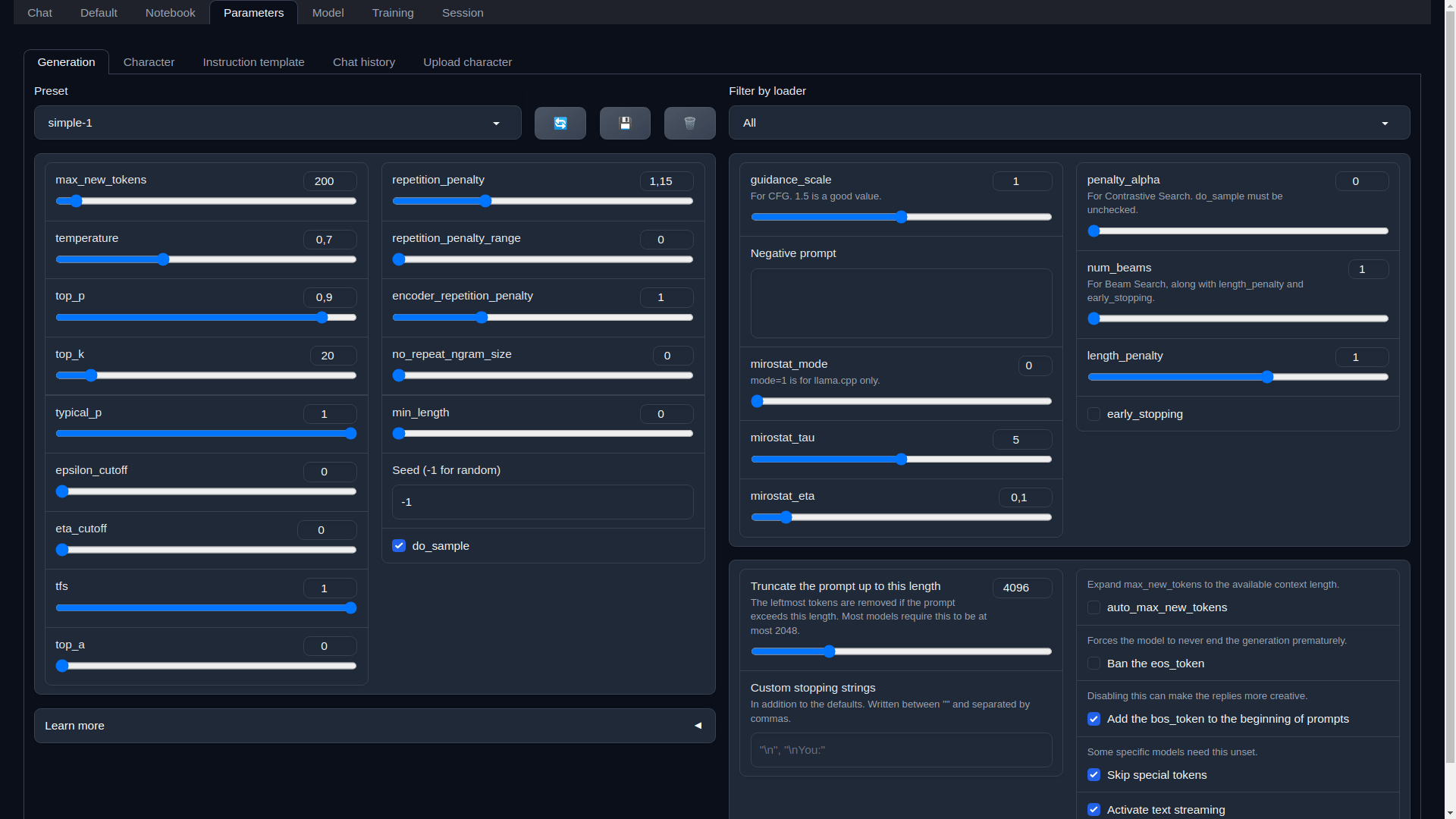
3) Assuming you get this far (many users won't even get to step 1) you're greeted with a web interface[0] FILLED to the brim with technical jargon and extremely overwhelming options just to get a model loaded, which is another mind warp because you get to try to select between a bunch of random models with no clear meaning and non-sensical/joke sounding names from someone called "TheBloke". Ok... Oh yeah, what's a "model"? GGUF? GPTQ? AWQ? Exllama? Prompt format? Transformers? Tokens? Temperature? Repeat for dozens of things you're familiar with but are meaningless to them.
Let's say you somehow braved this gauntlet and get this far now you get to chat with it. Ok, what about my local documents? text-generation-webui itself has nothing for that. Repeat this process over the 10 random open source projects from a bunch of names you've never heard of in an attempt to accomplish that.
This is "I saw this thing from Nvidia explode all over media, twitter, youtube, etc. I downloaded it from Nvidia, double-clicked, pointed it at a folder with documents, and it works".
It's a different inference engine with different capabilities. It should be a lot faster on Nvidia cards. I don't have comp benchmarks for llama.cpp but if you find some compare them to this.
Disingenuous to what? I'm asking what it brings someone who can already use an open source solution. I feel like you're just trying to argue for the sake of it.
Oh my apologies for the wild goose chase. I thought they had added support for Windows already. Should be possible to run it through WSL, but I suppose that’s a solid point for Nvidia in this discussion.
I think there's a market for a user who is not very computer savvy who at least understands how to use LLMs and would potentially run a chat one on their GPU especially if it's just a few clicks to turn on.


And perhaps they will add more models in the future?