Wow, that's incredibly close. I assumed there would be a public database of CE (European) approved devices or manufacturers, but I can't find one from a quick search.
The CE marking is a self certification program, and there isn't an approval process. All the can happen is that you can get fined after the fact for applying the mark to products which don't fulfil the necessary requirements.
Technically it is a self-certification program, since it's the device manufacturer who signs the certificate, but that's not the whole truth. A manufacturer still needs to prove compliance (in the case of the EMC directive, either Annex II or III) or slapping on the mark is just fraud.
I'm not interested in arguing you out of your surety. I do want to note that I believe that when an urban legend is implemented in reality, it is no longer a legend. And you aren't going to argue me out of expressing my opinion.
But you have presented no proof of that. What has been shown so far is that:
• One Chinese web site presents the information as factual, i.e. a simple retelling of the legend.
• Equipment exists which have the wrong dimensions on the CE logo.
What you have not proven (and neither has anyone else) is that some manufacturer has actually used the faulty CE dimensions to try to claim that they weren’t trying to show a CE mark, but instead this mythical “China Export” mark. Note that for the legend to work, it has to be some sort of benefit for the manufacturer, namely that they must be able to get out of being accused of falsely displaying a CE mark by, when accused, instead claiming that the CE mark is not in fact a CE mark. But this must be claimed publically by the manufacturer. Surely someone should have some example of this happening by now?
UL isn't actually mandatory in the US. The only thing mandatory that I am aware of is FCC certification for devices with signals over a certain number of Hz, and they wouldn't care about a USB port being abused.
Every turkey frier I've ever seen is a propane burner and a well sized pot to put on top of it. 0 electronics unless they have a thermostat type feature (which I've never seen).
Gotcha, I thought it was just an electrical certification. However if they won't certify a propane burner and a pot just because it's labeled 'turkey frier'... i'm not sure how they can certify any gas grill, gas range or propane burner of any kind.
Has to do with the large amounts of flammable oil that inevitably spill out.
Some years ago, I saw a video, done by Consumer Reports, I think, that showed a fireman, in full heat gear, using a turkey fryer, and showing how incredibly easy it is to spill oil.
Every Thanksgiving, there are always quite a few turkey fryer accidents.
1) they overfill the pot, even though every frier I have ever purchased comes with a table of turkey weight to oil (not perfect obv but generally they are conservative, at worst you must add a little oil once the bird is in the frier). Sometimes this table is literally etched into the pot. Failure here will overflow the oil and send it into the burner causing a fire, once that fire reaches the inside of the pot .. yaknow, not great.
2) they don't sufficiently dry the bird or even worse put it in frozen. The previous causes potential spatter that could 'boil over' and cause fire. The later i've seen some videos of .. much less great.
Let's be clear, you can do exactly this stupid shit deep frying something on your stovestop, at least with a turkey frier you can be outside away from flammable things.
It's pretty easy to deep fry a turkey safely and in fact every year I probably fry between 10-15 birds (I love turkey). On thanksgiving I generally end up frying 5-7 birds for my family and some of the neighbors who either are to scared or just don't want to buy a setup, either way I'm happy to do it for them.
1) make sure your oil level is right according to the pots instruction.
2) make sure your bird is thawed and pat it dry inside and out
3) heat the oil on the burner, but move the pot off the burner before inserting the turkey, also remove the pot before removing the turkey.
I recently ran into this buying an EVSE to charge my car. Amazon in the US is full of imports from generic Chinese brands that are half the price of name brands but not UL certified. Many of them say "UL certified cable" which doesn't tell you anything about the entire charging unit, just the wire stock they used.
It's all fraud. And at 40 amps, potentially quite dangerous.
Stuff like the post you are replying to is common "good luck with insurance" trope. Insurance protects you from stupidity, errors, and negligence. It doesn't protect you from fraud or intentional malice, but using an uncertified device is not fraud.
Note that after an accident related to personal stupidity or error, an insurance company could decide you are too risky to further insure, or that the cost for your insurance should increase dramatically. But they can't deny a claim.
All of this is of course a significant summary, but insurance won't (can't?) deny a claim linked to an uncertified electrical device in normal circumstances.
The head of store told me it was the policy because of insurance requirements we were looking at buying a paneled LED display/wall and UL vs Non-Certified was a large price difference. In the end we paid for UL. (They were actually probably identical panels, non-cert was from china, UL was from a us supplier)
Some devices do require a NRTL (nationally recognized testing laboratory) mark. That could mean UL or TUV or whatever. NFPA 70 will refer to “listed” or “recognized” devices in such cases.
Anyone can stick a CE sticker onto their products. It's a self certification mark, and I've never heard of a company ever getting in trouble over this stuff. All it says is "I promise to follow the CE rules" but there are no mandatory audits or anything, unless a company gets found out to be violating the spec.
I don't think the CE mark protects consumers the way it could decades ago, with international imports taking a few seconds and free postage to boot.
Fair point, but given that some manufacturers have no problem at all to just blatantly use brand names without permission, having a CE mark is unfortunately not a sure sign that a device has ever been inside a certification lab…
The device is specifying the output voltage, in very black, very tiny letters. How convenient. The person who took this almost impossible photograph should get a Pulitzer. No quantitative measurement for the real voltage, or current for that matter.


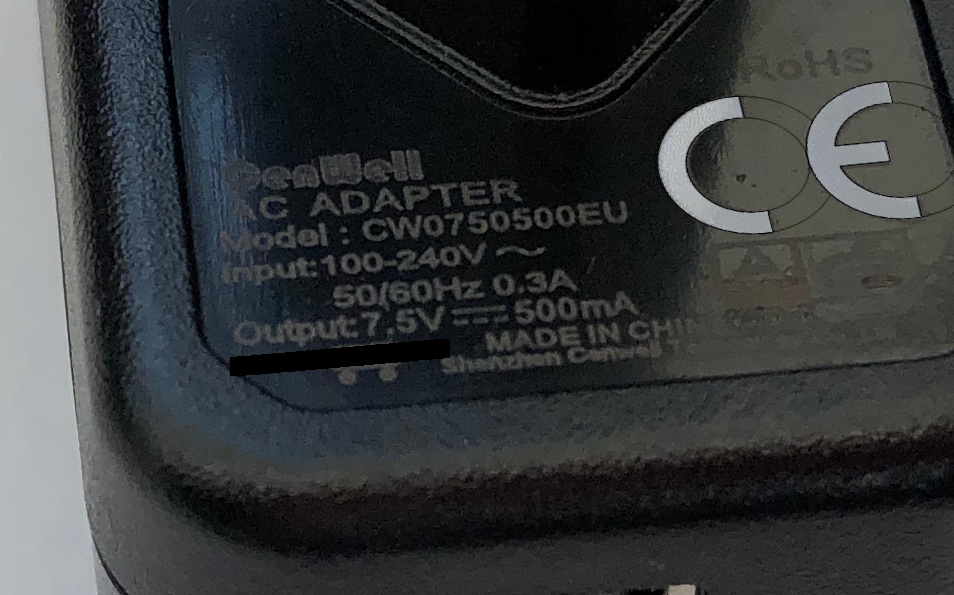
The device is specifying the output voltage, which isn't in spec for the connector, but it is (apparently) accurate.