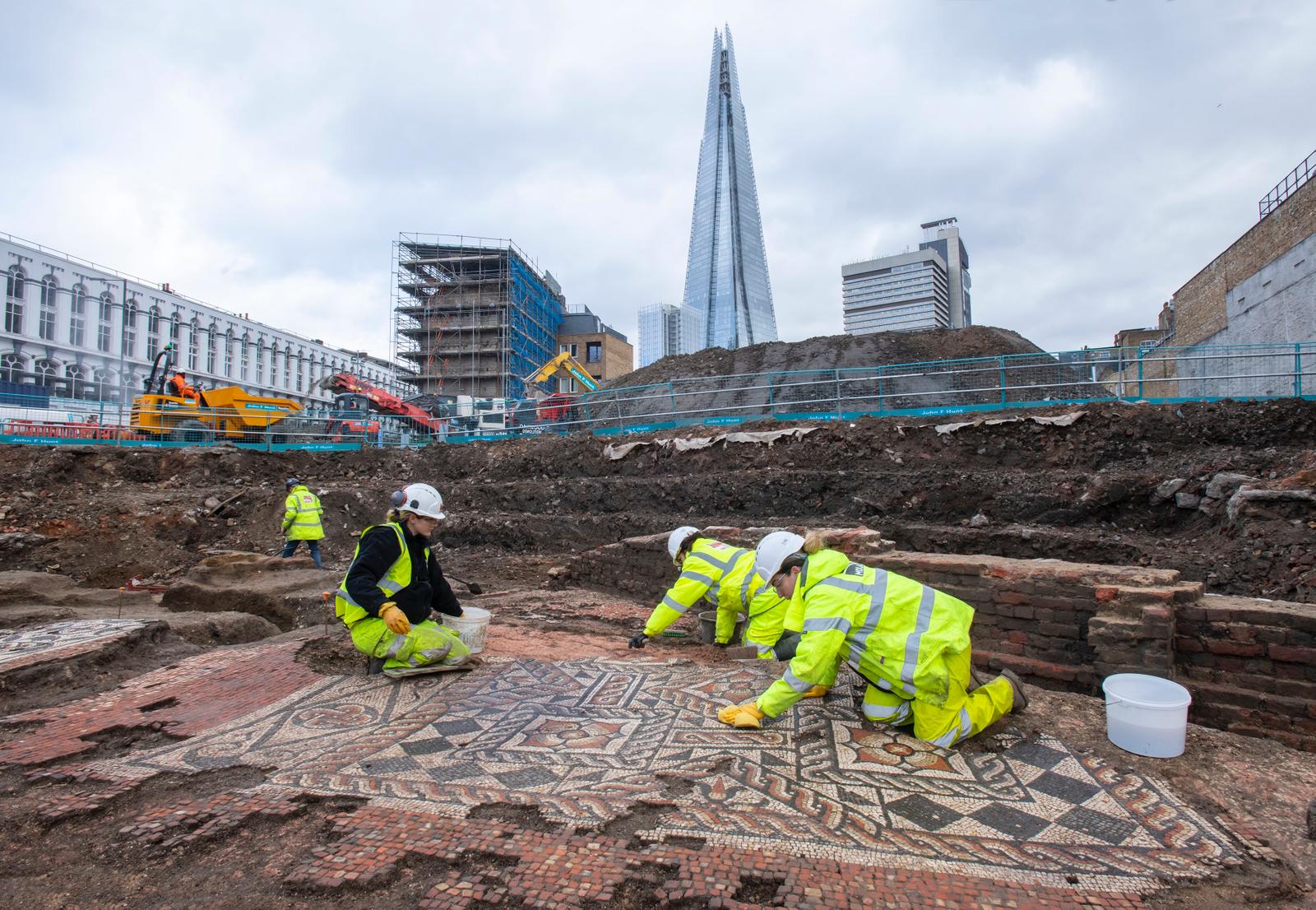
Whenever I see stuff like this, I feel pain for the developer. Of course this stuff should be preserved, but many times developers will destroy or hide these archaeological findings so their projects don't get delayed. I know this is common in other parts of the Mediterranean where the Roman Empire flourished - certainly in Rome and also in Beirut. Developers should be incentivized somehow not to destroy this world heritage.
Yeah. It seems like something you could get insurance for, though.
About 30 or 35 years ago my parents were asked by The University of Manitoba for permission to dig a 1 foot trench near the river which bounded one side of their property to look for artifacts of Canadian aboriginals. The plan was do do a long trench across twenty or thirty houses. They answered the letter with "of course you can" or something like that. Got a letter back a couple months later. It thanked them, but said that they were the only ones that answered in the affirmative. Apparently all their neighbours cared more about protecting their future right to build a shed over the priceless history of the people who lived there first.
If you ever dealt with any "preservation" types in Canada you would know why all of those guys said NO, more like F NO. They could find a piece of brick(our put one there), assign a department, probably get a 1mil budget, dig up your whole land then ban you from using it forever.
> They could find a piece of brick (or put one there)
So the claim here seems to be: A university archeologist may decide to place a (modern) brick in your backyard, which they will use to support their claim that it's an archeological site, so that they can have the opportunity to waste thousands of combined hours of work and a million dollars of their undersized budget digging up a site that they don't actually think has any artifacts of interest. To which I say:
I guarantee you that no backyard trench dig is getting 1m budgets and an entire department. Usually even being able to afford basic tools like up-to-date imagery is problematic.
I think in general this ends up being the same market failure the original post alluded to - there's tail risk of someone actually finding something, declaring your property a landmark/historical site which severely limits the possible use thus negatively impacts the value of your property... with zero compensation to you. Rational response there should be F NO.
> Apparently all their neighbours cared more about protecting their future right to build a shed over the priceless history of the people who lived there first.
Present people are worth more than past people. No thanks. Imagine you find something on your land. This so-called priceless artifact will be “protected” with no compensation to you.
You’re welcome to do that but knowing that these people will try to kick me off my land and lock it away like a nuclear waste dump in a time of housing crises means I’m going to deny access too.
As long as the artifacts sit undisturbed beneath the ground, that's also a form of preservation. What would be bad is simply digging the stuff up without a proper archeological excavation or at least a survey of the area - whether for fear of future restrictions being asserted, or otherwise.
Projects like this in the UK will tend to have archeologists involved from the outset, it an accepted risk in project planning, especially in places like London. You can barely stick a spade in the ground without hitting something.
Big projects like Crossrail have uncovered a lot of archaeology in London over the years.
When I was a teenager a guy at the gas station in my small town pulled up with a petrified femur bone taking up the entire trunk of his big sedan. It was found in a nearby quarry, and I guess no one wanted to report it so as not to disrupt business.
It is a bit of a shame that they are moving it. There is something special about seeing these remnants in their original location, imagining what the surroundings looked like and comparing with the current. Somewhat understandable though, London property prices being what they are. Not even the Roman empire can afford to stay.
I stumbled upon one of the most beautiful mosaics I've ever seen last November when I was visiting Bulla Regia in Tunisa (https://en.wikipedia.org/wiki/Bulla_Regia) & it's been preserved in it's original place: https://imgur.com/a/1B5o490. Well worth a visit if you're ever in the area.
Depending on where the mosaic is and what is being build there, it could be an amazing opportunity to incorporate the mosaic into the building itself, like a glass ceiling/floor that you can walk etc.
They're planning on preserving the remains of Shakespeare's Curtain Theatre in place behind a glass enclosure. Its exact location had been forgotten for a few hundred years, but was found underneath a pub's back yard in 2011[0]. It is where plays like Romeo and Juliet were performed by the acting troupe which included Shakespeare himself, and so is big enough to redesign the redevelopment around and turn into a feature[1]. Its still not open to the public yet so I can't comment on whether they've done a good job or not.
The inconveniencing of a property developer is fairly low priority compared to preserving our past, I'd say. You can't exactly make another one of these if it gets bulldozed.
They make a absolute fortune from that real estate and as others have said, if you have a plot of land in that location big enough to build on that has only ever had relatively shallow construction on it, you should 1) expect to find evidence of Roman occupation or evidence of plague burials and 2) expect to pay for the inconvenience.
I have absolutely no problem with them being required to cope with this themselves. There's a lot of history there and with the density of development in that area, there is really only one chance, each time, to do something about it.
For most developers this is priced in -- including when it's a state-sponsored project.
All around the UK there are plots of land that developers have acquired at an attractive price through sketchy regional development corporations, then gone bust (only to reemerge without debt) and the sites left as great big holes in the ground. In the town where I live there is a site that has been like this for two decades; it's gone through several developers, more than a couple of which had rather beneficial terms.
Major developers do not care when they walk out on a site if it is mildly inconvenient or not quite profitable enough; the least standard they should be held to is to pay for the costs of preserving our past when the site they have secured will ultimately make them a fortune as they lease off square footage to shady foreign investors!
Why isn't there a flat tax on all development (or the populace even) to cover this? like you said, it's "our past", why should only developers foot the bill?
Perhaps because they are the ones who would make the profit from what is surely a national asset. It's not as if they create the land that they make a profit from.
Then just take/forbid profit that is derived from whatever is discovered; there is no guarantee that it will be greater than preservation cost which is the whole issue.
Errr, because only developers get to privatise the profits from building on the land?
I'm always a bit surprised at people expressing incredulity that the state (which definitively controls the right to decide who gets to own land) hands out responsibilities with privileges.
There are all sorts of burdens and responsibilities, financially and otherwise, that fall on land owners and developers. This is just one of them. It's unusual but it's not outrageous.
so, why does that matter? What has that got to do with discovered artefacts?
Developers would make a profit off the land if nothing was discovered there.
Farmers also make profit off the land without any building required.
> There are all sorts of..
I'm not sure where you are going with this, I wasn't questioning the role of the state or that it "hands out responsibilities with privileges" - so it's kind of weird that you'd argue in the abstract like this. I'm arguing that there's no privilege for developers - discovered items are national assets and cannot be owned in many places.
I've done this work (CRM) in the past. Archaeologists are well aware of that flaw, but it's an inherent cost of preservation because the primary loss for the developer is time. There's an inherent trade-off between preservation and time that's already pushed very far towards the speed side.
I suppose you could attempt to fix it by compensating the developer with government money, but it's not obvious to me how anyone would calculate that amount fairly and uncontroversially.
It's a business - you don't know what their profit margin is. Presumably there are many who will advocate burdening developers with the cost of their own preservation aspirations while, at the same time, lamenting the lack of affordable housing due to the high cost of development.
> It's a business - you don't know what their profit margin is.
Except from their accounts, or their AGM, since many of them are PLCs.
I'm struggling to think of a London-based property developer that has gone bust solely on the basis of their London portfolio. It would be quite unusual.
The closest I can think of is Targetfollow, which went into (and emerged from) administration, but that happened because they were nationally overstretched; the impact was felt more the further you got from London.
We might see this happen as a result of pandemic influences on property uses, but I doubt it.
> Presumably there are many who will advocate burdening developers with the cost of their own preservation aspirations while, at the same time, lamenting the lack of affordable housing due to the high cost of development.
You set this up like it's an either-or, but it's not. The high cost of development in London has basically nothing to do with the risk of finding a mosaic.
This is just one of thousands of things a land "owner" has to deal with. If you expect to buy a piece of land and own it like some South African dictator then you only have yourself to blame.
In some countries you get to deal with fun things like the town threatening to tear down your grandparents house because it was no longer attached to a farm, long after everything else around it was converted to a residential area. No need for researchers to fuck you over.
The site is a few hundred metres away from a bridge built five times, first by the Romans. Those who want to avoid the risk of a minor national treasure on their plot should build further away from an area the Romans were clearly active in. I think it was known about before, buried under the previous building. It was always going to be looked at in redevelopment.
This is really common (and I assume to some extent costed in) when building in old cities. A building site beside my old office found a whole Viking village! (and they should definitely have known what they were getting into; there had been many other finds in the immediate area, and it was practically inevitable that there was _something_ there...)
Promising to move it is how you make sure you’re told about its existence. Otherwise, it’s better to use a technique that won’t reveal this until it’s too late.
I can only imagine the archaeological finds that sit undisturbed beneath landmarks that can never be moved (St Pauls, House of Commons, other ancient churches etc.). London is built on top of London.
It's pretty hard to put a shovel in the ground in London without hitting something old.
We've moved and covered rivers (Fleet, Neckinger, etc.), we've covered and uncovered plague pits, built over and through Roman walls, or you can just go plain-old mud-larking.
They found Roman artefacts under the new Bloomberg office when they built it. It halted development for some time. Its now open as a free museum: https://www.londonmithraeum.com/
Cool if you work in the City. My boss and I did it on our lunch break.
Just to clarify that the main discovery of the Temple of Mithras was in 1954. The Temple was then moved, put out in the open in Queen Victoria Street in front of some offices and was largely ignored - essentially just looked like a small ruined wall. I used to see a few tourists come to see it and quickly walk away.
Credit to Bloomberg for putting it back in its original position and making seeing it a worthwhile experience.
The Bloomberg office is worth a visit too - it won the Stirling Prize for architecture in the UK - but it's not open to the general public, although they have hosted some tech talks in there.
For new office developments the developers often decide to limit how deep they dig for fear that they will find something - not because they want to preserve it but because if they do then its 12 months delay whilst the site is properly explored.
It's not uncommon. Most Roman mosaics were laid using tesserae made of of local stone (most commonly limestone, sandstone and marble, but varies by area), glass and ceramics. Even in the case of the ceramics, the colour was baked in at firing, so there's nothing there (in terms of colours at least) in any of the materials, generally, to degrade. If they got worn, you just got the same colour through the whole of the tessera, so it wouldn't show in terms of degradation of the pattern - you'd just get wear and tear on the materials themselves.
"The archaeologists from Mola, who have worked at the site since last June, believe the room housing the mosaic was a triclinium, containing dining couches on which people would recline to eat and drink while admiring the decorative flooring."
eat and drink while admiring the ... floor?
What are the chances the author of the article completely made that up
I enjoy the minor imperfections... things that are meant to be symmetrical are slightly off here and there, and it's still quite pretty. I wonder what the design process for something like this was.
Ah yes, the only source of civilization in the world is an slave-based war-driven empire that enjoyed blood sports and had (for most of its history) an absolute monarch.