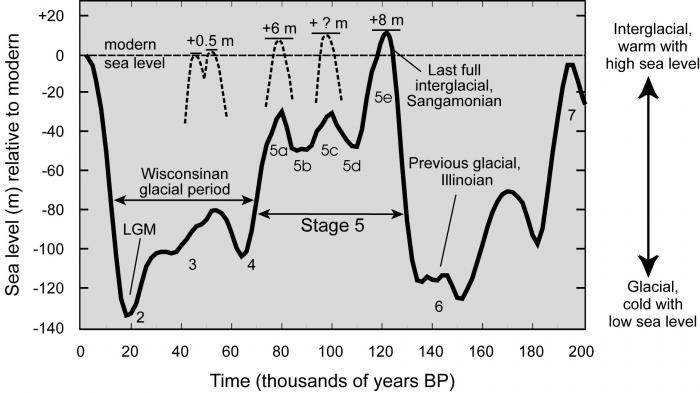
I have a friend who works for an environmental firm in California. They are specialists in identifying 50-100 year climate impact on new commercial construction. Every single project they've been working on for the past decade assumes within the next century there will be extensive sea-level rise wiping out most shorefront properties. He told me about it so glibly I didn't believe him, and he followed it up with: "oh yeah, every construction firm knows the coast is fucked, its common knowledge."
In 50 to 100 years we might have come up with a solution for coping with higher sea levels. Perhaps just elevated platforms to create an entire new city foundation 20 feet above the water. It’s not a big deal.
I think in 50 years we might be about as limited as we are today -- some technologies significantly (but not magically) improved, but much more restricted energy and material availability. We've undergone the greatest revolutions in history in the last century, and fundamentally building technology and energy usage isn't in a magical state compared to early 20th century. NY's Empire State was built in the 1930s. Roman buildings are better in some way than modern equivalents.
A significant sea level rise (>10m) would mean rebuilding the housing of >25% of US's population (~40% are living within 100km of the coast). Imagine 1 in 3 people needing to rebuild their homes. Because of our current mode of action, we're quickly approaching most environmental limits at the same time. If we assume availability and (inverse) cost is approximately proportional to natural reserves of a mineral, and that consumption is also approximately inversely related to cost, then most minerals are expected to deplete at similar times. That I know of, copper, several rare earth minerals, lithium, phosphor, and who knows what else.
Imagine the social shock this will bring, specially if current cultural, social and economic paradigms are maintained.
What is interesting to me is that we have the capability to do so much, but we always pass the buck to someone else and refuse to come together or take ownership of any problem that isn't beating down out front door.
It's never an issue with resources. It's an issue with community and leadership, and the refusal of the community to appoint leaders who lead.
Does this knowledge manifest in any way in the built environment? A lot of recent development in the Bay Area particularly has been below what should be considered a reasonable high water mark 50-100 years from today.
Most of the time the investors are adamant on building in a particular area, so it largely results in higher-elevation construction (think elevated freeways & roads), abandoning underground levels (parking, storage, dwelling), and heavily reinforced foundations.
Because people rich enough to buy coastal California real estate will be dead or in a nursing home by the time this happens. Or if they’re young, they have enough money that loosing a couple million is a cheap price to pay for living on the beach.
"Coastal real estate" in California is in no way endangered by sea level rise, being characterized by bluffs. Sea level rise imperils people who live along undesirable shores in places like Stockton and Newark and East Palo Alto.
It looks like with California beaches you typically don't have to go as far back to find higher ground than you do with say Florida beaches. From the pictures I've seen a lot of the beachfront houses are built one stilts, often with the back at the level of that higher ground behind the beach.
I don't think they built this was anticipating climate change--it was so if a bad combination of tides and storms pushed water far enough up the beach to reach where the house is it would be under the house instead of in the house. Nevertheless, it looks like a lot of these beachfront houses could take a meter or two of sea level rise and still be above water.
They'd have a lot less beach, so it would probably change the kind of person who wants to live in them, but it is quite possible that they would remain very desirable.
As far as things not actually on the beach goes, playing with the interactive sea level rise map from NOAA linked in kibwen's comment, it looks like there are a few places (such as the Long Beach area) where you get some extensive loss of land a ways in, but for most places on the Pacific coast it is just the beach itself that gets lost. It is more of a mixed bag for places not on the coast but on rivers or bodies of water connect to the coast.
Water is not simply a presence; it has weight, it has impact on everything. If the water level rises, it must have an impact on the coastline itself. Water might never reach the house, but it might make it impossible to maintain nonetheless.
The same reason places like Miami have a red hot market and construction is booming. People either can't fathom sea levels rising to the point of catastrophe, or they think a 50-100 year timeline is long enough to not really be relevant.
Miami Beach is one of the more precarious positions worldwide and the real estate market there is barely reacting to it with high elevations now commanding a slight premium over prior years even in poor areas. It looks like we collectively are only going to react after the fact even if some of us are worried about it individually.
Most condominiums built today using concrete-rebar construction will be torn down in the same timeframe. Concrete rebar has a lifetime of about 100 years, even when properly maintained.
But nobody buying a condo today looks at what the resale value will be in 50 years.
For institutional investors it will react maybe one quarter before it actually happens, and for retail it could continue even with their feet in water with good marketing.
His surprise is still reasonable, because as time goes on our information will get more precise. So, if this is true, you could buy today and then be unable to sell in 10 years as the market moves.
> A collapse of the entire glacier, which some researchers think is only centuries away, would raise global sea level by 65 centimeters. And because Thwaites occupies a deep basin into which neighboring glaciers would flow, its demise could eventually lead to the loss of the entire West Antarctic Ice Sheet, which locks up 3.3 meters of global sea level rise. “That would be a global change,” says Robert DeConto, a glaciologist at the University of Massachusetts, Amherst. “Our coastlines will look different from space.”
Fun ("fun") fact, the NOAA has a sea level rise map for the US, so you can see for yourself how this Florida-sized ice sheet impacts the real Florida's coastline.
Of course they won't. Relocating will create a lot more money than protecting. A protected city doesn't become more valuable, but higher land that I buy now for pennies will become prime coastal real estate by the end of the 21st century.
Mitigation is essentially always an option... no better how bad it is, it can almost always get worse, as the saying goes. Resignation is a very bad life strategy overall.
> In a worst case, this part of Thwaites could triple in speed, increasing the glacier’s contribution to global sea level in the short term to 5%, Pettit says.
...
> A collapse of the entire glacier, which some researchers think is only centuries away, would raise global sea level by 65 centimeters. And because Thwaites occupies a deep basin into which neighboring glaciers would flow, its demise could eventually lead to the loss of the entire West Antarctic Ice Sheet, which locks up 3.3 meters of global sea level rise.
So, in the short term this isn't an immediate danger to anyone. In the long term it is, but the trouble with long-term problems is that it's hard to get the political will do do anything. (That's assuming that anything can be done to stop it at this point.)
On the other hand: maybe it's just my imagination, but it seems like climate predictions are getting worse and catastrophes are approaching faster than just the normal passage of time would suggest. Maybe "only centuries away" will be revised down to "only a century away" and then "only decades away" as more information becomes available.
What can an individual do these days? I attempted to do my bit, I bought a e-car, I recycle, I try to write efficient code.. But the world my kid is getting is fucked, and while it'll impact me, nothing like what he's in for if I use a bit of imagination....
I sort of hope he doesn't have children, I'm already kinda depressed thinking about the kind of life mine will have, thinking about his, yeeeee. Maybe I'm just too much doom and gloom but..
Fuck, it's looking dark.
Is there really any hope? Can we stop ourselves, as we say in scotland, from "fucking it into a tree" ?
With leaders like Boris, Trump/Biden, Xi and co, Apparently we can't..
> What can an individual do these days? I attempted to do my bit, I bought a e-car, I recycle, I try to write efficient code.. But the world my kid is getting is fucked, and while it'll impact me, nothing like what he's in for if I use a bit of imagination....
Support legislations to tariffs imports and apply immigration quotas from countries that are not doing their part for the environment (emissions going up instead of down).
Recycling might not be as great as you think. 90%+ of the plastic in the oceans are coming directly from Asian rivers and countries that buy "raw" plastic from western countries in order to "recycle" it.
No one buys plastic from the US anymore. The plastic that's recycled in the US goes to a recycling facility that then pays the landfill to bury it with the other trash.
Plant trees. Specifically trees which bear some kind of crop. I've been focused on chestnuts. Keep planting them every year. Replace the ones that die from heat, cold, pestilence or storm to select for resilience.
Not only are mature trees a beautiful gift to the next generation but the yearly ritual of planting trees is and will be an important one to inculcate for our progeny if we hope for them to stay on this planet.
I mean, the way we're going now, an end is inevitable, but it always was.
But, are the number of years within the parameters that we, or I expected? Who knows, some of us are more optimistic about the future, and others less so.
The answer is almost always with collective action. As an individual, our impact or non-impact is very limited. Even if your individual consumption and impact turned to 0, in a world of 7.9 billion other individuals.
It's a big tragedy of the commons; this time, only coordination can save us. A shared responsibility. (practically) Everyone, and specially our leaders, need to be on the same page. Disasters will come all at once... we're depleting most minerals as well, pollution will only get worse, and so on.
For the lack of a better word, this is Nature's ""test"" to see if we have the ability to
1) Think on a global and collective level;
2) Value the future and not just the immediate present.
The default mode of the test is failure, and we seem quite likely to fail anyways. We have to fight very hard. I do believe if we could reach some kind of consensus and mutual enlightenment the technical and social challenge is not that frightening, and maybe we even have a good chance to become a proper space-faring civilization. It's important to be hopeful. A thousand years of a sustainable high technology civilization can achieve what might be approaching the limits of physics of our Universe -- and I'm quite confident colonizing even the galaxy is feasible in such a scenario.
My personal (idealistic, why not? ;) ) plan, my contribution, is to try to come up with a shared formalization of ethics most cultures/countries would accept (a sort of new version of human rights), which includes obvious stuff like valuing human life experience (and in general consciousness) as a primary target of our civilization. Recognizing we are all conscious individuals and so strict individualism is a silly, destructive paradigm, that truth can be well approximated and we can reason collectively towards a shared goal. I really want to prove it -- prove that significant divergences from such basic ethical systems are catastrophic or absurd -- thus we should all, regardless of other beliefs (or religions, or tastes), accept the basic premises and thus have a chance to not only survive, but to live well, to thrive.
My confidence in America's ability to come together to solve this approaches nil. I mean, we came together after 9/11 but that was primarily because we could bomb people on the other side of the world instead of making any real sacrifice for the greater good. When it came time to wear a piece of cloth on one's face or skip that night out when you've been near someone who tested positive for Covid, we failed because "muh freedoms".
Hopefully some other nation of importance will lead us to water AND make us drink.