> Genius said it found more than 100 examples of songs on Google that came from its site.
> In a statement, Google said the lyrics on its site, which pop up in little search-result squares called “information panels,” are licensed from partners, not created by Google... In 2016, Google partnered with LyricFind Inc., a Canadian company that secures deals with music publishers allowing companies such as Google to publish lyrics online.
So Google is properly licensing lyrics from song publishers and uses a third party to provide the lyrics, and somehow that third party wound up with more than a "hundred" -- not a million but a hundred -- that were copy-pasted from Genius at some point.
Except for the apostrophes thing being clever, this sounds like a complete non-issue? That Genius's issue is not with Google but the company they source from... AND that they'd have to prove a wholesale systematic copying (closer to millions of songs) as opposed to it being e.g. some rando employee who got lazy and took a shortcut one week?
I think Google are being deceptive here too. I find a lot of lyrics on Google that are mis-attributed and seem very unlikely to be correctly licensed.
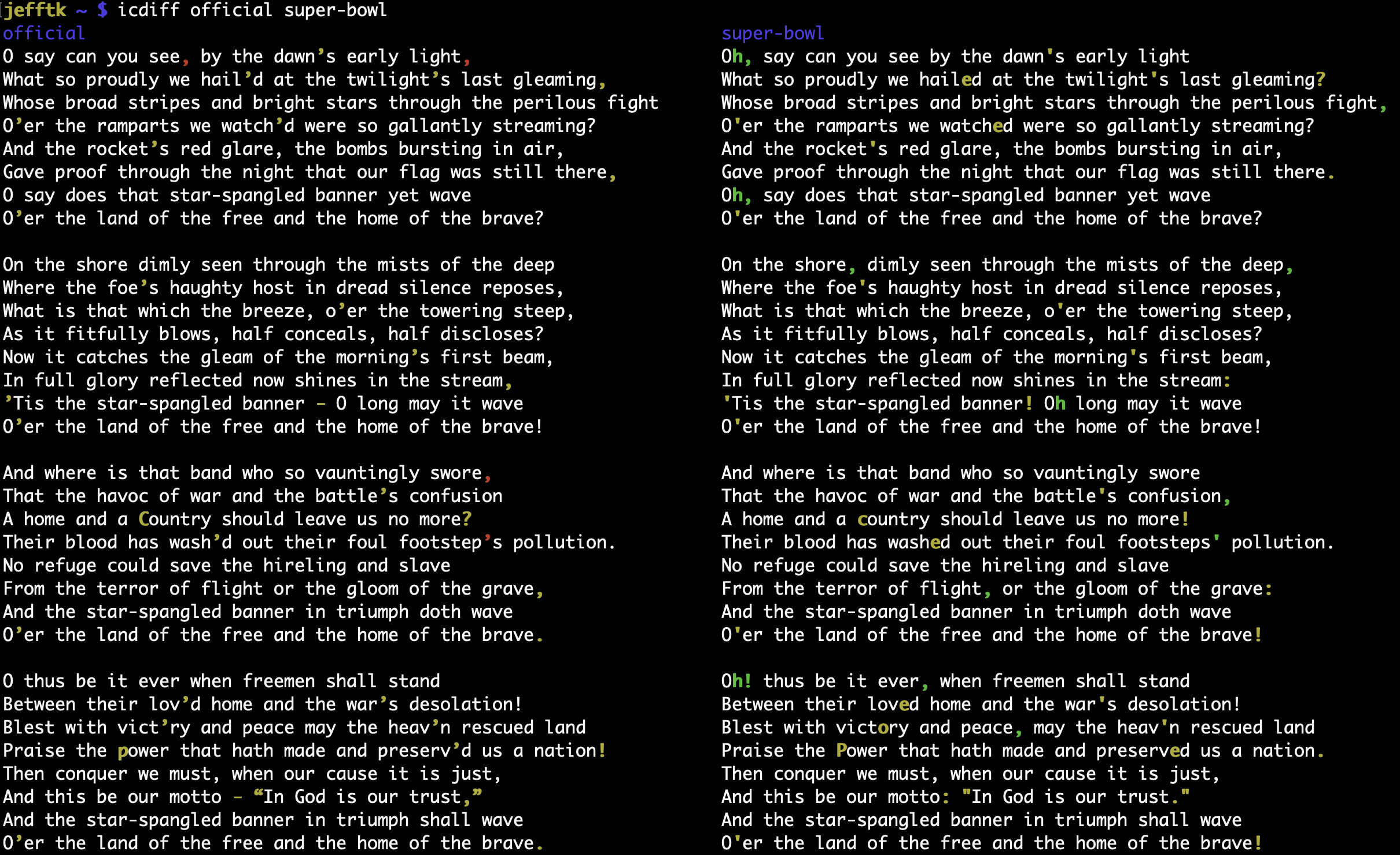
The best example is that Google claim that the copyright to the Star Spangled Banner, the National Anthem of the U.S.A., is owned by "Concord Music Publishing LLC". It's beyond parody.
Song-writers don't seem to have much of a say in their lyrics showing up on these sites, and are often not credited at all. This has been going on a long long time and getting it right doesn't seem to be a priority.
They're saying the lyrics come from the arrangement used for Super Bowl XXV, and that arrangement is copyright Concord Music Publishing. It would be better if they used the lyrics from the official public domain national anthem, but this isn't that weird.
Google are stating that the lyrics to the Star Spangled Banner are owned by Concord Music Publishing and are somehow derivative of the Super Bowl. That's just plain false, absolute misinformation.
It is obvious in this case that the information is wrong, but what of the many songs that Google misleads people into thinking are likewise locked up in rights? It's simply ridiculous on the face of it.
But merely performing a song doesn't give you any kind of monopoly whatsoever on the lyrics. Even arranging a song wouldn't give you copyright on the lyrics unless you substantially changed them. It is simply false that Concord Music Publishing LLC has copyright on the lyrics to "The Star Spangled Banner," even if these public domain lyrics were used in an arrangement controlled by that company.
Edit: Getting into the weeds a bit here, but I don't think performances themselves can be copyrighted (in the US, that is). Recordings can be copyrighted, as can musical compositions, lyrics, and subsequent arrangements. It is my understanding that, in order for something to be eligible for copyright, it must be fixed in a "tangible medium of expression."
It's also worth mentioning that music publishing companies generally control compositions, not recordings. But even supposing Concord Music Publishing has copyright on the arrangement used on that particular occasion, that does not imply they have copyright on the lyrics.
The article says it uses apostrophe fingerprinting... and a lot of songs have lots of apostrophes. Assuming just 4 apostrophes per song, there's only a 1/16 chance of it being an accidental match... but given that it's already quite unlikely for any text (including lyrics) to contain both types of apostrophes, practically speaking it's probably closer to a 1/100 or 1/1000 chance of false positives.
They should be able to accurately confirm whether hundreds of thousands of songs were taken from Genius, without any difficulty.
Unlikely. Official lyrics (printed in CD inserts, for example) often have punctuation mistakes, or they have no punctuation at all.
Unofficial lyrics can have the same words while still differing in punctuation, line breaks, capitalization, or spelling (since most languages have multiple ways to spell the same word -- color/colour, for example).
All the tiny variations could easily create a distinct fingerprint for each source of lyrics.
As an aside, Converge’s official lyrics include the phrase “soul survivors”. While it is almost certainly an error, it’s felt poetic to me, as if implying that suffering is an inevitable consequence of consciousness.
Genius does not appear to give a number on how many of their lyric pages had the hidden apostrophe codes, so we have no idea what the actual total count of copied songs is. I think the bigger issue is that Google denied having done anything wrong until this came under public attention, and there is no way for smaller companies to effectively pursue legal action against tech giants.
>“We take data quality and creator rights very seriously and hold our licensing partners accountable to the terms of our agreement,” Google said.
*when it comes under public scrutiny, otherwise we continue to profit from it as long as we can.
The same pattern you can use for any big company. Make some shady proxy one-day living pocket company, sign contract, let'em steal others IP, you are clear, ..., PROFIT!
I don't think that company even should know how their content will be used. For example if they just offer web-scraping service and provide raw data? For example for statistical analizes. And then Google publish this data as is on SERP and make money on adv. How is responsible in this case?
These guys are notorious for having stolen lyrics from other sites for many years and only licensing them after legal threats. Funny to see it all come full circle.
That sounds odd to me that any site would own the copyright to lyrics. Wouldnt that be the artist / record company's property?
The value add of Genius isnt so much in the lyrics but in the explanation and context given grom Genius. I have even seen actual artists confirm interpretations and explain some things as well I think Hittman from Dr. Dre's 2001 album was one such artist if I remember correctly.
I do see what you are saying on the other hand but I dont think that lyrics written down from a song are some random websites copyright / property.
I think the main value they add is working to agreggate all the lyrics into one site.
If Google is simply scraping that content from them without permission then that has been litigated many times in court and almost always comes out badly for the "scraper".
The same issue also comes up a lot when dealing with data that can't be copyrighted. For example stock quotes, sports statistics, and maps are all statements of fact and therefore no one can copyright them. However you still have to end up either gathering the information yourself or licensing it from a data provider. Simply scraping it off someone else who has already done one of those two is a quick way to get into legal trouble.
Google uses the lyrics to link you to Google Music, so they end up profiting from the content they scrapped.
Honestly if it was any small business doing this, there would be no harm, but considering Google can place themselves at the top of the search results for lyrics, then it is shady. They basically take Genius content, rank Genius low in the results and place themselves at the top.
I always hated this. It's been historically hard to get easy access to lyrics of songs you've bought! It always made no sense to me that you couldn't publish lyrics of songs.
I think legally you likely have not "bought" a song, you have licensed it. The license includes the right to listen to the song, but not to redistribute either the music or the lyrics.
"Ownership" such as it is for intellectual property is still with the copyright holder(s), which is why it makes sense that you don't have the same rights you would if it were truly "your" song.
To add a little nuance to this, there are two copyrights at play here, the song and the recording. The songwriter (who may or may not be one of the performers) originally owns the rights to the song, but often sells them to a publishing company. The lyrics pertain to the song. The recording is made with a mechanical license to the rights of the song, and a CD is distributed with a license to the recording (owned by the band, unless they recorded as a work-for-hire for their their record label, which is typical).
As a listener, you either own a physical product that happens to have been made with those licenses, or you're listening to a performance, if you're streaming. Neither of these things give you further rights with the song or recording.
This stuff is pretty wacky, and I may have some of those details wrong. I took a class in music industry law a decade ago
Maybe in the context of streaming, but when you buy a CD, AFAIK, you own the copy, but there are limits on what you can do with it because of copyright laws; Just because I own something, doesn’t mean I can make a copy and give it away. That
They’re also notorious for shady SEO practices that got them effectively de-listed a few years back too. The Genius/Google relationship has been rocky, to put it lightly.
Within the cesspool that is lyrics sites in general, Genius seems to be among the more ethical (At least they don't seem to engage in the common practice of showing search results for nonexistent lyrics).
I wonder how many companies Google has wounded/killed with their search infopanels. For example, yesterday I searched for “speedtest” expecting Ookla’s speedtest.net to be the top result. Nope, now it’s a one-click speed test offered by Google at the top. Great for users, devastating for the sites at the top of the SERPs.
Yellowpages and similar services proliferated about 10 years ago as way to capture passive AdSense revenue, but with many using outdated, incomplete, and often incorrect results. Those thousands of sites are now rendered unnecessary by Google's top box, street view, maps, menus, busy times, and other integrations. There is a clear path by which Google has arguably better served both search and advertising customers, at the expense of the publisher cost center, in this domain.
And someone else could better serve Google's customers by scraping their search results and infopanels and serving up the content without any ads or tracking.
Also, a company could better serve cable customers by recording all their content and stream it to customers charging a low monthly fee.
Neither of these are much different from Google's practices in regards to their info panels.
>And someone else could better serve Google's customers by scraping their search results and infopanels and serving up the content without any ads or tracking.
Unlike your second example, this example doesn't make any sense to me. The amount of effort and infrastructure required to do a decent job at this would surely make it at least as expensive as the way Google does it. How could this be cost-effective without ads? I imagine that the amount of people who'd be willing to pay for the same search results that they could get from Google is in the low single digits.
They're giving users what they want now. The reason we have antitrust laws is that unregulated free markets (i.e., "giving users what they want") have some well-known failure modes that produce happy customers and happy sellers until the entire market collapses and customers are no longer getting what they want.
Would you be satisfied if AOL bought out the internet, because that's what users wanted in the 1990s, and Google never had a chance to exist?
I am more sympathetic to google in this case as compared to others where the content provided is sourced by another company. In this case the "speed test" service is provided entirely by google as part of their search product, it doesn't rely on Ookla in some manner to power this service.
When your search "calculator" are you angry that Google displays its own web calculator before returning 3rd party results? These are simple utilities, and I don't see why it's bad for Google to offer is own. In fact for web tests it's more useful to me. Much of what I access is Google services, so testing latency and throughput to their servers is better for me.
> These are simple utilities, and I don't see why it's bad for Google to offer is own. In fact for web tests it's more useful to me. Much of what I access is Google services, so testing latency and throughput to their servers is better for me.
Small clarification: Google doesn't own the speed test. It owns the speed test client, but it performs the test against a third-party NDT server (an open-source server for bandwidth measurement)[1]. The servers are operated and maintained by M-Lab[2], a third-party consortium of companies of which Google is a member. The servers are all in commercial data centers and are completely separate from any Google service, so the speed test doesn't measure your bandwidth to Google.
> The web browser choice screen, also known as the web browser ballot box, was a screen displayed in Internet Explorer that offered ten to twelve browsers in a random order.
They aren't just doing it for simple utilities, they are literally trying to create some kind of "box" above search results for every possible query, subjective or objective. "Best movies of 2019", "What are the ingredients of pancakes?", the name of any store, restaurant, location, etc.
They are stealing the (often wrong) answers from the blogspam and putting it in their own box - how is that better? They should just filter out the blogspam - that’s ostensibly what a search engine company should be investing their time doing.
It’s slightly better to load the (often wrong) blogspam answers into a box than to link to the blogspam, although in doing so, it gives the wrong answer more authority. It’s much better to actually spend resources to filter blogspam from results and link to quality sites which have done actual research.
> Nothing wrong with that. (you are missing the /s) :)
Oligopoly is nearly as bad as Monopoly.
Τechnically once the big4 (plus a couple more) own the 99% of the traffic then we will have monopolies on each areas. Google on Search, Amazon on Shopping, Facebook on Socials, Apple on Phones.
And on the outer circle a parasitic ad/tracking ecosystem working with these 4 monopolies. I am not a pescimist, but as nightmare scenarios go, I take it that this is a plausible one.
There are just 4 companies that supply meat to all of US, there is just one company that supplies like half (or something in that range) of seeds, just 4-5 companies provide cable /internet services...
Monopoly is already a thing. A big part of the world is already controlled by just a handful of mega corporations and possibly just a few hundred ultra wealthy people. The internet is simply mirroring the real world :(
With all my respect to startups, I strongly believe that consumers should come first. If a large company can provide a cheaper/better service, then that should be encouraged.
As I see it, almost by definition, startups create their moment in the sun by finding blind-spots in the market. Fair play to the big companies who rise to the occasion and address these user needs once they've been pointed out.
We should not allow an economy where all of the gains from disruptive innovation are effectively subsumed under a few companies that take all the profit with no incentive to innovate on their own. We're already seeing the tech giants eat up every startup they can.
> I see nothing wrong with this, they are giving users what they want.
You're a very odd bird indeed if you think the vast majority of people want severely-biased search results, and for Google to unfairly leverage their search position to kill competition.
>You're a very odd bird indeed if you think the vast majority of people want severely-biased search results, and for Google to unfairly leverage their search position to kill competition.
In the case of the embedded speed test that pops up on Google vs. Oookla, it's not as simple as it might seem.
Google owns the JS widget that performs the test, but the backend server is owned and maintained by M-Lab, a third-party consortium (of which Google is a member).
It's a pretty neat project. The code is all open-source and the raw data of the speed tests is all publicly available and licensed under Creative Commons No Rights Reserved Zero Waiver:
It’s the power of Google as a portal to the internet and search engine; clearly it is a powerful position to have: Google can access demand for a service, and once it reaches a certain threshold decide to throw resources at creating their own version to keep you in their ecosystem.
I would like to know what Google team is in charge of using search trends to identify services to offer.
What does Google gain? Maybe some data, and that's probably what this is about, getting speed test data from lots of users. But revenue wise I don't think it gains anything and sties currently offering the service go out of business over night. Why go after Genius, well probably because it has some peripheral business interest like Google music which is benefiting from this behavior.
Google wants to keep users at google.com so it can keep showing them ads. Each time a user clicks away to speedtest.net or genius.com, that is a missed opportunity for revenue.
Except it's very likely that those 3rd party sites are monetized with Google AdWords. But I guess Google can make a bit more by cutting out the middle man.
~20 years ago some people were wondering what does Google gain from giving free service. The point is Google is trying to be the one stop shop for the whole internet no matter what you need.
Unfortunately I don't see anything changing for Google especially in the US where lobbying is such a cheap way to turn all legislation to their advantage.
I can see: speedtest indicates an interest in checking internet service which could lead to internet in Google Fiber in a particular region: assuming GF is still functioning. This is probably a stretch.
Yes, making a node that connects to another service seems like a goal.
Having a good idea of what kinds of internet speeds people have around the world is no doubt hugely useful for all sorts of things like planning Stadia[0]. But moreover, Google is a member of the M-Lab[1] project that runs the speedtest servers, so why not add the feature?
It's very similar to what Amazon does. They get information about demand for a certain product, and then make custom versions of the most popular third-party products sold on their site, competing directly with people who sell on their platform.
Well, to be fair if they were only surviving because of Google’s SERP listings... it sort of seems like a live by the sword: die by the sword situation.
If Google delisting your site destroys your business, there’s an argument to be made that they also created your business in the first place.
Mapmakers had a similar problem in the past, but the theft could be proven by creating data (“trap streets”) that didn’t exist. Sounds like Genius has been employing similar mechanisms and needs to proceed with legal remedies
Years ago I had one of the top Coin Tossing Apps on iOS. Google changed all that by answering a coin-toss search with an actual coin-toss. My mind was blown that I was actually competing with Google at that point...
Transcribing the lyrics yourself is kinda like writing the list of ingredients - it's a statement of fact. "The lyrics of this song are X."
Copying that effort from someone else, alternating apostrophes and all, is a bit different. In most cases, you can't prove that's what happened, but it's quite clear here.
Genius pays royalties for using the lyrics - if their own site is to believed (and why wouldn’t it?) they’ve struck deals with every major music publisher to license display of lyrics. I don't see how that's relevant to Google taking the rest of Genius's work (data entry/proofing/etc).
Maybe they do that now, but users used to at least to be able to add lyrics for any artist and song they wanted. There wasn't a license waiting period or anything before they went up.
Nobody is accusing Google of copying the annotations, just the lyrics.
Genius didn’t write them, and they didn’t even transcribe them as you point out.
I’m no Google fan in the context of ripping off competitors but Genius has a pretty shady history as well and it’s pretty hard to have sympathy for either of them.
The lyrics are user submitted so sometimes a user already transcribed them on one site and ports them over. Other times its just illogical to think some lyrics site owns copyrights to the transcription of a song. Now only one single site can have it perfectly transcribed and everyone else has to shift words around in order to make it a unique work worth copyrighting? What.
Crowdsourcing unpublished lyrics without permission is copyright infringement against the copyright owner of the lyrics--usually the songwriter or their publishing company.
One of the rights conferred by copyright is the right to not publish.
It's hard for me to imagine that the world would actually be a better place if you couldn't post the lyrics to a song without paying the rights holders or getting sued.
This is what baffles me the most. However if you are directly fetching them from someones servers you should at least provide attribution if you are wasting their resources.
You should provide more than that. It’s not just server resources but data entry and proofing and whatever else goes into making their product.
Genius pays royalties for using the lyrics - I don’t see why the fact that they don’t belong to Genius is relevant. If Amazon licenses a TV show that Netflix also licensed, it doesn’t give them the right to copy Netflix’s UI, descriptions, transcoded/edited video streams, etc.
The wikipedia info panels are particulary annoying, it seems pretty hard to find that actual link to the wiki article and I think they remove the wiki article from the main search results since it's now at the side.
I have noticed the opposite, that Googles lyrics are usually inaccurate and I assumed they were lifted from alternative sources than Genius. Just my experience, though.
It probably isn't Google though. They say they license and receive content from LyricFind Inc, which probably takes care of all the legal issues.
I'm guess that LyricFind got lawyers from all the major labels to sign licenses, but no one ever actually bothered to get the lyrics for them. Management probably told their tech people to just get them from wherever.
This seems pretty inane to me. Rightsholder licenses lyrics to both Genius and Google, Google copies lyric text from Genius. Seems like Genius shouldn't have a leg to stand on? (And even if they were technically right, they're wasting courts time and not actually achieving anything useful).
How is Genius.com in a position to make any claims on "its content" when said content is entirely the copyrighted works of various artists?
Just because the lyrics may be entered by users has no bearing on the fact that the lyrics are copyrighted works and that Genius.com doesn't own or have any rights to them. Just like doing a cover of another band's song doesn't mean you now own the song, reproducing and distributing a song's lyrics doesn't mean you now own the lyrics.
1) Google will apologize and remove genius.com from results
2) Traffic at genius will plummet
3) Genius will beg for mercy, and give Google full rights to all material
My experience has been the same, not once but many times. Often I consider the lyrics on Genius to be more accurate, to the point where I am in the habit of bypassing whatever Google tells me the lyrics are and searching directly for the former.
Frankly, what do they expect to gain here? A few thousands bucks? Even if Google is getting the lyrics from their site, it's not like they're irreplaceable. Seems like grasping at straws, and if I was an investor, I'd be worried.
Please don't use HN for political or ideological battle, or post flamebait. This is in the site guidelines: https://news.ycombinator.com/newsguidelines.html. Would you mind reviewing those rules and taking the spirit of this site more to heart when commenting here? The idea is to read what gratifies your curiosity and post from that place.
I see political and ideological posts all the time on HN. Sure most of them are of the progressive left wing variety, which seems perfectly fine with the mods. I don’t even think this post was all that flamebaity. Is anything I mentioned actually inaccurate? Is it the tone (which is simply a copy of the post I replied to)?
What made it flamebaity was the swerve to a partisan angle plus the snark plus the denunciatory rhetoric. You're right that the GP comment wasn't great either, but these things are all matters of degree and your reply was several degrees worse.
If you look more closely you'll notice that we moderate plenty of political and ideological posts of the progressive left wing variety. Perceptions of bias are distorted by a strong tendency everyone has to feel like their side is discriminated against while the side they dislike gets favored. I've written a ton about this if you or anyone want further explanation:
"You can opt out of featured snippets by preventing snippets on your page using the <meta name="googlebot" content="nosnippet"> tag on your page. This will remove all snippets on your page, including those in regular search results."
The WSJ also comments that rap genius does not have rights here - full disclosure I am an investor in Hipgnosis (SONG) - I trust Rap genius are paying them correctly.
The snippets aren't coming (directly) from Genius, though.
> In a statement, Google said the lyrics on its site, which pop up in little search-result squares called “information panels,” are licensed from partners, not created by Google.
> In 2016, Google partnered with LyricFind Inc., a Canadian company that secures deals with music publishers allowing companies such as Google to publish lyrics online.
The meta tag would have no effect. One of Google's vendors is stealing from Genius, not Google directly.
And have never heard of google licencing position 0 snippets before. And in the UK I see the actual song writers and publishers credited which is sort of what I would expect


> In a statement, Google said the lyrics on its site, which pop up in little search-result squares called “information panels,” are licensed from partners, not created by Google... In 2016, Google partnered with LyricFind Inc., a Canadian company that secures deals with music publishers allowing companies such as Google to publish lyrics online.
So Google is properly licensing lyrics from song publishers and uses a third party to provide the lyrics, and somehow that third party wound up with more than a "hundred" -- not a million but a hundred -- that were copy-pasted from Genius at some point.
Except for the apostrophes thing being clever, this sounds like a complete non-issue? That Genius's issue is not with Google but the company they source from... AND that they'd have to prove a wholesale systematic copying (closer to millions of songs) as opposed to it being e.g. some rando employee who got lazy and took a shortcut one week?