While attempting to refute the idea that the poor haven't improved their station since the 70s, they cite a lot of stats that show most households make more income than their parents did (inflation adjusted), but they completely neglect to account for the huge factor that is the number of people working (or cumulative hours worked) per household in order to achieve that improvement. In the 1970s, there were a lot more single-income households. The new standard of multi-income households, I expect, entirely accounts for any gains made by the lower income quintiles of people.
They also likely use inflation statistics that are problematic, at best.
When considering consumables, we've had pretty reasonable inflation and people are making more than their parents. But if you were to calculate inflation based on prices for things that don't benefit from advances in our production abilities (commodities, equities, housing, education, health care, etc), we'd be making nowhere near as much as previous generations when adjusted for inflation using that calculation.
Affording a car, TV, computer and food to feed ourselves isn't that difficult for many people. It's the life-altering purchases that are slipping farther and farther from the reach of the middle class.
Exactly. Low inflation doesn't help much if your salary increases get eaten up by housing, education hand healthcare. Rent, health care and education should be counted into inflation numbers.
The inflation rate does include rent, or "imputed rent" for home owners. However, it's an average of what people actually pay, including people who somehow got a sweet deal on housing costs, through rent control or buying their house a long time ago or whatever. It's not going to match the prices you see advertised when you're looking to move.
That not accurate because important information about the spatial distribution gets filtered out. Economists are pretending their statistics are filtering out 'noise' when they are really filtering out data they don't want people to see.
Inflation is an average. Newspapers usually report the national average, but there are a lot of other averages and they aren't being kept secret. This page has data for California:
The problem is while other statistics exist in practice policy makers, political leaders, businessmen, and economists in general have come ignore them. Rather than believing some small brained primate on the internet, here is Paul Volcker saying the same thing.
Another way to put it is that housing costs used to calculate inflation will lag market prices, because the cost is often locked in for a while. When prices go up, people often don't immediately start paying the new price.
They may factor those things in, but that doesn't mean they factor them in correctly or that their calculation ends up matching the realities of many middle-class people these days. From medical-illness-caused bankruptcies to crippling student loan debt to declining home ownership (by equity and age of first purchase), there are common realities that don't mesh with the CPI statistics that are calculated/released. You can argue that the CPI deals with averages and for every horror story of un-repayable student loan, savings-zapping cancer or hot housing market that makes purchasing a pipe dream for the majority of residents there are people who graduate college, get a job that pays well enough to repay their loans in time to save up and buy a home before starting a family and avoiding serious illnesses, but then is that statistic really useful in the face of so many people struggling?
At a certain point, enough individual incedences of a problem becomes far more than isolated incidents and graduates to a problem for society.
This brings up a great point that many people overlook: Inflation is hyper-specific to the consumer.
If the price of bread (and only the price of bread) went up 10x in price, then only consumers of bread would really be affected by it. You could argue all the hands that "touch" the bread, yes, but in the end the person paying $40 for a loaf of bread is actually affected by the inflation of it; for them to consider "inflation" in the large sense to have screwed them over.
Similarly, people without student loan debt (or over-burdening student loan debt) couldn't really give two shits about the inflation of SLD.
For me, guitars are a big deal. And I bring that up because there's a regulation now that effectively bans a type of wood used for guitars for centuries. If I were to want to buy a guitar with this type of wood that already exists, the price of it would be super inflated as the remaining safe-to-buy stock are grabbed up. This certainly only affects guitarists who favor a certain kind of tonewood; but is akin to my bread example above in demand/price.
I am not an expert but the way I have read about is that they also factor in better quality of items so even if your car costs 10000 more it's not counted as inflation because it's a better car compared to years ago and therefore has more value. I think the same is going on in health care and other areas. And excluding house prices is also a very questionable.
Yes, it's Hedonic Quality Adjustment [1]. If you follow through the example on the link, you see the negative CPI component, even though a) you can't actually buy the old version anymore - so you can't reap the "real" price benefit and b) the subjective experience ultimately for lots of these things is the same. i.e. a mid-level TV from 40 years ago probably gave the same hedonistic pleasure as one today. Arguably the older one gave more because of less other gadgets!
Also note that when you're a single earner household you may only need 1 car, eat out less, and don't need day care. Even if the cost of all those items remains the same, your cost of "living" goes up. Now add to that the need for education to maintain an "average" salary, and your costs increase faster than inflation to stay with the average.
They may not be calculating housing costs correctly.
For example, in Toronto house prices have seemed to go crazy. Industry reports agree. However housing inflation in Toronto measured by Statistics Canada does not show that.
Has anyone else noticed this or have an explanation? It's very strange.
I think Shiller's work was useful because housing prices (if I'm not mistaken) are not part of CPI.
Housing prices go into much bigger bubbles than rent. If interest rates go up or down, it doesn't very much affect the average person's ability to pay rent. But it has a huge impact on how much the average person can borrow.
My understanding for the reason that housing prices aren't included in CPI is because nobody buys houses in cash. So including mortgage payments in theory makes sense -- but it' tricky -- because everyone's mortgage originated at different times and under different circumstances.
I think my original statement was wrong, but I may have misheard what he told me. Looking up references on housing and CPI I see a lot about how the housing component gives bad signal -- it was rising during the 2008 crash for example. It's easy to see how it lags since people usually only buy at multi-year intervals.
> My understanding for the reason that housing prices aren't included in CPI is because nobody buys houses in cash
But they should include the sale value of houses in CPI, otherwise its pointless. Just because the vast majority of people buy houses with a mortgage doesn't mean the sale price isn't a real price
They are. The BLS puts together a 'market basket' that includes those items. However, it is the proportion that matters. Necessities like rent and healthcare are a larger proportions of expenses for the poor than they are for the middle and upper classes. When the market basket is created it takes consideration of everyone's expenses and so the weighting for healthcare costs say, falls below what it is that poor people spend on average and above what rich people spend on average (as a percent). Because these are a few of the spending categories that are inflating the fastest it is in this way that the CPI understates inflation for the poor and overstates it for the rich.
Recently read someone also making an observation that smoothed statistics are hiding that 'life event' expenses hit all at once and threaten every last bit of accumulated savings.
Have a baby and either daycare or one spouse off work for a couple of years. Main bread winner out of work for a year. Sending kids to college. Parents need support or assisted living. Major illness. End of like expenses.
That is interesting. I confirmed those numbers looking at the actual census data. The changes you mention are much less pronounced if you remove no-income households from the data though. Perhaps no-income households should be included in the 2 or more stat - since one could make a case for that category being the people who "gave up" because they couldn't keep up with expenses. I wonder what other things might be unaccounted for that could make the data "seem" this way - or perhaps my anecdata is just wrong. Also, the data doesn't go back further than 1980. I wonder what it would show if we had it back to 1970.
[Edit] Just another thought - that data does not break down the households into percentiles for total household income. I would expect that the fraction of multi and no income households w.r.t. total households has increased more on the lower income side of the spectrum than the middle/upper end. It also doesn't account for how much each earner brings in - which is related to the weekly hours stat in your source - I'd expect this to be even more influenced by accounting for income quintiles (or quartiles).
I wonder if those single income households include maintenance and alimony. The nature of families has changed significantly since the 1970s with more divorce and more children being raised in one parent households. I doubt the single parent receiving money from the estranged parent is counted as a two earner household, even though in some senses it is.
Once you add the changing rate of marriage, increase in single person households since the 70s, and the fact that real inflation often varies depending on which income quintile you're in, I don't think enough data is available to let you pick it apart meaningfully. So we're left trading anecdotes or stats with gaps. :)
The number of traditionally shaped families, i.e. mum, dad, and 2.2 children has plummeted since the 70s and the number of singles, with or without children has rocketed from both increasing separation and later entry into relationships.
I'm in agreement with your main point, that it's far harder for a single earner family to thrive now than in the past. I doubt I can cite that in any sensible way.
But has it changed in recent years? Anecdotally, I was born in 1983 and when I was growing up in the 90s single-parents & working-mothers were already common.
>the number of 2 or more income households has actually fallen
Where in your citation is this claim supported? The /percentage/ has fallen which could either mean that the number has fallen or that the total population increase at a faster pace than the number.
The biggest manipulation is they divide household income by the square of household size, which makes the bigger families of the 60’s seem to earn a lot less than they did. The whole thing is based on two studies funded by the same institute based on the same biased dataset, and diving into how they get their numbers is enlightening.
Ugh, which may be completely missing the causality. I’d argue that many people are having fewer kids (smaller households) soecifically because raising them has become so expensive.
That, to me, is what really seals it all as ridiculous. My parents had the standard of living they had with only my father working and in a fairly normal government job.
That as enough to support my mom and 2 children while also saving for retirement.
That standard of living now would require both parents working and being rather successful in their white collar careers. Even as a reasonably successful person in an advantaged field (tech), I can't imagine supporting an entire family.
If you cut out everything we have they didn't - cable TV, Netflix, computers, internet, cafes, restaurants, Kindle, better choices in grocery food and alcohol - and ate the sort of cheap food people lived on, things like meatloaf and crappy ingredient dishes, I reckon it would be entirely possible.
The only thing that is prohibitively expensive today vs 1980 is housing. The reasons for that are multiple, but mostly NIMBYism.
A quick look at education numbers finds that, since 1988, the cost of private four year college has doubled (in inflation-adjusted dollars), and the cost of state four year college has tripled.
Again in constant dollars, health care has seen a more than fivefold increase since 1970, from under $2000 to over $10,000 per capita. Constant dollars, mind you.
Health care and education costs are more or less fixed and unavoidable. They're more like fees than taxes, flat no matter the income.
Health care in the US costs twice as much as any other modernized nation, for worse results in many key measures (particularly no universal coverage, and high financial risk to individuals even with good insurance).
It's interesting when you imagine the other person is doing cooking, grocery shopping, child care, etc - doing the things you pay an app an inflated price to do for you.
However, it's housing - in the bay area in particular - that makes it look very impossible. For a relatively modest 1 BR apartment in SF, I'm paying close to half my after tax, after-401(k) take home, as a senior engineer doing relatively well.
If I'd need to pay 50% more to have a 2BR (at a minimum) for a wife and a child or two, that leaves a very small amount (for what's now twice as many people) to live on; roughly 10% of my base salary. It looks nearly impossible.
If you are extremely frugal (no restaurants, no vacations), if you get really lucky in finding housing, and most of all if there are no big surprise expenses (e.g. medical ones), MAYBE.
But none of those caveats applied in the case of my father; his standard of living was higher than mine is now.
Of course, if I were to move to another market, it's quite possible. I might take a 20% pay cut but if real estate is a third the cost than suddenly it doesn't seem like an impossible scaling issue that it currently is. I might even be able to afford a car.
Yes, outside wandering has been replaced with, "here's an iPad".
But if you're talking about any sort of instruction I'd say the prices have tripled. If you're talking about something like organized hockey? Prices are astronomical.
Hockey is not a good measure of kids activities. Not really common outside of the north, and wayyyy more expensive than most other sports.
Kids basketball consists of 1) kid. 2) shoes. 3) ball. And you only need 1 ball per group of kids. Ditto for soccer (futbol) A jersey is optional.
Hockey requires a bunch of pads which will be changed out every year or two as the kid gets bigger. Hopefully they have a sibling that can make use of them otherwise it's a sunk cost. Then there are broken sticks, broken teeth, hockey bags, ice time -- non-trvial -- and it adds up.
Assume $120 annually for Netflix. A cost almost everyone assumes now, and most people have (58M subscribers in the US/~120M households in the US). $120 compounded yearly at an 8% rate over 18 years is almost ~$5k. Depending on the year attended that's anywhere between 2/3 years of a degree and half of a semester at a public institution (in today's dollars).
Point is, it all adds up. And taking your example; the most expensive things we spend money on are also inflating at an abnormally high rate. The money has to come from somewhere, and when it's leaking out $10/month at a time, it's sometimes hard to find and easy to overlook.
Another problem is that discretionary spending as a percent of household expenses went down over the same period. Households are much less financially secure than they used to be as a result.
In the 1970s, a single income household could more or less make ends meet when the primary bread winner couldn't work. The other spouse would find a job, the household would consume however much less, and life continued.
Nowadays, it's not unheard of for non-discretionary spending (mortgage or rent, other loans, taxes, health insurance, etc.) to constitute over half of a household's spending. If either of the two spouses can't work, things can rapidly go to hell.
Some things have become more difficult since then too. Free range parenting is very frowned upon - and micro-managing kids takes a lot of time and effort.
That is not needed the way washing cloth and ironing was. Which is why the micromanagement trends are not domain of working classes as much as upper classes.
Micromanaged kids don't need parent at home a lot of it is outsourced to schools and clubs. And parent at home wishing to be needed or useful may be contributing to the perceived need for micromanagement (plus those who want women at home for emotional or ideological reasons want to see all that mecessary).
I have four kids and several friends with kids, and I can tell you that the amount of effort+time it takes to not get CPS called on you (depending on where you live) can be very substantial.
Is this actually true, though? Do you have cases you can point to which establish that lower bound (parents who have had CPS called and CPS actually did something) or is this just the normal evolution of keeping up with the Joneses.
The reason I ask is that I hear this sentiment from parents a lot, and I got curious so I talked with actual CPS officials who laughed heartily at the things the parents thought.
Out of curiosity, what does get CPS called on you in your area? Second question: how much of it is a need of the child and how much serves more of "social mores controll" function?
For the record, I don't actually want to return to 1970 standards. However, I suspect that the extreme micromanagement has multiple reasons, but child's needs are not really the driver.
I agree with your last point. Anecdotally, as a kid I hated having a full schedule of mandatory activities, constant regiment, always getting ready. My friends who were the most stressed and unhappy were the ones with the most extracurricular responsibilities. Yet their parents were always pleased that they took on 4 AP classes, did 3 seasons of sports, lead role in the play, stem program after classes, etc. just to build up a college resume rather than improve a child’s happiness.
Before kids were staying up late playing video games, they were staying up late with a comic book. I think there’s a fallacy in this notion that technology has changed how much time is spent by a child being productive or not. The medium might have changed, but I expect the mean amount of time goofing off (be it book, radio, tv, video game, or internet) to be constant throughout generations of children and teenagers.
Wouldn't this be addressed by the fact that, as you said, we now have a new standard of multi-income households?
If everyone in America was in a single-income household, and then we all became, for instance, two-income households, wouldn't it make sense for individual incomes to drop by half?
Yes, exactly, and that shouldn't be a factor in the argument that wages are decreasing because the rich are capturing all economic gains. Looking at household income can (very roughly) remove that from factoring into the data.
Only if GDP remained constant. Inflation-adjusted GDP increase from ~5 trillion in the 70's to ~18 trillion today. Much larger than 2x, and not every household is dual-income.
Wouldn’t you want to adjust this for household growth too? Not saying it wouldn’t be larger than 2x, but population has grown and households I believe are growing even faster, so maybe it’s actually closer to 2x?
This is an astoundingly bad comparison if it's missing the point I think it's missing. It's arguing that the average person makes more than their parents by comparing household income. I searched the article a few times for a few keywords trying to make sure I hadn't missed anything, but I see no mention of number of wage earners per household.
All the rest, about "fringe benefits" and the conclusion that everything's not perfect because we still have excessive occupational licensing and minimum wages is just garbage hand-waving.
edit: I re-read it, and the panel data that shows the same income gains per cohort is not clear on how the data was gathered, but the Pew and Brookings data is CLEARLY household data, NOT individual data.
Splinter mentions "Some reasons for increased household-level income inequality include skill- biased technological change (Acemoglu, 2002), decreased marriage and employment rates (Larrimore, 2014), and the exclusion of employee benefits and government trans- fers from most income definitions (Burkhauser, Larrimore, and Simon, 2012; Auten and Splinter, 2018)."
So, he's discussing how decreased marriage rates might drive down household wages (increasing inequality, particularly among the poorer groups), but a quick command-F is not finding any mention of how the impact of these decreased marriage rates may be counterbalanced (and possibly/likely?) outweighed by increased total number of wage earners per household.
From past podcasts he doesn't see the problem with having two people working to get that gain while ignoring the individual stagnating/declining worker pay. That stance is not logical to me, but it seems to fit his view on the world.
Okay, so he's being intentionally misleading in this piece, rather than presenting an academic view.
I'm fine with that stance, too. He's welcome to argue that the average household is "better off" as long as he's willing to subtract the added costs this situation creates. Or you can calculate doing the reverse; calculate the value generated with a greater number of stay-at-home parents in the 70s, so that this opportunity cost is reflected in the numbers when a second earner enters the formal workforce. Then at least we're comparing apples to apples and we can see where we end up. It's totally possible those lower-income cohorts are better off now, but he hasn't attempted to prove it.
Also, it's a lie to present this as individuals earning more money unless you acknowledge that you're averaging individuals across households, and not comparing ACTUAL working individuals.. And admit that you're factoring in some number of individuals in the 70s earning $0 and some other number of individuals today earning $0.
Yeah, once two people are working you NEED more income. Often one of the two people working spends their entire paycheck on child care. You may also to speed more on cleaning, home and auto repair, as you will have less time to do those yourself. You may need to spend more on healthcare since there will be less time to work out and cook good meals. You may need to spend more on food as there will be less time to cook good meals.
The author Russ Roberts runs the EconTalk podcast and is a well respected economist/journalist/thinker in the field, definitely worth reading for a fair assessment.
Here he presents a few studies that go against general economic consensus popularized mainly by Piketty in "Capital in the 21st century" and through papers/writing by Krugman, Saez, Zucman, Stiglitz, etc. that most of the economic gains in the past 100 years have gone to a concentrated few owners of capital.
Roberts highlights a few studies that use panel data (same people tracked over time) instead of cross-section data (snapshots of different populations at different times) and show that 70% of children from low-income households generally earn more than their parents, and usually end up with about 2x more income (only 33% of high-income children earn more than their parents.)
Another study looks at people age 35-40 in 1987 and then how they did when they were 55-60 in 2007. Median income was down for the top 5%, middle quintile was up 27%, and bottom quintile median income rose 100%.
Basically - absolute mobility (how much people gain over time) is still decently healthy today in percentage terms in the US, but relative mobility (how easy it is to move between classes) is widening and the wealthy in 1980 still have a much higher income on average than the poor in 1980.
Also, the poor in 2014 were actually worse off than the poor in the 1980s which Roberts attributes to poor people reporting less income in 2014, that there could be more poor immigrants in 2014 with less education, and that 2014 could be an unrepresentative year.
Personally I don't buy Robert's "glass half full" argument, but I appreciate him bringing some panel data into the discussion to temper the prevailing economic narrative.
I think if he looked at studies that include wealth and net worth panel data, not just income, that account for assets such as homes, the results would be much much different.
> Here he presents a few studies that go against general economic consensus popularized mainly by Piketty in "Capital in the 21st century" and through papers/writing by Krugman, Saez, Zucman, Stiglitz, etc. that most of the economic gains in the past 100 years have gone to a concentrated few owners of capital.
> Basically - absolute mobility (how much people gain over time) is still decently healthy today in percentage terms in the US, but relative mobility (how easy it is to move between classes) is widening and the wealthy in 1980 still have a much higher income on average than the poor in 1980.
These are not at all in conflict. As you say, the studies he discusses are not related to, much less undermine, any of the arguments that Krugman/Saez/Zucman/Piketty are making. I don't see any reason why individual characteristics like absolute mobility should be used to measure the health or inequality of an overall economy. Income mobility is a different thing from concentration of wealth or inequality.
Agreed. I think he was trying to write a controversial piece to break free from the status quo thinking of "inequality is growing" but totally missed the forest for the trees in his conclusion.
Makes me wonder if he had an alternative agenda with this piece and question his economic analysis in general.
Also I think Roberts is on here under the username russroberts613, and responded to the comments in this thread 2 hours ago, so upvote him to get his opinion/rebuttal seen and seek him out if you have any questions
Russ' political views have been drifting steadily right over time so the data that he cherry picks regarding inflation, total household income, income inequality, is not surprising. I used to listen to his podcast pretty frequently to get a different perspective on econ but now it's pretty painful due to his increasing inability to see outside his own bubble.
There was a guest this summer who noted that unmarried and areligious people are "emasculated". The guest also received zero push-back while implying that immigrants were purposefully being directed by the government to avoid assimilation and that we should return to harsh methods for dealing with immigrants. Russ just let the whole statement slide by without comment.
Have conversations with difficult people, sure, but have a conversation, don't just let stuff like that slide by! Not sure how long I'll be subscribed if those attitudes keep receiving clear air.
> The author Russ Roberts runs the EconTalk podcast and is a well respected economist/journalist/thinker in the field, definitely worth reading for a fair assessment.
I am starting to wonder if there is such a thing. I can respect an academic who writes scientific papers for their peers to review. I can respect an academic who has opinions of the state of the world. I can't respect someone who mixes the two. If you write something for an audience that can't asses the validity of your statement you are deliberately deceiving people. I can't respect that.
There is a reason why Piketty's book is 700 pages and certainly enough, both good and bad, have been said about it already. He isn't adding anything apparently noteworthy here. How does a normal person begin to explore all the "facts and figures" presented in the article. and how do you figure out if it is even valid to the overall discussion? The answer is that you don't, and the author knows this. It is dishonest.
When Neil Degrasse Tyson says that we should explore space his argument isn't a bunch of statistics on how it would benefit humanity 23.95%, even though I am sure he could come up with some. That is because he has made a career out of teaching people about space and hoping they will share his excitement, rather than being a politician telling people what to think.
So no, I really don't understand why I should listen to Russ Roberts.
Correct me if I'm wrong, but is he trying to say that if a lower-to-middle-class person now makes $10K more than his parents (who made $40k combined), that somehow that is better than the wealthy person that now makes $10K less than his parents (who made $1.2m combined) ?
I think this deserves a "man on the street" survey to see which income most people would prefer...
Better is a very subjective term here, which was my point. The lower-to-middle class person is still subject to all kinds of economic issues that are of zero concern to the wealthy person.
The author Russ Roberts runs the EconTalk and is a well respected economist/journalist/thinker in the field, definitely worth reading for a fair assessment.
The thing one needs to understand about economics is that it's field where analysis and advocacy have never been separate. It's not just Marx and von Mises that were strong advocates of policy. Smith, Ricardo and Keynes had the favored policy and thus favored world view.
So being a respected economic commentator by itself isn't by itself a testament to objectivity.
The article is worth a glance but others here have to pointed to the serious methodological problems - following individuals falls victim to regression to mean, some poor can become wealth and some wealthy can become poor says nothing about the average gulf between the groups. Even more, if we have a society where the whole population is divided between wealthy and poor randomly, with each having a 1% of becoming wealthy and otherwise barely surviving, we might have a fair society but it would also be an extremely dysfunctional society (but know such fairness really could exist, so we're just left with the income inequality).
Further, One might say there's a complex debate that goes between economists, where the arguments are framed as "how do we measure this policy's impact on equity, well-being and etc" but where each debater has their own emphasis and measure of these things. One pole might be a grim state socialism while another pole might be a Nietzsche/Harry-Lime view that "the goal of a society is to produce five great men and if the majority must be destitute for this, so be it". It's easy to say "we should be in the middle" but the reality talk of middles essentially involves where each debater wants to claim the "Overton Window" is located and so incrementally move it.
He's a fellow at Stanford School of Economics and he's a typical academic...
Which is to say, that his articles must be taken independently. His opinions on other issues are not discussed, so it's easy to build a strawman about his other opinions.
That also means that we must point out the fact that this article is only a small subset of data, that really tells us only what the data was collected on.
Roberts is a fellow at the rightwing Hoover Institution, which like most rightwing think tanks gets significant funding from rightwing billionaires who have a particular ideological agenda.
Of all the academic types at rightwing think tanks like AEI, Heritage, Cato, Russ Roberts is probably the best. I like him. But this issue - wealth inequality- is core to rightwing interests.
The whole point of much of this analysis (and the videos shown) is that household income can be very misleading. But most if not all of the analyses I report on are for individuals over time. So changes in the number of earners are actually more of a problem for most of the gloomy studies that look at households by quintile. Incredibly, the proportion of households with two earners is LOWER in 2014 than in 1980 because of the large increase in households with one or no earners. Marriage is not nearly as common as it used to be. The data are here in Table H-12: https://www.census.gov/data/tables/time-series/demo/income-p...
I also would add as I did in the essay, that I am not claiming that everything is OK in the economy. I am trying to respond to the relentless claim that the rich got all the gains of the last few decades. It's simply not true. That doesn't mean everything is fine. But just figuring out what actually happened is surprisingly complicated. The people who claim that the economy is only helping the rich should be more nuanced.
I think it is generally well-understood that individuals more senior in their career have generally higher incomes. So, when it is stated that "the rich" are obtaining wealth gains, it is explicitly looking at structural changes rather than simply an earnings cycle for individuals continuing to be true. Your first sentence is "Adjusted for inflation, the US economy has more than doubled in real terms since 1975" -- but it was the case even in 1975 that there was absolute income mobility as one progressed in their career. So, your argument purports to disprove the relative mobility or inequality arguments of Saez/Piketty but in fact cannot.
That is why there is so much pushback on this piece of yours: because it appears to be attacking a strawman unrelated to real inequality in the system.
As you're no doubt aware, these kinds of analyses can be tricky when dealing with fat-tailed distributions, such as income. Using the median can hide exactly the kinds of large disparities that Piketty, et al, are talking about. Likewise, saying that 93% of the poor exceeded their parents' income while only 70% of the wealthy did so leaves out the most important number, which is the aggregate amount by which each group benefited.
I don't believe anyone has made the claim that the poor have gotten nothing; only that they have gotten a grossly disproportionate share of growth. Nothing in your article refutes that premise. Indeed, you seem to go out of your way to avoid actually addressing it directly.
> Incredibly, the proportion of households with two earners is LOWER in 2014 than in 1980 because of the large increase in households with one or no earners. Marriage is not nearly as common as it used to be. The data are here in Table H-12
That's interesting data.
However, one income supporting one person is very different from one income supporting 4+ people. Is there any reason why we shouldn't just use division (# earners/household size) here?
The gains have been looted by the healthcare providers. It is not uncommon for health coverage to exceed $2k/mo for a typical family of 4, that's $24k/year. The median US household income is $59k, so the total comp is $83k/year. See the gains now?
This absurd amount is not reflected in a paycheck and one may think "my job pays for it" but that is still your money.
This is correct. I dropped my "Affordable" Care Act plan in January when BCBS quoted a monthly principal increase from $696 to over $2200 for the Silver level plan my family of four had been enrolled in. We are young and healthy.
$2200 is monthly rent on a luxury condominium in Honolulu.
I asked the agent on the phone if he had children, and if he could afford such a plan. He replied that he could not.
Well thats just going to make health insurance more expensive for more people now isn't it? IIRC poor people get subsidised healthcare now so if the middle class workers aren't paying for healthcare... who is?
So do we see that in other countries without outrageous healthcare premiums? I don't know, but I'm sure there are examples of countries where a company won't be paying for that and causing one's wage to stagnate because of it.
We don't have those premiums in Australia, and many of us only have private healthcare because we get taxed more if we don't... because of the good public health system it's not required. Our payment is A$320 (US$230) for a family of 4.
But wages are still stagnant here.
AFAICT US employers cover healthcare because that's how it's historically set up, and that's now the expectation. So if they tried to pull back on paying it, even with the crazy increases, employees would walk.
Whereas here, health insurance has nothing to do with employment.
But in both our cases, there's little providing upward pressure on "direct" wages.
That is just one example, the truth is that American society has many such "middleman looters" which exploit the system for gain at the expense of the middle and working classes.
A few examples:
* Student loan industry / higher education debt
* Unaffordable housing and exploitative renting due to NIMBY building practices
* Police ticketing as a revenue stream for municipal tax authorities
All of this either didn't exist for their parents, or were not as severe. All of this adds up to a middle class which has significantly less than their parents.
Not to get all Marxist - but using IRA's/401k's to get labor to go all-in on the stock-market was one hell of a judo move by the American capital class.
A pension might have been swell if you planned on working at pan am for half a century. I can take my IRA anywhere. The worker is unshackled from the pension purse their employer dangled over their head to keep them complicit and loyal to the executive board for decades.
This. They're no longer tied to the employer in hopes of good retirement, they can instead shop around for raises/skills. Which is more money which can be self-invested back into the self-pension/401k. In 401k matching situations, this means more matched, too, instead of an arbitrary salary promise after retirement.
I do not have numbers for comparison of pension vs 401k/self-funded pension. Though I'd love to see what either gets you in similar contributions.
I had to reread your comment several times before I think I parsed it correctly. "Labor" is people, right? But not the same people as "The American Capital Class"?
Anyway, I'm pretty sure there are bond and cash options in most retirement accounts, if the stock market isn't your thing.
And my original comment wasn't really saying I'm happy about the rising costs of health care, just pointing out a small silver lining to it, or maybe just an idea of how to make it hurt less.
I think its fantastic both ways, it helps both sides close a gap. When you have a large divide between, then you get general intents to tax, seize and punish stocks. In argentina, whenever the stock market goes up 5% the marxist-left goes bonkers on all fronts saying the economy is tanking and workers are being robbed. Literally.
The whole thing he is explaining is just regression to the mean. Yes, if you take people who are currently rich and people who are currently poor, over time the poor will likely go up in income and the rich go down.
Using this as a counterpoint to accusations of the rich taking all the gains is like pointing out that a wealthy duke could only pass his whole dukedom to one of his children, and the others would have to make do with much less.
It is simultaneously true that the gains of the last few decades have largely gone to "those who are rich", and that the identities of "those who are rich" are not completely stable.
The whole thing he is explaining is just regression to the mean.
The author directly addresses this further down in the article. Regression to the mean is a possible explanation of the numbers he cites, but it doesn't refute the main point he's making, which is that some numbers suggest poor people capture more of the gains from economic growth than is widely thought.
This reads like research sponsored by a tobacco company showing that cigarettes are actually not that harmful.
I like how it frames the economy as this independent entity that we just sort of observe and hope for the best. Oh our divining rod produced these arbitrary statistics so the glass is half full guys!
In reality, though, the forces of human nature driving the economy don't change. Since the dawn of the surplus, there have always been a handful of kings and many serfs, and there probably always will be.
> Since the dawn of the surplus, there have always been a handful of kings and many serfs, and there probably always will be.
One thing is different though: the thralls of today possess costly devices that simultaneously entertain and surveil them, among other things. Past kings would never even have dreamed about that.
I think it's largely irrelevant. Do the kings of today have a harder or easier time maintaining the status quo? I think most changes and fluctuations there are more attributable to chance (i.e. mechanisms we don't understand) than our conscious efforts. The same devices that surveil can also empower, in the end it could be a wash. We change the world around us but I'm convinced there's a certain homeostasis to our social and cultural experience, at core we're having the same conversations and dealing with issues analogous to the ones they had 3000 years ago.
Past kings would have banned just possessing any inflammatory information. If Wikipedia was around 800 years ago and you, a serf, were caught using it, the king of England would have cut your head off in the city center, and the public would cheer and celebrate your death.
The income divide increasing int he past few decades is due to globalization. This much is obvious.
Many huge American companies have done super well as we move to a global economy - tech is a great example. There's more money to be made when you can start selling more iPhones to India and the development costs stay the same.
Whether this new global revenue wealth goes workers vs corporate pockets depends on the supply of labor. Does Apple mostly want to employ Americans? If so, these rich global companies need to compete for a limited supply of American workers - our salaries rise. Tech workers in the USA make much more money than other countries - we have many successful companies here all wanting American tech labor.
On the flip side , not all American labor falls under this category. If companies don't care if the labor is domestic or outsourced or immigration is easy (flexible supply), then American workers don't see much gain from these global companies making more global money - the new wealth is split between top American executives and developing countries..
Most companies fall into the latter category - which is why we've seen the income divide grow, the average American worker's wage stagnate, and developing countries wages grow.
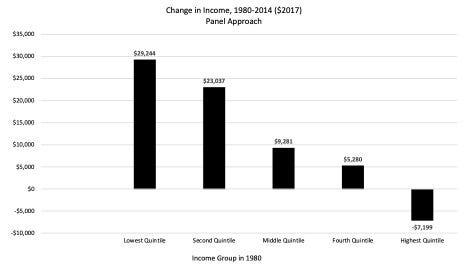
This bullshit article tries to paint a rosy picture of the economy by dismissing proportional median income gains between quintiles and instead argues that absolute income gains of individuals over time is enough evidence to suggest everything is actually great. This chart [1] seems to be the crux of their argument, as in - Surprise! Over 30 years poor people gained an average of almost $30k in income! I sure fucking hope someone who started at minimum wage in 1980 is making $30k more today.
And even though the median income of the top 1% went from $189,000 to $843,000 in that sime timeframe, that's not important because in our sample, the average income of those in the top QUINTILE actually FELL $7k. Guess you couldn't find any 1%ers for your study?
Bottom line - if the economy can't support a living wage for the working class, it's not doing all that great.
Thank you for writing this comment so that I don't feel like a crazy person after reading this article. It came across to me as so obviously flawed that it's hard to even apply Hanlon's Razor to it.
Not once does he mention of any correction for the obvious bias that people make different amounts at different points in their careers.
Using his exact same process, you could also show that the average height of Americans has increased significantly in the past thirty years, possibly up to a foot! Because, duh, people are shorter when they're kids.
If you're trying to measure how the economy is doing over time, you don't want panels, you want to compare equivalent people at different points in time. Comparing a 20 year old in 1980 to a 50 year old in 2010 confounds the differences between 1980 and 2010 with the differences between being 20 and being 50.
There are reasonable criticisms that identifying representative "equal" people over time is hard, but the author's solution seems dramatically worse than all of them.
One huge blind spot in using panel data over a 34 year period is that a lot of the people you are initially looking at are retired, and so do not typically pay as much tax or otherwise need to make the same amount of income to have the same standard of living.
From the article: "The study looks at people who were 35–40 in 1987 and then looks at how they were doing 20 years later, when they are 55–60. The median income of the people in the top 20% in 1987 ended up 5% lower twenty years later. The people in the middle 20% ended up with median income that was 27% higher. And if you started in the bottom 20%, your income doubled. If you were in the top 1% in 1987, 20 years later, median income was 29% lower."
In other words, regression to the mean. Of course the poorest people are more likely to gain in income -- when you start at the bottom, there's really only one direction you can go.
You can still have regression to the mean among individuals while society itself is becoming horrifyingly unequal.
"Of course the poorest people are more likely to gain in income -- when you start at the bottom, there's really only one direction you can go."
But doesn't this claim in itself refute the thesis that all the income gains are going to the top? If we find people at the bottom gaining income far faster than people at the top, which is what my quote claims, isn't that evidence that we live in a just society, not an unjust one?
Firstly as pointed out in other comments they were measuring income. People at higher incomes in the 80s were probably more likely to retire early or "on time". A more representative number would be wealth which I would imagine is probably horrifying in the vein that the parent and grandparent meant. People living hand to mouth in the 80s were probably doing the same in 2014. People who could save probably weren't.
Even just from the numbers presented imagine the lower percentile person who was making say 10k in constant dollars in the 80s. They're making 20k (100% increase) in same dollars in 2014.
Imagining the person in top was making 1,000,000 dollars in constant dollars they dropped 29% so they're now "only" making 750kish.
No, because what you’re measuring is rate of change vs volume. If you made $1 and now you make $2, that is 100% growth in income. If you made $1M and now make $1.2M that is 20% growth, but in absolute dollars you make way more.
Inequality isn't a problem.
Fairness is the problem when it comes to economic growth. People want to have a fair chance, not just one half taking all the benefits.
The fact that inequality exists is not the problem, it's the severity of the inequality that is the problem.
Take an extreme example - out of a population of 1000 people you have 1 person owning 99% of the wealth, with the other 1% distributed to the other 999. Does that seem like an efficient, properly operating economy to you?
Obviously there is some balancing needs to happen, the trick is figuring out where the fulcrum should sit for the most efficiency.
Inequality is great really. It incentivizes people to give extra effort for a reward. But gone too far, the efficiency of humanity will drop. There needs to be (and there probably is) shifts in wealth to keep things moving. Let's get those moon bases going.
Not from the article: people who were in the top quintile or 1% in 1987 are far more likely to have retired early than those in middle or bottom quintile. Tell me about their wealth, not their income.
> Surprise! Over 30 years poor people gained an average of almost $30k in income! I sure fucking hope someone who started at minimum wage in 1980 is making $30k more today.
Well this is an important part of his argument. The people's wages are not stagnant, but rather they went up an 30K (including inflation). That fact this their wages went up is not trivial.
But that's not a useful fact. People are going to get older regardless of what economic policy choices you make, so observing that people go through economic changes as they age isn't actionable.
By analogy, if you're trying to choose effective dietary policy, a study that shows people got taller over the past twenty years isn't helpful if you measure the same people. All it shows you is that children grow larger as they become adults.
What is the connection between aging and wages? Sure, most people make more money when they get older, but this was looking at ~40 to retirement when people are already at their peak earnings.
I wouldn't take it for granted that the older you are the more you make.
Imagine this: at one high school, there's a 80% literacy rate in the 2008 class. Then it drops to a 60% rate for the 2018 class.
Even if the 2008 cohort may now have a 90% literacy rate, that doesn't change the fact that the school is declining in literacy, and trying to argue otherwise verges on duplicitous.
I make less than I did as a junior engineer 18 years ago after accounting for inflation and COLA. Assuming my accumulated experience is worth nothing or I guess it apparently has negative value. Not all ships rise.
Was that large junior wage due to the 2000's cyber boom and was later readjusted to the new reality? Or has your wage actually remained stagnant / rose slower than inflation since that time?
It's supply and demand 101, illegal immigration combined with offshoring lowers wages and increases profit margin for the wealthy. Low wage jobs are taken by illegal immigrants, forcing US citizens to take on debt to go to college, where wages are also lowered because there are now thousands of college grads desperate to pay off their debt that can't be eliminated through bankruptcy due to congress being lobbied. A wonderful scam. Same thing with big tech companies pushing for more H1B to push down engineering wages and lower standard of living. This stuff shouldn't even be left vs right, it should be common sense.
Here's bernie sanders talking about how open boarders is pushed by the koch brothers to give them cheap labor
We're rapidly heading towards feudalism 2.0. You can already see it in the Bay Area(and essentially any major urban area) where only the wealthy can afford a home. The majority pay a large chunk of their income to their landlord
I'd like you to actually cite those claims you've made, because so far you've just repeated a lot of nonsense I hear from people that refuse to back up their arguments with empirical evidence.
Immigration is hardly the issue. Low-wage jobs exist because of the lack of labor protections for workers resulting in companies looking for the cheapest and most efficient labor they can, even if it means tapping desperate people who have no other options.
If you want to fix the problem, you start by increasing the minimum wage and having proper healthcare. Any other complaints about illegal immigration driving down wages is in my opinion deflection. Because if you remove illegal immigration, they'll just move to exploiting the next most vulnerable population (prison labor, people with disabilities etc)
My point is that we should be offering citizenship to these people instead of H1B, which is glorified indentured servitude that only benefits giant corporations. Not to mention the blatant fraud in hiring practices companies use to justify more, ie: nobody in the US has 15 years of experience with ReactJS, tensorflow, or another technology that hasn't even existed that long, so we need more visas.
If it was actually about getting talent and not driving down wages we would be giving these people citizenship.
even worse; absolute household income gains over time, not accounting for the increase in person-hours worked outside of the home, nor the corresponding increases in yard work, housekeeping, child care, meal preparation costs....
When you actually follow the same people, the poor see the greater increase in income than the most wealthy. You may poo-poo a $30K inflation-adjusted increase in pay, but that moves someone from the lower class to the middle class.
That's social mobility, not wage growth. Those are not the same thing.
It's akin to arguing that wage growth is looking at income of a person that was flipping burgers while in school 10 years ago now leads an engineering team.
It's not the same job, not the adequate comparison.
I presume you work in IT related field, so imagine you decided to take a break and be a parking lot attendant... You cannot then quote your own example as an instance of falling wages for IT workers.
You can't have social mobility without wage growth, so I'm not sure what you're getting at.
And it doesn't matter if it's not the same job. The argument has always been about opportunity and the key point of this article is for people who start out in the lowest income quintile, the average wages doubles over time.
But this isn't wage growth. When you switch between different socioeconomic profession groups, the wage of your previous socioeconomic group doesn't change because your wages have changed. Socioeconomic group isn't for life, you know. Once you become rich, you stop being poor.
Except that wage growth debate isn't about opportunity. He's trying to argue about oranges, when the initial issue is about apples.
Arguments about wage growth are about costs, productivity and compensation.
As in - if you're 2x more productive at doing the same job, then the gains are deposited somewhere.
The argument in the end is that productivity gains are not distributed at a fair level. Equal isn't ever a requirement for a stable society, fair is enough.
Yeah right? I read this and thought 'Yes, wealthy people stay quite wealthy throughout their lives, while poor people work their way into higher salaries.'
Adjusted for inflation, the US economy has more than doubled in real terms since 1975. How much of that growth has gone to the average person? According to many economists, the answer is close to zero.
First of all, the population has increased from around 200M to 325M. The inflation-adjusted economic output would have to increase by that same factor just to say the same per capita.
The problem with most economic analysis is that adjustments are generally based on arbitrary metrics like PPP or inflation.
If a child (or couple) in Britain earns three times as much, in "real" terms, that their parent (or parents) did at that stage of life, they will probably have to live in a smaller house, further from the center of town, with a worse commute.
Pretty much the biggest QoL improvements knocked out. The fact they can buy a few more toys or nicer food is not really that consequential.
Exactly. I probably earn 2X what my father made, inflation adjusted, when he was my age. Buuuut, I pay 5X what he paid for housing, 20X what he paid for healthcare, ∞X what he paid in student loans, have a commute 6X longer than his, live in a house 75% the size of his (he also had two houses at my age, by the way), work 1.25X his hours and have a crappy 401k rather than a nice defined-benefit pension. Comparing just salary misses the story.
Yes, they should, but they are not, and realistically cannot be.
Inflation statistics are almost useless in calculating quality of life for this reason.
They calculate an average over a population. An example of why this is silly, is that the average 40 year old both has lower personal inflation _and_ can weather inflation much more readily than the average 20 year old.
On top of the studies within the article, there are other really interesting papers. Some time back I was searching information on the chiseling out of the middle class, and I found this paper [1]. And the paper does describe that chiseling out. In 1979 the middle class controlled 46% of all income, and the upper/rich classes controlled 30%. Today (as of 2014) the rich and upper class control 63% with the middle class left with 26%. There's even been a chiseling out of the middle class as a whole declining from 38.8% of society to 32% of society. That's where most media outlets leave it. It sounds grim.
But the eye opener is this. This is the change in the size of each economic group between 1979 and 2014 as a percent of the total population:
- Rich: 0.1% -> 1.8%
- Upper Middle Class: 12.9% -> 29.4%
- Middle Class: 38.8% -> 32%
- Lower Middle Class: 23.9% -> 17.1%
- Poor or Near-Poor: 24.3% -> 19.8%
Statistics like this are certainly subject to biased interpretation and 'massaging'. If one is curious about the source, wiki has a section on the political stance of the Urban Institute [2]. Though the paper itself is very transparent in their methodology and extremely readable. I found it all eye opening to the point that it literally changed my worldview. This change is only since 1979! We are doing something incredibly right from an economic point of view. I don't understand the media motivations in choosing to omit these crucial, and greatly encouraging, data when writing on this topic.
I'm more curious as to why you chose to omit the critically important data behind the study. What exactly is your motivation there?
First, let's look at how they define the income brackets:
-Poor and near-poor $0 $29,999
-Lower middle class $30,000 $49,999
-Middle class $50,000 $99,999
-Upper middle class $100,000 $349,999
-Rich $350,000 None
A quote from the publication: "The study did not adjust for regional differences in the cost of living, the underreporting and
exclusion of certain sources of material support, or taxes."
As with all statistics it is incredibly easy to look at one and yell out 'The economy is doing FINE!' while ignoring the economic realities for many people. Income levels may rise, but the average costs for middle-class workers has skyrocketed as well. Someone living in SF earning over 100k would count as upper-middle despite likely barely being able to survive.
Indeed. And similarly, as the paper mentions, there are many places in the US where someone earning just under $100k would only be counted as middle class, even though they'd be well into the upper middle class. So the important question then is there a big bias in one direction or another? The paper concludes that the answer to this is no.
So why would they use such an ostensibly broad metric in the first place? The paper also goes into this. The reason is that on a micro level there are often extreme quality of living differences that are not accurately reflected by any data. For instance the CPI inflation rate of San Francisco, according to California, is only 11% higher than the US average. By any metric you'll be able to point to various little bubbles throughout the nation and indicate, accurately, that the macro level data does not hold true.
So you need to try to pick aggregate data that most likely balances out the biases so much as possible. Do you think this fails to do so?
This is the change in the size of each economic group between 1979 and 2014 as a percent of the total population
Then aren't your numbers a positive sign? The size of the poor, lower middle class and middle class have shrank and the upper middle and rich have grown.
Doesn't that suggest that people are generally moving up in economic class?
There's a popular book called "Factfulness" that explores the dynamic you're describing: the world is generally getting better and the media is institutionally incapable of reporting it (because they thrive on sensation instead of facts).
If you are swayed by facts and data, it's probably right up your alley.
Yep. I read the definitions... And boy are these people LAAAAZZYYYYYY!!! They could actually scale the data and compare adequate areas. I mean... California is 20% of the population and has median income 20% higher than average across US. But sure... 200k earning family of two in NYC, Bay Area, Seattle, DC are Upper Middle Class apparently.
I mean... Read this bullshit! Washington DC is 3x more populous that Des Moines, even in 2016.
"However, inaccurately placing people from Washington, DC, as upper middle class because they have incomes just above $100,000, even though they have high local costs and would not generally be considered as being upper middle class in that location, is offset by categorizing Des Moines, IA, families with incomes just below $100,000 as being middle class, even though those families could be considered upper middle class because costs in their area are low."
I have nothing against this article.. its all analysis and information.. but is it just me or does it have very little to do with what we actually think of when we consider where the benefits have gone?
Where are the numbers on average expected spend, including spending expectations for disposable income. so that we get a reasonable idea of someones saving power. and compare this to various income levels. We don't live in a vacuum and we all have to be living up to the expectations of those around us.
Also looking at social mobility, security to find a job etc. numbers are irrelevant freedoms are relevant.
If the poor earn lots more than the rich (in comparison to previous generations) do these days but rich people living expenses have not gone up and tax evasion has increased and the spending expectations on the poor have increased then I would still say the benefits have gone to the rich.
if the poor are still working 40 hour weeks and a few people are becoming so rich that if they reduced their income to millions per year that they could reduce average working hours to 30 hours per week i would still be hard pushed to say that the benefits were not being hoarded by the rich.
I don't know.. there are many ways to look at this but these numbers seem among the least relevant - like they have absolutely no causal link with the concerns that people have.
Are there any articles that go attempt to put numbers on some of these vaguer but more relevant things? i feel like even data with huge error bars could be very damning - or am i just naive and jealous of my parents :)?
- Income levels indicate practical income that market is willing to pay, therefore claiming that unreported income boosts poor people's income is bogus. Unreported income going into poor peoples pockets will not exceed median levels. It may shift what is considered median, but I absolutely disagree that all of that money drastically changes the state of poorer people.
- Adding up poorer people gains and saying that their gains are 70%, while rich people's gain are 33% is also misleading. Wealth transfer and accumulation is totally ignored by this.
Wages have stagnated is a technically incorrect statement. If you take wealth accumulation, you'll have to change the tune... Wealthy people become wealthier, at a rate considerably higher than the average individual.
Just mere tax "optimization" options are way more readily available for rich people, than to poor people. According to Warren Buffet - his taxes are lower even in relative terms, than his own secretary's. Which makes an employee's wage growth of 70% not even close to 33% of a rich person's.
If you look at that first report of increased family income, also in the referenced Pew report it says 59% of sons make as much or more then their fathers, which means 41% are doing worse. So 4 of every 10 sons does worse than his father in this time of economic growth.
Two more factors come into play. US working class stagnation started in the early 1970s and got going in the 1980s. The study starts in 1968, which means some of the growth pointed to for the children is actually what is kept from late 1960s and early 1970s growth, not now. If the study had started five years later, the results would look worse.
Also the politically influenced Boskin commission revised historical inflation estimates in the mid 1990s, also making things look rosier. If you believe, as I do, that inflation estimates were correct in 1996 and that Boskin was wrong, then things look bleaker in that light as well.
Although 4 in 10 sons doing worse than their fathers (from the Pew report he cites) is bleak enough.
If Ohio's steel industry grows by 500% who reaps the benefits? Me? The guy writing code in Portland, Oregon?
No... its pretty clear that a specific subset of people receive the benefits. The people who own the steel mill. The people who receive employment from the steel mill. The governments which tax the steel mill. But not me.
Economic growth isn't uniform. Its an uneven field that benefits some and not others. That's why people move and change jobs. That's why societies abandon old interests and embrace new interests.
I don't know why anyone should feel entitled to economic growth if they didn't participate in it in any way.
I think the thing that is at odds with this attitude is that more and more prevalently "The people who receive employment from the steel mill." don't actually benefit from 500% growth. Instead they might have 6 additional months of job security with little to no raises. And that job security isn't a favor it's because that's the amount of time those workers are needed to get through whatever contract and not any further. In other words, the absolute maximum profit the steel mill can make.
And of course your argument is on the side of the people that risked everything to start a steel mill. So yeah, it's a complex system - but that doesn't mean we have to shit on everyone else.
It's not "shitting on" anyone; it's how (efficient) economics works. You don't earn more money unless you're producing more value. If a steel mill increases its output by way of some new automation, the accounting department and janitorial staff are unlikely to see a wage increase. The folks on the assembly line are also unlikely to see a wage increase because they're not more productive. The people who will be principally rewarded are the people who developed (including investing) the automation.
In other words, as I understand it, economic rules aren't arbitrary--it's not like some cabal of mean rich guys is preventing us from flipping the switch that would make everyone obscenely rich (which is distinct from a cabal of mean rich guys _interfering_ with an economy to make themselves wealthy at the expense of the efficiency of the economy).
If you pursue "efficiency" to extremes like this, you're going to bump up against political and social realities that are going to ruin your efficiencies in ways that make giving pay increases seem like a no-brainer.
1. I don't think this is true in any meaningful capacity; it just means we need to find ways to keep a critical mass of people involved in productivity.
2. This is a different argument than the one to which I was responding (which seemed to be something like, "it's mean to have the opinion that economic systems reward productivity").
You cannot pursue "pure capitalism" to its logical end. Like "pure communism", it just ends in misery and suffering for everyone.
"Productivity" cannot be re-defined so that those that do the actual labor are removed from the equation. If a company or firm produces more revenue, than it's a simple value judgement as to how that revenue is distributed, and, right now, those at the top of company management and investors are the only people making that decision. Organizations like unions simply change how that decision is made by re-balancing the power involved with the decision. You may want to keep all of the revenue gains from your automation to yourself and your investors, but you may not be able to if it means that most of your workforce walks off the job. Likewise, you can automate your entire operations with robots and computers, but good luck trying to sell whatever it is you're producing when everyone is (effectively) unemployed.
Your comment seems to agree with mine. I’m not advocating for “pure capitalism”, and your “simple value judgment” (as described) is pure economic reasoning:
> You may want to keep all of the revenue gains from your automation to yourself and your investors, but you may not be able to if it means that most of your workforce walks off the job.
Which isn’t to say that it’s not a value judgment, but rather that an economy is made up of a sea of value judgments interoperating, though not all value judgments are sustainable or well-calculated.
Aren't the people running the new machines creating more value because the machines make them more productive?
If not, doesn't that suggest that it would be virtually impossible for average people to meaningfully improve their economic condition since any meaningful increases in productivity are almost certainly going to be a result of advances in technology?
Wages depend directly on the supply of and demand for labor, and only indirectly on the amount of value produced in an hour of labor. So if assembly line workers notice that coders are making tons of money, and so the assembly line workers move en masse away from assembly line work toward technical careers, then the factory owners would have to compensate the remaining assembly line workers higher since there is no longer a ready supply of competent labor ready to replace them. It would not even have to be that assembly line workers switch careers, just that the number of new workers entering the field declines as young people choose other, more lucrative career paths.
Unfortunately, it is quite difficult to make your way into a technical career without a significant investment in education and (I would argue) a certain personality type. So we aren't seeing thousands of people moving away from low-skill jobs into technical careers. The supply of labor for jobs like "warehouse worker" simply hasn't declined enough to offset the decline in demand (due to increased automation, outsourcing, structural changes, or whatever). The result is that those workers see lower wages. At the same time, compensation in technical careers seems a bit ridiculous: $200k to write Python for 35 hours a week? I've heard numbers like that thrown around - but companies still complain of a lack of qualified workers for those roles.
This is all just to say that the owners of capital aren't going to pass excess profits on to labor out of the goodness of their hearts, just as labor isn't going to work harder than the bare minimum required to keep getting their paycheck. But they might be forced to pay higher wages if they can't find good workers. If the structure of the economy changes so that some sectors are more productive, then the supply and demand of labor should shift to keep things from getting out of whack. That hasn't been happening in recent decades.
> It's not "shitting on" anyone; it's how (efficient) economics works. You don't earn more money unless you're producing more value. If a steel mill increases its output by way of some new automation, the accounting department and janitorial staff are unlikely to see a wage increase. The folks on the assembly line are also unlikely to see a wage increase because they're not more productive. The people who will be principally rewarded are the people who developed (including investing) the automation.
In your example, all the steel mill owners have to do to make more money is to passively own the steel mill while their employees work to improve it. If "efficient economics" works by compensating the people who create value, why are the passive owners getting most of the compensation? They're not creating any value. By your logic they probably should get less than the janitors and assembly line workers, who at least create some value.
You are battling with the century old fight about interests. What are interests at all.
You can read much argumentation from different economists across the ages about this topic. Hating interest is a very natural endeavor: it has been banned for long periods of time after all.
But economics has clarified that interests is just what you pay for opportunity cost. If you build a hammer, you can use it or loan it. And you can loan it for another new hammer in the future, plus, some value extra for not having it.
You could then, in the next period, loan the new hammer again. And so on, forever, without causing anyone harm, you can "passively" gain an income from your original investment. This is Bastiat's explanation of interest from the 1850's
> Good question! That’s the “investment” part. They risked the funds to create the value in the first place in exchange for returns on their investment.
That's not really an answer. You're just saying their entitled to the passive returns from ownership because they owned something else. It's circular. Anyone could take a risk with the funds if given access to them, even the janitors and line workers.
> You're just saying their entitled to the passive returns from ownership because they owned something else.
Not sure what you mean here, but I agree that investors are entitled to the returns stipulated in the investment agreement. Hopefully this isn't a controversial position.
> Anyone could take a risk with the funds if given access to them, even the janitors and line workers.
Yes, janitors and line workers can (and regularly do) invest their finances as well, frequently for the very company for which they work (although they are very likely not investing enough to be principal owners, because even very small companies tend to be very expensive relative to the average salary of a janitor or line worker).
> Not sure what you mean here, but I'm saying investors are entitled to the returns stipulated in the investment agreement.
You said "...(efficient) economics [means y]ou don't earn more money unless you're producing more value." However, an owner can be nearly completely idle yet still profit handsomely, by simply paying others a modest fee to increase her fortune, so your statement isn't really true.
I think you misunderstand investment. Enterprises are risky; someone has to lose money when they fail or otherwise lose value. Those people are investors. Employees can also be investors (e.g., employee owned companies or other arrangements in which employees buy stock in their companies). By definition, the people who get returns on investment are the investors. Buying risk (aka investment) is inherently valuable.
If you think employees should get returns on investment, then you're necessarily advocating for forcing them to take home less money and risking the difference on the performance of their company.
The good news is that many employees do invest in their own company or in other companies, and they're free to choose their investments such that they can tune the knobs of 'amount' and 'risk' to suit their personal goals.
I understand investment, I'm just telling you that your original statement is wrong. If you're an owner, you don't have to create any value to get paid. Mere ownership gets owners paid. Sure, they can actively invest if they want to, and they may be better off for it, but that kind of activity is strictly optional.
> If you're an owner, you don't have to create any value to get paid. Mere ownership gets owners paid. Sure, they can actively invest if they want to, and they may be better off for it, but that kind of activity is strictly optional.
This isn't true. Owners are investors by definition; owners are the sole investors in their companies. Like all investors, owners don't "get paid" unless they sell their shares at a higher price than they bought them. I'm not sure if you take issue with those definitions or if you're trying to nit-pick what it means to 'create value', but I'm pretty sure I've simplified this as much as I can. Good luck.
> Nearly completely idle, except for the part about building a whole new steel mill. That's... not very idle.
No one said they built it, just that they owned it. It's totally possible (and common!) to own something that you didn't build and have never had a hand in operating.
But lets say a new steel plant was built. Who actually built it? Was it the the owner, or the project managers, engineers, architects, construction crews, etc.? Which of these groups contributed more value to the enterprise?
All right, let me put it this way. Without the money, it doesn't get built. The project managers, engineers, architects, and construction crews (plus the steel workers' local) aren't going to have a bake sale and come up with the money. If there's going to be a steel mill, the owner has to do something - at least write the checks plus hire someone to be the general contractor, and someone else to be the plant manager once it's built.
And the owner has to have at least a reasonable chance of getting paid back for their investment. They're not building a steel mill as a charity. So if you don't let the owners make money off of their steel mills, then you don't get any steel mills. Whose life does that make better?
[Edit: And letting the owner make as much as the janitor isn't going to cut it. The owner is putting in hundreds of millions of dollars; letting them get back $15/hour is a completely inadequate return for the level of risk they are taking.]
> The project managers, engineers, architects, and construction crews (plus the steel workers' local) aren't going to have a bake sale and come up with the money.
But if they did, they'd still be investors (i.e., employee-owners) and everything I said would still apply :).
More seriously, employee-owned businesses aren't uncommon, but still, the investors/employees are profiting from the company's increased producitivity _as investors_--their wages don't increase, the value of their shares increases. Just like owners in sole-proprieter businesses like our hypothetical steel mill.
I have a problem with calling people that have a lot of money to invest with as value creating. We should give more respect to the people who do the work instead of funneling all the benefits to people who just happen to have money.
Sorry dude, that's how economies work. Investors agree to buy shares in exchange for the right to sell those shares later. Employees agree to work in exchange for a salary; if they can find a larger salary elsewhere, they're free to pursue it. If employees want to buy some part of a company, they can do that as well (assuming they can persuade someone with shares to sell them) and then they'll earn (or lose) RoI just like other investors.
There is no natural law that says things have to be that way. The economy is man made and when you look a different countries you'll see that there is a lot variation. There is no natural reason that for example investment income should be taxed lower than employment income. You could come up with a law that requires a certain share of the company's profits to be distributed to employees instead everything going to shareholders.
There are lot of things that can be tweaked.
In general I object to the idea that people who have a lot of money (earned or inherited) create more value than the people working for them. Both sides play a role in this economy and deserve to be respected as value creator.
> In general I object to the idea that people who have a lot of money (earned or inherited) create more value than the people working for them. Both sides play a role in this economy and deserve to be respected as value creator.
Right. Efficient economies do reward people according to the value they create. I'm pushing you toward one of the following arguments:
1. Returns on investment are artificially high (relative to wages) because of an inefficiency in the economy
2. We should introduce inefficiency in the economy in order to keep RoIs artificially low (relative to wages)
If (1), then please describe the inefficiencies (you mentioned one possibility--taxes on investment income). If (2), what good could come of this?
I don't think inefficiency is the right word. How do you determine efficiency of an economy? One person's efficiency may be the other person's loss. It's more about value judgements. Things that should be reevaluated in my view:
* The primacy of shareholders. Workers should be recognized as stakeholders in a company
* Preferential tax treatment of investment income
* Inheritance tax
* Health care
* Retirement options
In general I would like to see the balance of power shifted back a little towards workers.
The issue isn't whether or not we want good things for working class people; it's how to make things better without devestating the economy. It turns out that if you do things like forcibly dilute shares for each new worker, it has ramifications which may actually exacerbate poverty. The trick is show how your proposal will succeed without disastrous consequences. :)
More common, every other year or so, they will get a 'raise' that management loves to promote, that doesn't cover the cost of living adjustments the last 2 years.
>I don't know why anyone should feel entitled to economic growth if they didn't participate in it in any way.
Maybe that's the real question then - what prevents people from participating in the economic growth?
The economy has seen strong growth for about a decade now, yet stock ownership in the broader population remains low. Unemployment is low, but incomes also remain low outside the top 10% of earners. Overall savings across the population is very low, with by some studies approx 36% having _no_ retirement savings.
So - I agree with your statement about economic growth not being uniform, but it does lead one to question what's preventing greater participation.
>but it does lead one to question what's preventing greater participation.
It seems as if capitalism is designed to concentrate wealth in the hands of owners and shareholders. Employees were never intended to participate beyond the means granted them by their wages, and the incentives behind the financial systems with which they could tend to fleece anyone but the wealthy.
Somehow we've convinced ourselves that capitalism is supposed to be more egalitarian than it is. I think solutions begin with recognizing that the inequities we see in society are not a flaw in the system, but the system working as intended.
>I don't know why anyone should feel entitled to economic growth if they didn't participate in it in any way.
Tangentially related point:
The problem occurs when advances in technology make it so the vast majority of humans are literally _unable_, not to be mistaken for _unwilling_, to participate in economic growth.
In this scenario inequality shoots through the roof and that reasonably leads to instability and violence. At a certain point the wealth has to be shared in order to maintain a stable and high-quality society. A pragmatic wealthy person in this scenario should see wealth redistribution as a wise investment, not a cost, seeing as the "let them eat cake" alternative is less desirable if you like to keep your head.
> A pragmatic wealthy person in this scenario should see wealth redistribution as a wise investment, not a cost, seeing as the "let them eat cake" alternative is less desirable if you like to keep your head.
This seems like a false dichotomy in that (for the foreseeable future) we have other options, like retraining people whose jobs have been automated away. This is strictly better (read "less invasive" and "more economically efficient") than wealth redistribution programs [^1].
[^1]: To avoid the motte and bailey fallacies that accompany poorly-defined or otherwise ambiguous terms such as "redistribution", I'm referring to the typical redistribution programs which take wealth from one group and give it to another group with no net increase in economic productivity. These are the kinds of programs which are controversial and objectionable.
>like retraining people whose jobs have been automated away
In the scenario I am describing, this is not possible.
Yes I am aware of the luddites. I also strongly believe that a threshold exists where technology can outperform humans in every conceivable way, and we will cross that line one day. FWIW, complete collapse of our (current) economic system would occur well before we reach that line anyways. If even 50% of humans were displaced by technology you would likely see violent revolution. Consider the impact of the US great depression, where just under 25% of people were unemployed...
> In the scenario I am describing, this is not possible.
Ok, I wasn't sure how you meant your comment, so I addressed the more plausible (although less literal) interpretation. Thanks for clarifying though. I imagine your scenario is theoretically possible, but it's science fiction for the foreseeable future, so I'm not very concerned about it. That said, it's interesting and I often think about it; I'd be really interested to hear economists opinions.
Retraining might equalize things enough to prevent violent insurrection. However, if a fair share of profit increases only go to executives/shareholders, then I'm not sure we can train people for jobs high enough up the hierarchy to actually reach a just system.
It's not really a tractable problem without concretely defining 'fair' and 'just'. It seems like you're driving toward something interesting (if only theoretical); I'd be really interested to hear from an economist.
That's a good point. I don't have much theoretical background in economics so I feel like I'm unintentionally speaking vaguely due to not knowing the correct/best terms and theories.
I think the way I would define fair (and obviously this is somewhat a value judgement rather than objective fact) is that:
I don't think its unjust that a CEO gets payed more than a line worker, but when the company succeeds then I think the increase in profits should be divided up such that the ratio of their incomes stays about the same.
Also, when I say "just" I don't mean that in an extreme way where if profits aren't divided up 100% fairly then employees are oppressed wage slaves. Even if my ideal system where implemented things would still be subjective. For example, what if my employer implemented very generous benefits but didn't pay quite as well?
I guess the problem I have with terms like "justice" and "injustice" (not to pick on you specifically) is it seems to presume that poverty is the result of greed or nefarious motives when it's exclusively the result of economic inefficiency (sometimes this inefficiency is caused by greed). In failing to properly diagnose the problem, solutions come out which actually reduce market efficiency and thus perpetuate more poverty. Moreover, everyone already agrees that poverty is bad, so arguing about "injustice" instead of "optimizing the economy" seems unlikely to persuade anyone.
I'm already on board with eliminating poverty! Don't tell me "hiking the minimum wage is the right thing to do and the economics will work itself out", show me the math that says we can do it without inadvertently creating more poverty.
Because many of those people have the experience of participating in economic growth then being denied the benefits, and so when they see it elsewhere, they assume the same thing is happening to those workers as well.
I think that the complaint is more that the people who receive employment from the steel mill do not receive a portion of the increased profits. Instead they go only/mostly to the owner of the steel mill.
As I understand it, looking at the numbers for the country as a whole is more meant as a way to observe overall trends. I don't think its meant to say that literally everyone across the country should benefit from any gains in any part of the country (or similarly gains in industries that they are not a part of),
>I don't know why anyone should feel entitled to economic growth if they didn't participate in it in any way.
Can we use this entitlement argument elsewhere? Would that be fair?
So, how would you feel if I restated this as:
>I don't know why anyone should feel entitled to economic benefits, if they don't contribute to the pool of economic benefits
Two issues I take with this:
1. Those incapable of contributing, such as the psychologically or physically unwell, must I guess just die
2. I could restate this further as "Returns from entitlement should correlate linearly with input to entitlement," that is, the more taxes in real dollars you pay, the more benefits you should get from the system, which I think is awful for many reasons.
It is a very different society, one where the top 90% give to the bottom 10%, to one where the middle 80% take from the top 10%, eat most and give scraps to the bottom 10%. A society that cares for the weak does not need to fund it with taxes, it can subsist on charity. You will see that in practice, always a middle class person takes the money first before it goes to the person that needs it.
It's sad that people still think we benefit from taxes. If people patched their own roads, paid for their own schools, paid for the police, we'd still be far far far richer. Instead we're paying 10-20k PER BOMB. Every time we drop 5 bombs that could have been a freaking decent salary for a local teacher. Instead that money is killing, like 50-100 people.
The world has become what it is because of the way we treat other people. People learn from people in power that -that is the way to treat others.
Getting people to pay for all of those things is what taxes are for. If it was completely voluntary how many people would actually pitch in to pay for all of these services?
What about the communities that are unable to afford these services?
It’s very easy to imagine that in your scenario that the very wealthy segment themselves off to pay for private services while everyone else suffers.
> If it was completely voluntary how many people would actually pitch in to pay for all of these services?
Government is the system where everyone expects to live at everyone elses expense. I ask you, if you believe nobody wants to pay for it, why do you think people want it at all?
> What about the communities that are unable to afford these services?
Government does not make it affordable. Government does not pay for it: someone pays for it, the government takes a cut, and gives it to someone else.
" The people who receive employment from the steel mill. "
I think a lot of people who have employment there don't feel like they are getting benefits. When I look at my company we just got an E-mail how great the company is doing but during my performance review I was told "sorry, no raises or promotions". So I don't feel like I am benefiting from the company doing well.
Stuff like this annoys me. The workers in the steel mill aren't receiving the benefits of the 500% growth. it is largely going to the executives and not the workers.
Am I completely mis-reading the report? By following the same people, the report grossly states that someone's salary tend to go up with age. How revolutionary! I'm pretty sure the vast majority of people draw better salaries with teh more experienced they get. This has nothing to do with the repartition of the increase of the economy.
>This does not mean that everything is fine in the American economy. There are special privileges reserved for the rich that help them reduce their risk of downward mobility — financial bailouts are the most egregious example.
That is such an important thing to note. It's so important to make an even playing field. Equal opportunities allow people to climb that ladders. The economy does much better when people are able to take risks,like start businesses. Also business opportunities open up when the big incumbents fail. To me, the financial bailouts are the worst thing to happen to the economy in a long time. Risks were taken by investment companies and they shifted the burden of those risks not working out on to the tax payer, that is so wrong.
This is an important way to look at the data. By looking at individuals over time, it essentially quantifies social mobility. But then you have to take it a step further. Does the difference in individuals' mobility over time change over time? In other words, has social mobility gotten better or worse? Only then are you comparing apples to apples in pessimism/optimism.
One flaw here, as others have noted, is the number of wage-earners per household.
But there is even a greater factor: the inflation-adjusted GDP per capita! In 1968 it was $24k; in 2008 it was $50k. Is the author really surprised that a lot of households make more than their parents?
I can only speak of my experience. Adam smith pointed out that the rich will always dominate the poor, as we are small and we can talk to each other. This has been my experience as well.
I could point out a few but I’m currently partying. Here’s my favorite and tell
me if it is close enough to convince you “People of the same trade seldom meet together, even for merriment and diversion, but the conversation ends in a conspiracy against the public, or in some contrivance to raise prices.”
He continues to say that any attempt to prevent it would be either ineffective or cause the monopoly itself. He gives as examples the regulations of “making a registry with name and address of every tradesman makes it easier for them to congregate” and “the requirement to make a retirement fund makes congregation a necessity”. Praphrasing
He also advocated for free education, free clothing. People want to pain adam smith as an extremist, but having read him a couple of ties, he'd be considered a centrist today.
We're definitely due for a major shift in our political and economic systems over the next hundred years. At some point, the inequality and gains going to the top are going to boil over into something like the European-wide revolutions of 1848. Back then, much of central europe was still ruled by absolutist monarchs, with even the wealthiest business owners not having representation in government. Basically, people were scared of what a kingless republic is capable of after the reign of terror during the French Revolution. Within a few decades, and especially after WW1, the entire continent transformed republics. It's bound to boil over again at some point.
>Adjusted for inflation, the US economy has more than doubled in real terms since 1975. How much of that growth has gone to the average person? According to many economists, the answer is close to zero.
Simple question to ask yourself and anyone you know: would you rather be alive in your income bracket (inflation adjusted, etc.) today or 30 years ago?
I keep asking this question to people I've met and have yet to have any takers for the 30 years ago option. Clearly these types of economic measurements are missing something important. Deflationary technology improvements not being properly taken into account? Something else?
This has been the drum beat for well over two decades. Conservatives revised CPI and CPI markers to their liking in the mid 1990s with the Boskin commission.
Yet if you look at inflation over the past two decades and see idle class heirs enriched and the workers creating the wealth stagnant, it's back to the old inflation-is-overstated argument. I mean, Trump is saying it this week in criticizing the Fed chair.
An odd counterpart to German conservative bankers, who seem more obsessed with low inflation and currency stability.
I find it somewhat unsurprising that if you follow individuals over time, you would see that poor people gain more than rich people on a percentage basis.
The question is, what percentage of people are gaining? One success story can significantly affect the mean when you’re starting from a small number.
Another issue with just using averages and math: say you're looking at the housing crisis 10 years ago. Math says that the middle class actually had a net gain in wealth because when your house gets foreclosed on, you no longer have all that debt. 2006 -> buy $200k house with $190k mortgage. 2008 -> House worth $130k, still owe $175k. So net worth is -$45k. (This is not yet accounting for toxic assets in which you could assume the house not to be sellable and the owner thus a full $175k in debt). Owner defaults, net worth is now $0. A mathematical net worth increase of $45k, even though most people would agree this is a bad thing.
A home mortgage is secured by the home and is usually non-recourse. Your personal net worth can never go negative because of the mortgage liability. It's all upside as far as the homeowner is concerned, or at least loss is limited to your initial down payment. The price for this is the interest rate you pay, which has factored into it a risk premium; and if you don't make the industry standard 20% down payment you literally pay for additional mortgage insurance.
A secured, non-recourse loan is not a personal liability. In terms of accounting, it's its own thing, like a limited liability company. That's how you need to think of it. For better or worse there's no place in a cut-throat capitalist society for people who can't wrap their heads around that.
We have to share our resources with an increasingly larger proportion of a growing humanity and nobody can do anything about it. We just don't want to hear or see the facts until it's already a fact of the past.
Tl;dr: Wealthy and poor cohorts are not necessarily stable over time, generational boundaries in particular seem to be a relatively strong predictor of change. However people who are now poor are just as poor as the poor of the 70s, while those who are now extremely wealthy are even more extremely wealthy than the rich of the 70s.
I bet that compound earnings are the main contributor here. It's much easier to save more money because you're wealthy and have more money. Across generations this effect is massive.
*EDIT: I think I misinterpreted your point, but I'm going to leave this because I think it's valid.
That probably contributes, however the reality is that most Americans (particularly below-average earners) are living paycheck to paycheck and therefore don't have opportunities to significantly contribute to savings. I suspect that the average American is far more affected by compound debt rather than compound savings.
Rather, I think that there are 2 main factors driving upward mobility of low-skill/replaceable/disposable workers:
1. Over time, some are able to break into industries where they can build a career instead of working dead-end minimum-wage jobs.
2. Many busted their asses so that their kids could get a good education. Their kids saw how hard their parents struggled and were motivated to pursue stable careers.
That will certainly be compounded by the demise of the estate tax. That said it’s not like intergenerational wealth is a new thing, wouldn’t that be the case way before the 70s?
It seems the trickle down economics approach taken since the 70s from both Democrats and Republicans hasn’t really helped anyone but the rich.
I think this explains a gap between a line of wealthy people and the poor classes that reach adulthood with 0 wealth. But on the other side, an upper class that have a kid that never produces and lives off the inheritance will fall behind another one that continues with the empire growing. And it turns out, most multi-millionaires have a regression to the mean: people really do spend up inheritances.
If the world gets richer, we should expect that the richest will be wealthiest with the passage of time, due to the compounding effect of wealth itself, but thats not really a problem for anyone..
First, purchasing power is not considered. If wages are stagnant, but most consumer goods have gotten cheaper, then the bottom 50% with stagnant wages is capturing productivity gains.
Second, there’s no account for economic mobility. Wages for the bottom 50% are stagnant but most people don’t stay the same income all their life. There’s no account of economic mobility.
From the article: “As in the other panel studies, when you follow the same people, the biggest gains go to the poorest people. “
If wages are stagnant with respect to the consumer price index, they are not capturing productivity gains, because the CPI accounts for lower prices on goods.
The benefit of the decrease in cost of some consumer goods is strongly handicapped by the fact that child care, health care and education have all gone up in price.
I'm skeptical of how much economic mobility mitigates the fact that the top 1% controls so much wealth. If you randomly assigned every bank account to a different person you could also say that the poorest people had the most to gain by this, but things are just as unequal as before.
That is not the TLDR. The post is about cross-cohort vs. same-cohort comparisons. The argument is that if you follow the same people over time, the poor make the biggest percentage gains.
Nothing in this is about inflation or prices of consumer goods. And in fact, inflation metrics take that into account.
> And some studies include the elderly which lowers measured progress because the elderly are an increasing share of the population and they are less likely to be working full-time if at all
Should probably just burn them for fuel, right?
> And many of the most pessimistic studies about the fate of the American middle class ignore the fall in marriage and the increase in divorce since the 1970s and the effects that demographic change has had on the way we measure changes in household income
The right wing culture warrior says that if people got and stayed married they'd be better off. The left wing materialist says that if people were better off they'd be getting married more and staying together longer. Which is more likely: every young person got brain worms at the same time that made them want to not do monogamy/family things, or the stratum of society that has always tried to capture as much of its productivity as possible has made gains in its project?
As to the rest of it: I don't particularly care if the same exact individuals have effected a greater capture of the economic output of this country, I do care that as a whole the top Xtile captures a larger slice. That does, in fact, matter materially to me even though I'm imminently comfortable. I'll leave it to the real stats nerds to punch holes in the math.