Apparently a bunch of states (23?) are using a software system called Interstate Crosscheck to look for "double voters".
> Election officials in more than two dozen states have compiled lists of citizens whom they allege could be registered in more than one state – thus potentially able to cast multiple ballots – and eligible to be purged from the voter rolls.
The problem is that it often only uses a persons name as a singular data point. So if a person votes with the same first/last name as another person in another state, it's possible that vote could be wiped out. It was even matching names even though there were differences in middle names or had Jr/Sr at the end.
The journalist, Greg Palast, who investigated this back in 2014 has been doing radio circuits again recently saying that it's still being used in a bunch of states. Not sure about the validity of this since there hasn't been much reporting elsewhere on this. He seems to be the only one talking about it. And googling 'Interstate Crosscheck' only brings up his articles and democrat superpac websites.
No, it is not possible for your vote to be "wiped out." If you cast a ballot it will be counted. It's frankly a bit dangerous to imply otherwise.
As it says in the bit of article you quoted, states can use these systems to find people who are "eligible to be purged from the rolls." This is bad. Especially when it disproportionately affects certain populations of people.
But if you show up on election day and you've been purged from the rolls, election officials are required by law to provide you with a provisional ballot.
At least in New York, if you aren't on the voter list you cast an affidavit ballot. This is reviewed for accuracy. If it passes, the envelope is opened and the vote counted. If it fails, the vote is discarded (a letter is also supposed to be sent).
If you are on the voter rolls and vote, your vote is counted. If you aren't, it's tougher to be as certain.
You're right, I misread that. It would prevent people from being on the 'electoral rolls' which could prevent them from voting. Not removing people's votes retroactively.
I could see a system that would prevent you from getting a ballot in multiple locations. Since the vote is supposedly anonymous, I'm not sure how they'd purge a cast ballot.
Interesting. I'm registered in 3 states (I always kinda assumed registering in a new state unregistered you in another) and my wife is registered in 2. I wonder if my name is on that list. Damn even the criteria they use doesn't technically have to be unique; it's possible to have the same name, DOB and last 4 digits of a SSN (though that's likely incredibly rare but still the possibility is theoretically there).
I feel as if our entire election and voting process needs a `re-write`.
Yeah, that's nuts, there are 20 other people with my name just living in the bay area. That system could wipe out some non-zero percent of the Irish vote.
> I feel as if our entire election and voting process needs a `re-write`.
I'm not American, but in my opinion this should have been the the major issue in this election. All the tripe about email servers and orange-tinted buffoons seems designed purely to prevent people considering this.
May I humbly suggest two things: first, you swap the right to bear arms for the right to hold citizen's initiated referendums. As I understand it, the second amendment was designed to prevent government tyranny, but it's obviously not working and causes a LOT of collateral damage.
Second, somehow beef up your fourth estate. Citizens need reliable information that is not tainted by political or corporate agendas. I have no idea how to do this, but you are a resourceful people.
> May I humbly suggest two things: first, you swap the right to bear arms for the right to hold citizen's initiated referendums.
Most states have them, and they're pretty terrible. Get 51% of those of your fellow citizens who bother to show up to support it, and a referendum can rewrite any law — worse, an amendment can write anything into the state constitution.
Our problem at the moment is that we're too much a democracy and too little a republic.
> Second, somehow beef up your fourth estate.
I think that the media — particularly their coverage of the primaries — bear a great deal of the blame for today. Making them stronger would exacerbate that.
This would be to find those multi-registered voters. Considering the current system is merely first + lastname, I think either approach above would be superior and without leaking SSN's to yet another government database.
Yeah honestly I don't get the outrage. A national ID would solve a ton of issues. Individual states could add information to and remove from the ID and it could link up everything. Even people who are for voting IDs it could be used for that as long as it didn't cost anything.
Yeah I know it can help "track" you. Look, you're already being tracked far more without the damn thing. In my opinion a national ID would be well worth it.
As a software developer who has had to answer the tough question of "how do we identify our users?", a tiny part of me wishes every human had a UUID tattooed on.
Our DNA is actually one heck of a unique fingerprint, but it's currently still quite hard to read... when that changes things will get interesting.
> So if a person votes with the same first/last name as another person in another state, it's possible that vote could be wiped out. It was even matching names even though there were differences in middle names or had Jr/Sr at the end.
Funny how this exact same problem was a non-issue for the left when it came to "No-fly, No-Buy."
Not really (or at least you would lose privacy part), one reason why voting is anonymous is to prevent 1) intimidation 2) paying people to vote in favor of specific issues.
If block chain would be used it would be easy for someone buying votes to verify that the people who got paid voted in certain way.
It's possible. But yeah, like you said, if your identity was linked to your address or hash you'd lose anonymity.
You'd have to really trust whoever was keeping the records to have a secure db which we know is basically impossible and could allow for coercion if a malicious actor got hold of it.
However if this problem was solved, it would allow for cryptographically provable elections.
I don't understand why you were downvoted. Your question is valid and relevant. There are problems with the current election process, that were evident in the primary elections. There are many manufacturers of e-voting machines, but these are opaque, proprietary and possibly hackable (as has been demonstrated in past years by security researchers). With current wave of interst in blockchain technology, there are several new ventures that are exploring blockchain as an immutable, authoritative record or log that cannot be hacked. The problem is that it is too transparent (people may see who you voted for, not just that you voted). But I think this problem can be solved, and will likely be solved. It may take a few years.
It's pretty but what is this really telling us? There's a 126% increase in searchers for "Voter intimidation" in Hoback, Wyoming. OK, so does that mean that someone's being intimidated? Planning to intimidate? Curious about the news? Does a "126% increase" mean there were 7 searches today instead of just 4?
Unless I'm reading something on your graph incorrectly it's almost perfectly correlated with Martha Stewart Living subscribers. Looks like it applies almost exactly to me.
Well I already did the work I'm willing to do on my end. Further research would obviously have to take in to consideration deviations from general population density, but just looking at the map, there's a lot of voter intimidation being reported in the south that clearly has nothing to do with population density.
Also, there's no correlation with voter intimidation and population density for cities in the midwest.
So I guess it's just my word and my graph against your word and, well, nothing else. So you better get to work!
I'm not sure why you're pretending that it should be someone else's job to prove the point you're trying to make. You threw up a graph which looks identical to a population-density graph and are pretending you gave us evidence of your assertion.
The boundary is where racial demographics are closest to the national average, are you arguing that voter intimidation is more likely in places demographically similar to average national demographics and less likely in places statistically further from the average (either higher % white people or higher % non-white people than national average)?
i'm searching this stuff in california. not because it's happening to me but i want to hear about the horrific things happening in north carolina and elsewhere.
How come? I would think the opposite. Voting from home absolutely applies to "voter intimidation" situations. Someone could literally be in your home with a gun to your head, making you vote the way they want you to vote.
The same problem as well as vote buying applies to online voting, too. But those are not even the biggest problems with online voting, so most people tend not to focus on them.
They are tracking what search terms people are using to search from Google. These search terms have been grouped under few headings, like "voter intimidation". Looks like they are not telling what search terms are actually used. Maybe this is to prevent people from gaming the system.
"[...] To ensure the map includes the most relevant trends, we compiled a list of ways English and Spanish-speaking voters might indicate voting issues through their search queries on Election Day, by looking at historical data from 2012 Election, Super Tuesday 2016, and early voting 2016. We combined hundreds of the most relevant search terms around the following voting issues [...]"
Good points, I thought the same, but they actually address that if you click the logo (though it's just a possible explanation of how that data point might be explained):
"FEARS OF VOTER INTIMIDATION KEEPING PEOPLE FROM THE POLLS
We’ve had a lot of reports of people worried about going to the polls because of threats of voter intimidation. While the fears are real — and we certainly expect to see one-off issues of attempts at intimidating voters (like the Trump supporters will bull horns in West Palm Beach) — there is no evidence to suggest that an organized campaign to intimidate voters is underway. "
The most value I see here is the map presents you way to observe state-by-state disparities about the searches that MAY reflect some state-level, systemic disenfranchisement due to voting laws, disorganization, negligence and like. For example, it's notable that NC has a high concentration of searches for "Inactive Voter Status" compared to a much more populated state like Texas.
Of course, this could just mean people in NC are more curious about "Inactive Voter Status" than the rest of the country... but I would reserve that possibility for search terms like "Voter Fraud" that are a more politicized.
I just had to vote "provisional" myself (Palm Beach County).
I have a feeling there is going to be a lot of fraud reports against the Florida Board of Elections. We registered almost 2 weeks before our Oct 11 deadline, yet neither my wife nor I were in their system - we received no mail or anything from the BoE.
My vote, I'm absolutely certain now, will be thrown in the trash. Even if it isn't, the election will be over by the time it's "counted".
Think I'm simply spreading FUD? Take a look at the 2004 Florida general election... this state's election board is wholly corrupted.
Unfortunately the US is setup in such a way so that individual states get to decide who is eligible to vote. This is a state right defined in the constitution[0].
In practice the vast majority of states have similar voting requirements. But because, in theory, they could all differ then no unified automated system is possible, it would have to be per-state.
Of course individual states could create an automatic voter registration system, and I believe some have/do. But a lot of other states are actively trying to disenfranchise the poor, young, or minorities who would benefit the most from automatic registration.
Ultimately voting and voter registration needs to be handled by a non-partisan organisation within states. But considering it would take partisan politicians to set up such a non-partisan organisation, it has little chance of happening.
In PA, when you change your address with PennDOT (who runs our DMV), there is a checkbox to update your voter registration. It's not the most obvious connection, but it seems to work pretty well.
The party machines play games to try and purge the other side's voters to bias the results in their favor. This gets woven into the 10 year redistricting cycle as they scheme to gerrymander districts to further dilute the opposing party's constituents. Everyone in office is a beneficiary of this system so they won't take measures to fix it.
I know it sucks but it's good that you at least voted provisionally. If you get any kind of receipt, etc, it can help if there's class actions following the election. Given the state of this election... there very well might be.
"Wholly corrupted" would mean 110% voted for the selected politician. "Wholly corrupted" would imply a completely bought and sold election board. This is absolutely not the case, and goes to feed apathy, violence, and adverse voting outcomes (Mussolini, Mugabe, etc.). Note that I am not implying any of the political candidates this year meet this qualification.
"Polling stations are engineered to underserve minorities", "voters are wrongfully being purged from the rolls", "districts are drawn for the advantage of a political party" are truthful statements that are more meaningful.
This is not 1930s Dominican Republic. Politicians are not so stupid these days (at least not in terms of their political cleverness). Corruption is not so obvious when the public has become much more informed.
"Wholly corrupted" in election terms can be very correctly defined as "The politician selected is not the one who received the most intended actual votes", even if the vote disparity is a very small number. To extend it even further, you could include the fact that this can happen legally under the electoral college system, but what I am referring to is simply a situation where the lesser desired (by vote count) candidate wins, by means of the combined effects of a number of subtly and carefully corrupted systems.
Same thing happened to me in Ohio. I had moved nearly two months ago and changed my voting registration almost immediately. Still had my old address listed.
Hopefully, theres nothing that goes wrong with the provisional votes.
A 100% increase in searches for "voter intimidation" in my city (Seattle) is interesting. I'd love additional context on who is searching for that (i.e. is it the intimidators or the fearful?)
Nonetheless, this seems like the beginning of an interesting tool. What would it take to do some sort of fuzzy matching on related searches, like broken voting machines for voting machine problems? I suppose you could wait for a related term to breach a threshold and begin tracking it with related terms.
It could also be people who had a /wonderful/ easy voting experience, and heard from some guy who reads HN that 'voter intimidation' was a trending search term, so decided to search and see what the fuss was about...
Given that Washington State is all mail-in, I doubt we're seeing a lot of actual voter intimidation! I'm also in Seattle, and dropped my ballot off at one of three drop-off points. There were some nice people in smocks there who thanked me for voting.
This. I don't understand the whole going to a location to vote on two dozen things that I probably don't know well enough versus reading a pamphlet and taking an hour or so to fill it out at my leisure.
Seriously why do we have voting places anymore? Just do it all by mail.
I don't understand the whole going to a location to vote on two dozen things that I probably don't know well enough versus reading a pamphlet and taking an hour or so to fill it out at my leisure.
You're doing it wrong. Before you go to vote, do all of that stuff you listed after the word "versus". Instead of marking a ballot, just write it down on a piece of paper. Bring that paper with you when you vote. Worked well for me during 30 years of going to a polling place.
Me, as a Washington resident, I miss going to the polling place. I dunno, I just liked the whole physical process of going to our designated place, mingling with my neighbors and fellow citizens...and going into work late because you wouldn't dare ding me for voting. Because you don't hate democracy...do you? Now voting is just more paperwork I have to do, along with rebalancing my 401K and filling out those insurance forms I've been putting off.
"Rural Right Wing Nuts Challenging Voter Credentials" , "Urban Left Wing Maniacs Handing out Booze for Votes" and "Voting Machines Problems" are staple news stories on Election Day in America.
Just regular people scared by media propaganda. That would be my guess. Exactly like the other items in the list. 'Long lines' doesn't mean people forming long lines are searching for it.
A population density overlay would have been helpful as would a voting trend by state or even by municipality or district to understand if there are any statistically relevant discrepancies. That said, I suspect the point of this tool is to lower the barriers to voting to allow everyone's vote to be collected.
Almost, but my very densely populated state of Massachusetts has barely any trending searches for "provisional ballot", and none in Boston; whereas the swingier state of Ohio awash with trending "Provisional Ballot" searches.
Performance is poor on my older laptop. Maybe I'm getting to the point where web devs should leave me in the dust, but, it's also a shame to waste resources on newer systems. I suspect the problem is that it's built on React, which struggles with large data sets.
If the team is reading this, I'd bring up a point made on the Netflix dev blog: the key to great React perf is doing the expensive stuff outside of React. Do it low-level, stitch it in with lifecycle callbacks. You can end up keeping most of your code in React's world, while fixing most of the performance problem.
I completely disagree: I think that voting, in person, surrounded by other members of the community, is an important part of our civil religion. Election Day should be a true holiday, dedicated to patriotic and civic commemorations.
In particular, I think that early voting leaves voters liable to act on less information than is necessary. Obviously there must be a cutoff — if a candidate goes insane the day after the election, it's too late — but I think it's preferable for all voters to be acting on the same available information.
Obviously some folks need to be away from home on Election Day, but I think that the vast majority of us should be voting together, with our communities.
I fear that the trend towards early voting will lead to increased partisanship, and that the way we've been running our elections and districting for the past century or so has led to a decreased sense of community and patriotism.
You don't get the option to vote in person. We don't even have voter booths.
Instead, the state mails you a voter guide and a ballot that you fill out in the convenience of your own home. This allows you to review the candidates and new proposed bills line by line.
Once filled out you simply drop it off at one of the hundreds of drop-off locations and you're done (or mail it in if you have time). This can all be done weeks ahead of November 8th.
There is always going to be some potential for that. "Take a picture of how you voted or I'll beat you" would work fine even with polling places, although it'd be a little trickier.
The system saves a ton of money and time, and we have record numbers of voters in Oregon this year.
Sure, but if the ballot booth provides real privacy... it's not hard to do. It's also a common method of proving you voted a certain way in order to sell your vote.
This morning when I voted I was surprised that it was hardly a "booth". It had sides to the screen to attempt to block it from view, but it you turn your head you could see the screen next to you - and their screen.
This allows you to review the candidates and new proposed bills line by line.
As I said in another comment, there's nothing stopping you from reviewing candidates and bills line-by-line in the convenience of your own home even if you go to a voting booth. Even if you were a completely honest student in school, surely you've heard of "cheat sheets"? Unlike school, they are allowed in the voting booth (at least in IN, NC, and WA when they had voting booths).
Yes, of course. Long lines to vote is not a function of the size of the country, it's more likely to be a function of the number of people and the number of available polling stations in a given area. There are very many large cities around the world that can handle voting without the excessive lines seen in the US.
I'm a bit peeved polls didn't open until 9AM in New Rockford ND when the state (and a fair number of farmers) said they would open at 7AM. Wonder what that would be on Google's chart.
I suppose two hours could be considered that. Its still harvest for a lot of these folks so this is a not good thing. Lot of farmers were getting a full mad on as I went back to my car. I'm not very fond of being late to work, but I would not have made it back in time tonight.
Sortof OT: I was also interested in election trends. While Google is focusing on real-time search trends regarding voting, I looked at meme trends leading up to the election. There are interesting trends in the amount of attention different candidate memes received over time. It will be interesting to see whether the attention received by candidates is translated into votes, today.
This is pretty, but it's all statistical outliers; every highlighted spot is a small city where random fluctuations above a low baseline are most likely to generate seemingly-impressive spikes in query volume.
This is cool, but seems to me to be very especially vulnerable to the Observer Effect. Any fluctuation in these search terms that shows up here will cause people to try and find out more by searching for those terms themselves. What may have started out as random noise gets fed through a feedback loop and amplified, while not necessarily being signal.
I saw an increase in searches for voter intimidation near where I live. I immediately went to DuckDuckGo, and "!n voter intimidation". Now I'm part of the problem, apparently :)
You might consider including the BSD licenses those projects were published under in your minified JavaScript file. Is this project's source code published anywhere?
Thanks for the heads up. Our deploy process was stripping out all the attributions :(. This has been fixed and they are back in now. Regrettably the project's source is not currently available.
As someone who is not a developer and doesn't know that much about open source licenses, is this something you have to do? If I built something using React, I have to publish their license with my code? If I build something with Javascript, do I have to publish their license as well?
Do I have to tell everyone what technologies I've used to built my software, or...? That seems weird to me, but again I'm not a developer so I've never dealt with that. I've never released a license with my Bash scripts.
Attribution is the common requirement among most open source licenses [0]. Developers occasionally reference or link to the license, but the proper thing to do is to include the license in its entirety with the source code.
> I've never released a license with my Bash scripts.
You reserve all rights to your published works without stating otherwise. Developers would be wise to avoid redistributing unlicensed works without the written consent of the copyright holder(s).
I don't see a link to the source code either. This was undoubtedly built on top of many open source projects, but I have no way to view the licenses and copyright notices.
I wish this were normalized by electoral college size, it would go part-way to normalizing by population but also be normalized with respect to impact on outcome.
I love the American elections! The data, the coverage, the websites, the data-driven-campaigning... all of it.
I mean, I'm glad I don't live there and have to choose between these disasters of candidates and see either of them hand over the control of the world to Asia... but I do love the elections as a platform!
Particularly intersting is the 'inactive voter status' band along the cotton belt (a region of African Americans in the southern sates where the voting rights act was recently repealed). Yet no such searches in KS, CO, NE, WY etc.
While we're on the subject of voter intimidation, there has been constant intimidation of Trump supporters throughout this whole campaign[0]. And at the same time, Democrats had a deliberate campaign to incite Trump supporters to violence[1] although this required provoking them by infiltrating their private events, while Trump supporters were harassed and abused on the streets.
Progressives have this insane argument that goes that violence and intimidation against Trump supporters is actually ok and not contrary to our deepest values, because it is done by private citizens and not the government.
As someone trying to inspect dots, it's very annoying to me that the detail windows pop up and can block other dots. I'm not sure how you'd stop this but I found this very clunky to use. I'm also not sure if it offers anything useful...
Because it's one of the Laws of the Internet that there is a relevant XKCD for every topic. The prefix "obligatory" means "it obviously should be here already, but for some reason it isn't".
XKCDs are also sometimes prefixed with "relevant", for obvious reasons.
It's not so much about HN, it's a meme that's been around nearly as long as xkcd has. I recall seeing "Obligatory xkcd" on Fark.com as far back as 2007 or so. I've also seen it on Reddit and similar forums over the years; hell I've even seen it in Usenet discussions.
It's been around a lot longer than that; I first saw it in version 3.0.0 of esr's Jargon File, which was released in 1993, and I doubt it was newly added then.
That's not really happening here. As it is now, the upper-mid west through New England is hard to distinguish, but there is a lot of activity in North Carolina, an extremely important State to the Trump campaign.
I just really want to know how many estimated ppl voted for each candidate in each state. Couldn't they just extrapolate that based on search/browsing history (IE. if someone visited BreitBart, they're probably voting for Trump, if someone visited 538, most likely Clinton)
I would think that's extremely unreliable. If it was true, it would be really bad. I want to know what Trump and Clinton are saying regardless of who I vote for. I visit BreitBart but voted for relatively few Republicans. I think one of the main problems with our political process is that our news feeds are turning into echo chambers, polarizing everyone who doesn't go out of their way to really think critically and expand their horizons.


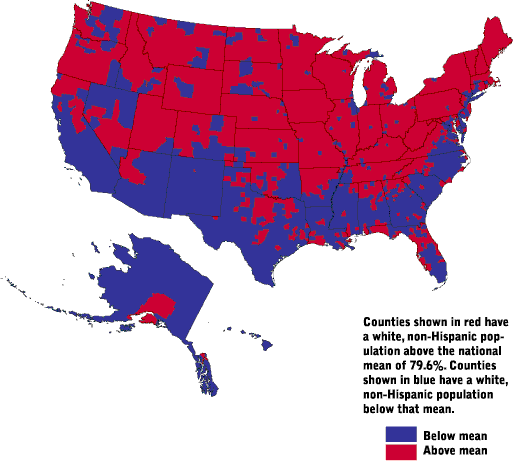

> Election officials in more than two dozen states have compiled lists of citizens whom they allege could be registered in more than one state – thus potentially able to cast multiple ballots – and eligible to be purged from the voter rolls.
The problem is that it often only uses a persons name as a singular data point. So if a person votes with the same first/last name as another person in another state, it's possible that vote could be wiped out. It was even matching names even though there were differences in middle names or had Jr/Sr at the end.
The journalist, Greg Palast, who investigated this back in 2014 has been doing radio circuits again recently saying that it's still being used in a bunch of states. Not sure about the validity of this since there hasn't been much reporting elsewhere on this. He seems to be the only one talking about it. And googling 'Interstate Crosscheck' only brings up his articles and democrat superpac websites.
http://projects.aljazeera.com/2014/double-voters/index.html
http://www.rollingstone.com/politics/features/the-gops-steal...