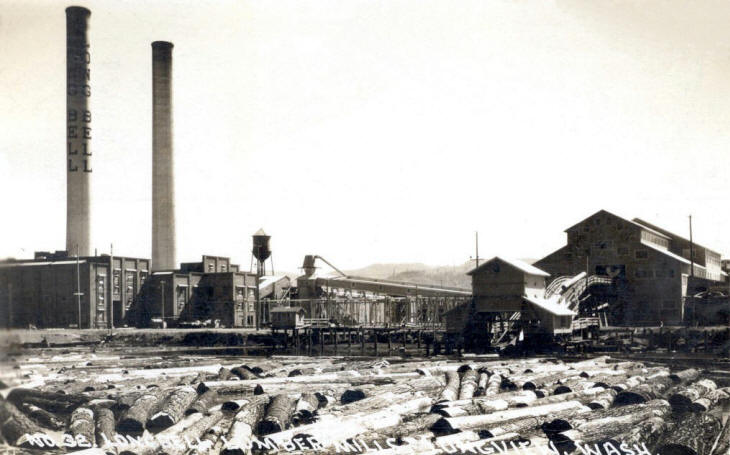
I've been looking for an hour for an image to post here, it is a end-on view of the long bell sawmill log drying facility. The logs are so large that it takes a while to realize the scale of the image, the people are tiny compared with the logs. Just a few hundred years ago large parts of the US and Canada were covered with forests of giant white pine and other trees that are now a rarity. With 'giant' I really mean giant, logs 5 meters or more in diameter were not exceptional. Unfortunately I haven't been able to locate the image, the closest that I've found is this one, which gives you a tiny little taste of what was lost:
Those trees must have taken hundreds of years to grow so wide. Chopping them down for wood would never be sustainable (that's why they are gone, right?). The great win of this technology is that you can use small trees that grow fast and can be sourced from managed/sustainable forests.
Modern 'engineered wood' is there for a reason: it is cheaper and stronger by weight than solid beams. But nothing quite replaces the feeling that comes with a 16" square beam that is now in use in it's third building since it was originally cut.
If you look closely at many cheap wooden products you'll notice a peculiar kind of joint in use that allows a lot of scraps to be glued together with roughly the same strength as a regular piece of wood of the same diameter. Ikea beds use this trick for instance. That's an interesting approach because it greatly increases the amount of usable wood from a tree.
Yes, there is some recovery due to better forest management. But compared to a few hundred years ago it is still quite meager and I suspect it will never go back to where it was as long as the economy depends in some small part on logging.
I've seen an old map of Canada from the Hudson Bay company days. It was a very thin line of settlements just North of the border, and then this vast white outline inscribed with 'Immense Forests'.
Driving around Ranger Lake in Northern Ontario (be sure you take enough gas with you) is a really nice way to see Canada with different eyes. Plenty of logging there too but the feeling of not having a settlement near you for 75 km or so in any direction is quite a strange one in the Western world. (Or at least, it was for me)
The primary factor limiting the scope of Canada's forests isn't logging -- it's farming. A lot of land was cleared early in Canada's history; a few trees being cut down here and there are quite insignificant in their comparative impact.
I've lived in the middle of a logging concession and the degree of forest management going on today compared to even the recent past is impressive, given a few hundred years of this Canada will once again have some extremely impressive forests. Right now it is already getting there but nothing at this scale can be fixed rapidly if only because it takes a long time for a forest to really reach maturity.
Have you been near the Timmins area? (North of Sudbury)
Haha, that's the kind of literal answer only a programmer would give :)
Ok, so there is an area inscribed by Timmins on the North-East side, Wawa in the North-West, Sault-Ste Marie in the South-West and Sudbury in the South-East. Inside that square is a very nice sample of what Canada must have looked like in the past. The only 'real' (blacktop) road crossing the area is the 129, you can simply ignore that. If you ever feel really adventurous hiking in that area is an experience that I won't be able to put into words.
Let me give you just one picture to give you an idea of what it looks like (from the Western most boundary):





https://s-media-cache-ak0.pinimg.com/236x/a6/8c/1f/a68c1f38c...