Their PR is unfortunately low quality and low on facts, though critical thinking would also try to look at the "why".
The futur or "solar roads" is clearly not highways and express lanes. It's slow speed, commercial areas - as badly presented by Colas.
For the context, land use in Europe is so different than in the US. Suburbs don't crawl as much and space is more of a premium.
Thinking at a really local level, for a new retail space like this: https://goo.gl/maps/BRkQ5qNyaQU2 - the fields around the center are either here to stay or would be built on.
About 80% of this commercial space is parking lots. It's wasted space. Why not use it to produce power? Why use additional fertile or constructible terrain to add solar tiles?
Since 2015, businesses in France also have to build either gardens or solar panels on their rooftops (new constructions and redevelopments). So that's turning 90% of space used into something productive or "user-friendly". Again why not do it?
The pricing of those solar tiles is interesting: 6 euros per max watt produced on location. Cheap enough - and you get free power for parking users.
It's also great PR for solar to get inserted in people's lives at such locations.
> About 80% of this commercial space is parking lots. It's wasted space. Why not use it to produce power?
You didn't get my point obviously. Parking spaces are to park on. When a car is on a parking space, it's blocking the light from tiles under it and also casting a shadow.
> Why use additional fertile or constructible terrain to add solar tiles?
Because they won't have cars park on them. They will also be at an optimal angle and cleaner.
On a parking lot, not 100% is used by cars. Lots of space for driving/walking through and around.
The example above show the paring lot partially full with a lot of space for solar panel roads: https://goo.gl/maps/ZR5kNMZYGbE2
Also, in France, we're limited in farming space. Sure, it's going to go away eventually, while we outsource farming elsewhere, but replacing fields with solar panels is not as obvious of a tradeoff as it could be elsewhere in the world.
Why not just make covered parking, and put solar panels on top? Then you can just use "regular" solar panels, which will be a lot cheaper, last a lot longer, and produce a lot more electricity. Plus, covered parking! The additional structure will be costly, but I wouldn't be surprised if it ended up being the same total cost as the tiles.
Or they could COVER the parking lot with these panels, which would not only generate more electricity, but would also be far more durable, provide shade/cover, and reduce the need for air conditioning systems to be run when because you'll no longer be climbing into a hot car.
Your accountant will also be working to make the business look as bad as possible on paper to save you tax. With that caveat, it's a tool I've used to investigate markets to see how big they are.
Genuinely like the idea, but wouldn't trust a service that uses PHP on a VPS without SSL. I'm sure you will fix the SSL when you launch, and I'm just a snob with regards to PHP.
I have huge respect for PHP, and many years of PHP development under my belt. I wouldn't dream of using it for something pretty heavy weight such a this. Certainly a factor that would come into play for some prospective users.
Running a payment gateway and authentication services is like painting a massive target on your back. The security must be impeccable, one mistake would be a monumental score on the part of a cracker.
A VPS introduces many layers of possible weakness, that could be used a entry points for an attack.
PHP just isn't the right tool for the job. I agree with you, that at this point in time it's secure. I trust that other languages, with smaller, simpler code bases will be more secure over time.
A local branch line (UK) has been testing battery powered trains this year, to save the expensive of electrifying the line. They charge the batteries on the electrified main line. Hopefully this will take off on other branch lines.
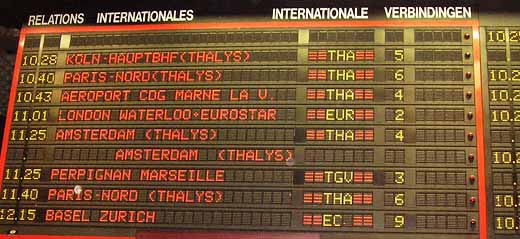
There's something very special about walking into a train station in the heart of a European city, and seeing a departure board that looks like this: http://www.enjoy-europe.com/hte/chap17/images/P1020015-Bruss... the sense that you could just buy a ticket and jump on a train to anywhere. You tend not to get the same feeling from an airport departure board, where for the most part you couldn't just buy a ticket and fly to any of those destinations.
I'll second Oslo to Bergen. We did it in reverse, as part of the 'Norway in a Nutshell' itinerary which is about 12 hours (can be done over two days) because it replaces some of the rail journey with a fjord cruise, the Flam railway, and a mountain coach.
In Europe, the convenience/inconvenience of airport locations varies a ton (which does influence purchase choices somewhat). For example Frankfurt's airport is only 8 minutes by commuter rail from the city center, and Copenhagen's is 12 minutes. But Paris-CDG and London-LHR are far from their city centers.
You still have to trek through the airport, wait in security lines etc etc. so in reality it takes much longer than the time it takes the train to travel from the airport to the city. That said flying is often if not nearly always cheaper for short hauls in Europe.